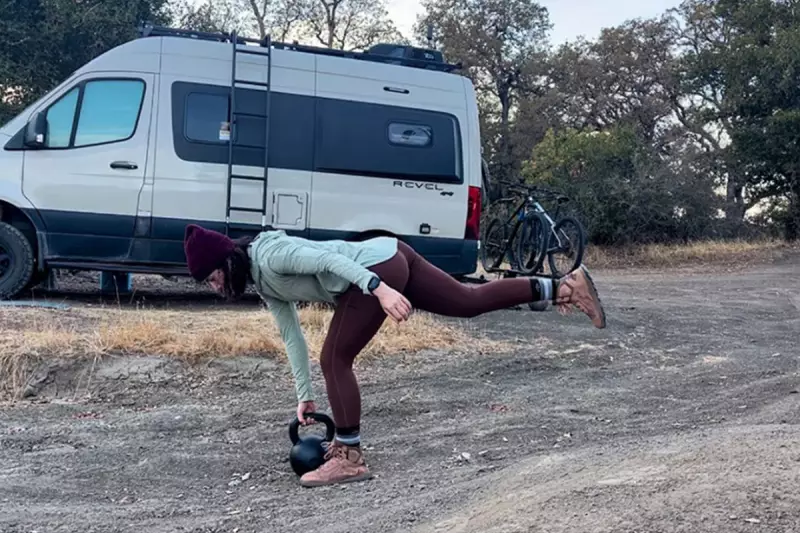
Forget the gym membership. Building a stronger, more resilient body is entirely possible from the comfort of your own home with just a single piece of equipment, according to a leading fitness expert.
The Proof is in the Training: Strength Gains on the Road
Amanda Capritto, a certified personal trainer and founder of Smarter Sweat, has spent the last year living and training full-time from a converted van. Her gym kit has been limited to resistance bands, a single 15kg dumbbell, and an 18kg kettlebell.
Despite this minimalist setup, Capritto recently achieved a personal best, performing eight reps per leg on Bulgarian split squats while holding a 30kg dumbbell in each hand. "Not only did I avoid losing strength after a year of working out as a full-time traveller, but I actually got stronger," she states. "It really goes to show that consistency and intensity are key."

The Minimal Equipment Full-Body Workout
Capritto shares her straightforward, six-move routine designed for building full-body strength with minimal kit. The workout is split into straight sets and supersets for efficiency.
Straight Sets: Complete all sets of one exercise, resting for 60 seconds between each, before moving to the next.
- Single-Arm Bent-Over Row: 2 sets of 5-15 reps each side.
- Single-Leg Romanian Deadlift: 2 sets of 5-15 reps each side.
Superset 1: Perform these exercises back-to-back with no rest, then rest for 60 seconds.
- Kettlebell Swing: 2 sets of 5-15 reps.
- Close-Grip Press-Up: 2 sets of 5-15 reps.
Superset 2: Perform back-to-back, then rest 60 seconds.
- Alternating Reverse Lunge: 2 sets of 10-15 reps each side.
- Suitcase Carry: 2 sets of 30 seconds each side.
Capritto advises using the lower rep range (5-8) if your kettlebell feels heavy for a given move, and the higher end (12-15) if it feels light, allowing you to tailor the session to your available weight.
How to Progress Your Home Training Without Heavier Weights
The cornerstone of effective strength training is progressive overload—making workouts more challenging over time. Without access to a full rack of dumbbells, you must manipulate other variables. Capritto outlines her top methods.
Manipulate Sets, Reps and Rest
"For beginners in particular, it’s possible to make a lot of progress by manipulating the simpler variables, such as repetitions, sets and rest intervals," says Capritto. Once high reps become easy, try adding an extra set, more reps, or shortening your rest periods to increase intensity.
Increase Time Under Tension
Slowing down your repetitions dramatically increases muscular effort. "Take three full seconds to descend, pause for another three seconds in the bottom of the squat position, then stand back up," Capritto suggests for exercises like goblet squats.
Switch to Unilateral Exercises
Swap bilateral moves (using both limbs) for unilateral (one-sided) versions. "Substitute a goblet squat for a Bulgarian split squat. This way, you’re lifting the same weight with one leg, rather than sharing the load," she explains. This effectively increases the load per limb.
Focus on Explosive Power
Power training—generating force quickly—adds a new dimension. Capritto recommends two approaches: adding plyometrics like squat jumps, or "speeding up the concentric portion of a movement," such as driving the hips forward rapidly in a Romanian deadlift.
Expand Your Range of Motion
Simply moving through a greater joint angle can heighten difficulty. Try squatting deeper or elevating your hands during press-ups to allow your chest to sink lower, increasing the stretch and demand on the muscles.
Why Minimal Equipment Training Works
The body follows the SAID principle (Specific Adaptations to Imposed Demands). If you consistently challenge it, it adapts. Capritto notes that beginners can thrive with minimal kit, as any new resistance training provides a potent stimulus for muscle and strength gains.

While advanced liftters may eventually need more equipment, Capritto's experience proves the ceiling is high. "After training with minimal equipment myself for a year now, I think that point is much further out than most people would assume," she concludes, offering hope for anyone looking to build serious strength beyond the gym walls.