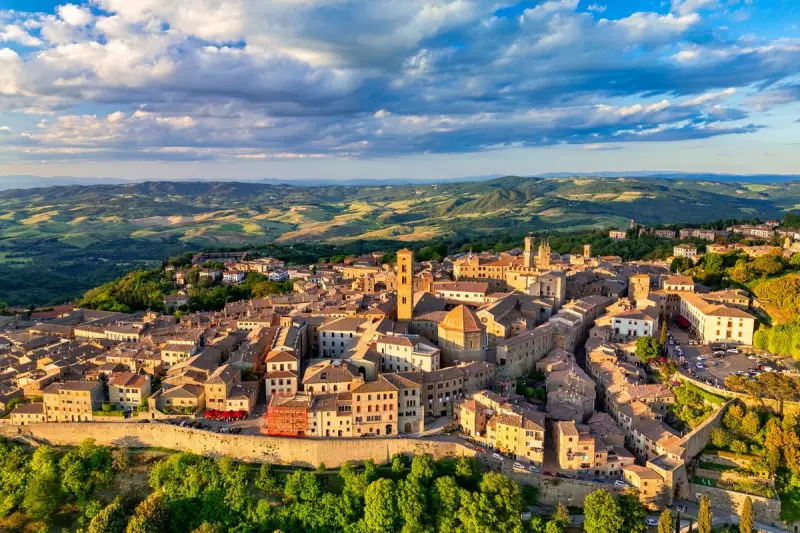
While Italy boasts countless stunning destinations, from the Amalfi Coast to Sicily, the region of Tuscany holds a unique and enduring magic. It's a land seemingly painted in soft, golden light, where gentle hills are adorned with cypress trees, olive groves, and classic Italian villas. While cities like Florence and Siena rightly draw crowds, the quintessential Tuscan experience often lies in exploring the medieval hilltop towns scattered across the countryside.
Discovering Tuscany's Timeless Hilltop Gems
Driving between these historic settlements, each with its own distinct character, is a journey through time and breathtaking scenery. From the famous skyline of San Gimignano to the wine-rich valleys of Chianti, these compact towns offer an authentic taste of Italian culture, history, and gastronomy, all within easy reach of one another. Here are seven of the very best to include on your itinerary.
1. San Gimignano: The Town of Towers
San Gimignano is arguably Tuscany's most iconic small town, celebrated for its remarkable medieval towers. Between the 11th and 13th centuries, rival noble families constructed these towers as symbols of power and wealth, with a staggering 72 believed to have existed at the town's peak. Today, 14 survive, creating a unforgettable skyline. Visitors can wander the cobbled streets, visit the cathedral, explore the Palazzo del Popolo, and enjoy the panoramic views from its elevated position.

2. Montalcino: A Paradise for Wine Connoisseurs
Nestled in the picturesque Val d’Orcia, Montalcino is a haven for wine lovers. It is the exclusive home of the renowned Brunello di Montalcino and Rosso di Montalcino wines. The rustic setting, surrounded by vineyards, cypress trees, and olive groves, is exceptionally beautiful. Key activities include walking the ancient fortress walls, exploring the Piazza del Popolo, and, most importantly, indulging in wine tastings at local estates.
3. Pienza: The Ideal Renaissance Town
Also located in the Val d’Orcia, Pienza is a masterpiece of Renaissance urban planning, commissioned by Pope Pius II in the 15th century. Encircled by medieval walls, its centre is a delightful maze of cobbled lanes like the aptly named Via dell’Amore (Street of Love). All paths lead to the elegant Pio II plaza, flanked by the cathedral, Palazzo Piccolomini, and the museum in Palazzo Borgia. The views over the rolling hills to Mount Amiata are spectacular.
4. Greve in Chianti & Montefioralle: Heart of the Vineyards
A trip to Tuscany is incomplete without visiting the Chianti wine region. Greve in Chianti is a scenic hub, centred on the portico-lined Piazza Matteotti with its fresh produce vendors. Just above it lies Montefioralle, one of Tuscany's oldest villages, still enclosed by its original walls. Its car-free centre is perfect for a stroll, culminating in a climb to the Santo Stefano church for sweeping vineyard views.
5. Volterra: Where Etruscan, Roman & Medieval History Collide
Once a powerful Etruscan city, Volterra is a treasure trove of history and Italian craftsmanship. Its highlights span millennia: the Etruscan Porta all’Arco gate and Guarnacci Museum, a 2,000-year-old Roman amphitheatre, and medieval landmarks like the Duomo and Palazzo dei Priori. The town also gained cinematic fame through the Twilight film series.
6. Pitigliano: The Dramatic "Little Jerusalem"
In the Maremma region near the coast, Pitigliano presents a dramatic sight: rows of sandstone buildings seemingly rising from a cliff of volcanic red "tuff" stone. Known as "Little Jerusalem" for its historic Jewish community, visitors can explore the old Jewish Quarter, synagogue, and museum. Other attractions include the Palazzo Orsini fortress, the Sette Cannelle fountain, and local wine tastings.

7. Pietrasanta: The Artists' Coastal Retreat
Close to the upmarket resorts of the Tuscan coast, Pietrasanta has long been a magnet for artists, including Michelangelo. Today, it boasts one of Italy's highest concentrations of art galleries. Beyond its proximity to beaches, cultural highlights include the Duomo, the Rocca di Sala fortress, an archaeological museum, marble quarries, and the annual La Versiliana performing arts festival.
Planning Your Tuscan Town-Hopping Adventure
These seven towns offer a perfect cross-section of Tuscany's diverse charms: world-class wine, profound history, stunning art, and unparalleled landscapes. The region's compact nature makes a self-drive tour the ideal way to discover them, allowing you to move at your own pace and stumble upon hidden gems between the main stops. Whether you're seeking a deep dive into Renaissance history, a gourmet journey, or simply the pleasure of getting lost in ancient, car-free streets, Tuscany's small towns deliver an experience that is both quintessentially Italian and uniquely magical.