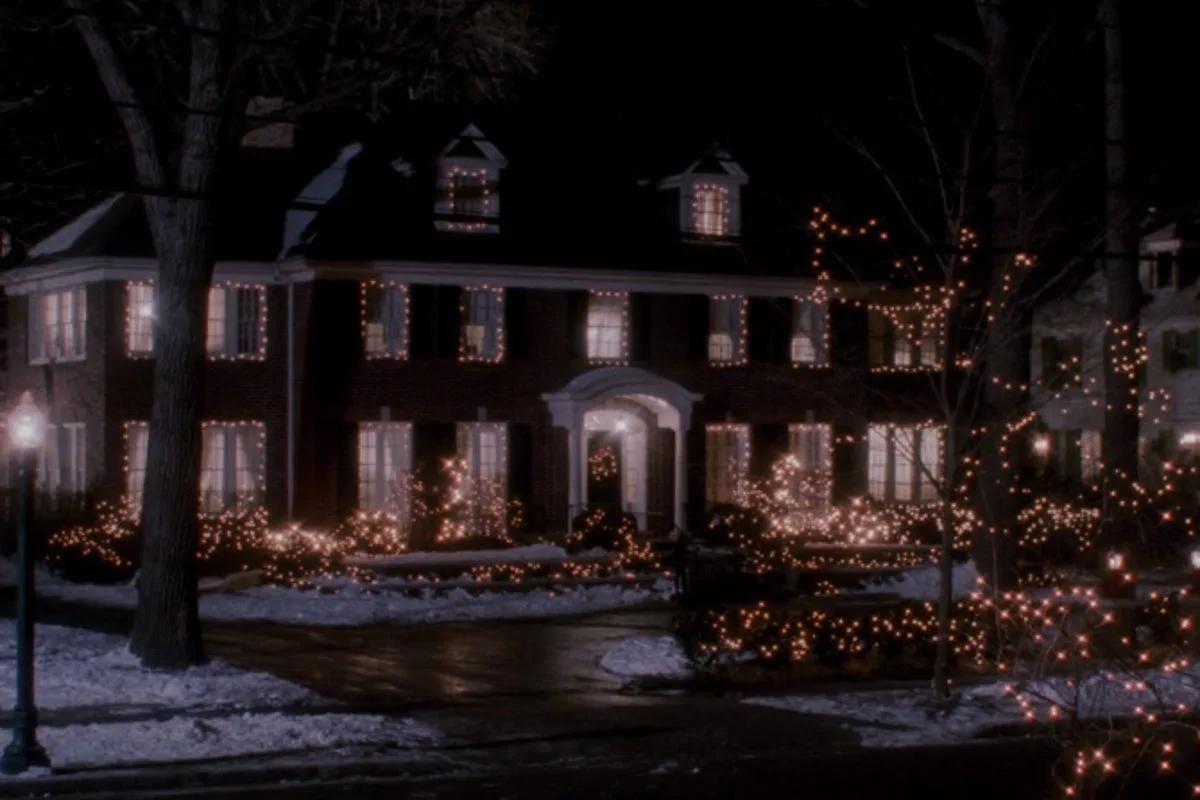
When director Chris Columbus chose 671 Lincoln Avenue in Winnetka, Illinois, as the setting for Home Alone, he described the five-bedroom Georgian house as “warm and menacing.” The owner at the time, John Abendshien, was taken aback. “I thought, what on earth does he mean by ‘menacing’!” Abendshien recalled to The Independent. “I always thought it had a warm vibe! But when I saw the completed film for the first time, and the scene where Kevin is preparing to do battle with the Wet Bandits, with John Williams’ soundtrack in the background, and those eerie lights coming out of the house, I thought yes, I get the ‘menacing’ bit now!”
Released in 1990, Home Alone became an instant hit, topping the box office for three months. In the 35 years since, the story of eight-year-old Kevin McCallister defending his home from bungling burglars has become a Christmas staple, with the McCallister house as familiar to fans as their own homes. Abendshien, a healthcare strategist, bought the property for $875,000 in 1989 after being captivated by its natural light and shape. “I cannot explain it to this day, but when we pulled up and looked at it something about that place just captured my heart,” he said.
Less than a year later, location scout Jacolyn Bucksbaum approached Abendshien about using the house for National Lampoon's Christmas Vacation. He had first met Bucksbaum in 1983 when screenwriter John Hughes was filming Sixteen Candles in nearby Evanston. Hughes, who grew up in the area, favoured the Chicago North Shore for its “Norman Rockwell-ian atmosphere,” Abendshien noted. When Columbus and crew arrived to shoot Home Alone, the Abendshien family initially moved out but later returned, living in a “movie cave” of several rooms while filming continued.

The family had a unique vantage point on the production. “The only restriction was if they were doing exterior filming, we couldn’t go by the windows,” Abendshien said. “It took me back to my Army days when I was crawling like a GI under the window!” He grew fond of the cast and crew, especially Dan Stern, who played Marv the Wet Bandit. “Dan Stern… is a prankster in real life. He loved to hang out with the kids and have fun with them,” Abendshien recalled.