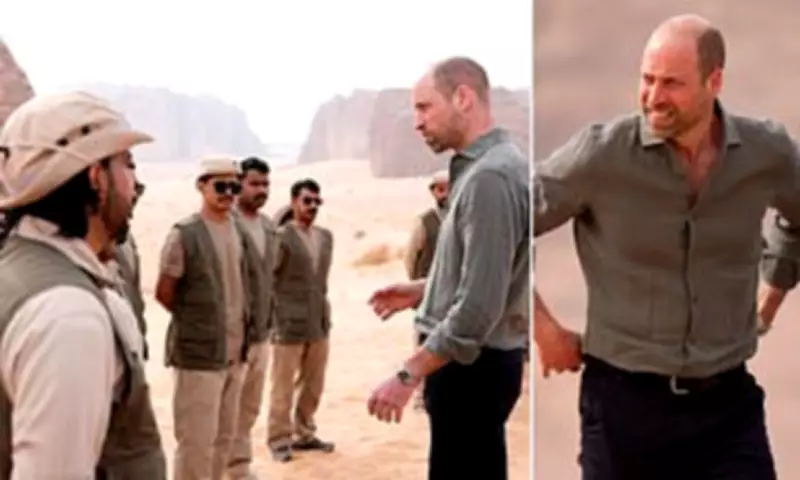
Prince William attempted to shift focus from the ongoing Jeffrey Epstein scandal today by immersing himself in conservation efforts during a visit to Saudi Arabia's spectacular desert dunes. The Prince of Wales dedicated his final day in the desert kingdom to exploring environmental initiatives, deliberately steering attention toward ecological preservation rather than royal controversies.
Exploring Saudi Arabia's Natural Crown Jewel
William, a longstanding advocate for wildlife conservation, spent his morning at the exclusive Sharaan Nature Reserve in AlUla. This remarkable 7,000-year-old archaeological site represents one of Saudi Arabia's most significant cultural transformation projects, spearheaded by Prince Badr bin Abdullah bin Farhan Al Saud, the Minister of Culture and Governor for the Royal Commission for AlUla.
The AlUla region is undergoing substantial development as a premier cultural and heritage destination, with substantial investments flowing into arts programming, archaeological research, infrastructure enhancement, and comprehensive community training programs. At the private reserve, which remains inaccessible to the general public, William engaged with local rangers to understand their crucial work in protecting and conserving both wildlife and the natural environment.

A Guided Tour Through Conservation Efforts
Accompanied by Bassim Al Balawi, the Lead Ranger and an AlUla native, William embarked on a tour making three significant stops focused on wildlife conservation, land restoration, and broader ecological initiatives. The conservation project's most ambitious goal involves reintroducing the critically endangered Arabian Leopard to Sharaan by 2035, representing a landmark effort in species preservation.
His initial stop at the Alqaliba Mountain Viewpoint provided striking vistas of vast sandscapes and rock formations. Here, William met with Saudi rangers who detailed their conservation efforts within Sharaan and emphasized their commitment to local community engagement. Dressed in navy chinos, a khaki shirt, and brown walking boots, William observed, 'The local community are used to what they've got - unless you show them something different, they don't know what to do.'
William then questioned Prince Badr about AlUla's unique qualities, asking why the region merited such focused tourism and nature reserve development. Prince Badr explained, 'We have the heritage and the natural topography here so it makes sense for the strategy of Alula.' William responded enthusiastically, 'That they have a vision to do this is really exciting. The tourism will come. What I find so exciting is it's so new, this all started in 2019, it's going to be so exciting to see all the progress. So many others will say, 'if Saudi Arabia can do it, we can do it'.'
Focus on the Arabian Leopard
The Prince of Wales displayed particular interest in the Arabian leopard's fate, inquiring when the species last appeared in AlUla. Rangers informed him that the leopard hadn't been sighted in the region since the 1980s, with only 38 individuals remaining in Saudi Arabia, all currently living in captivity. This revelation underscored the urgency of the reintroduction program.
During a coffee break with Prince Badr and rangers, William acknowledged the challenging scope of their work, noting, 'It's hard work for you guys, I'd have thought, it's a big area you've got to cover. It must be quite exciting getting the vegetation and wildlife and what impact it will have. The tourists will come too. Well, good luck guys. Lots to do, it'll keep you busy.'
Hands-On Conservation Activities
At his subsequent reserve stop, William received detailed briefings about the land restoration program from the RCU's Habitat and Restoration team. He participated directly in conservation efforts by planting an acacia tree alongside Prince Badr, symbolizing his commitment to environmental restoration.
The final stop brought William to the remarkable 'Dancing Rocks' formation, where he learned more about ongoing conservation initiatives aimed at protecting and reintroducing native species, with particular emphasis on the critically endangered Arabian Leopard.

Scale and Significance of Sharaan Reserve
The Sharaan Nature Reserve encompasses an impressive 1,540 square kilometers of desert, mountains, and former rangeland. As one of AlUla's six nature reserves, which collectively cover more than 50 percent of AlUla County, Sharaan aims to restore 65,000 hectares of degraded rangeland. The reserve plays a crucial role in rebalancing fragile ecosystems while preserving and reintroducing native species including gazelles, the Arabian oryx, and acacia woodlands.
Notably, the Zoological Society of London maintains an active partnership with the RCU, providing support for conservation projects including the rewilding of critically endangered species like the Arabian leopard.
Cultural Exploration and Sustainable Farming
Later in his visit, William planned to explore AlUla's historic old town, featuring more than 900 traditional mud-brick houses, a historic citadel, and a network of narrow alleyways that once formed a thriving settlement along the ancient incense road. This historic trade route carried spices, textiles, and aromatics across Arabia for centuries, representing a significant chapter in regional history.
The prince concluded his visit by touring AlUla's Oasis and EcoGardening farm, where he met local farmers to understand their commitment to sustainable farming practices and preserving their region's agricultural heritage.
Epstein Scandal Overshadowing Conservation Focus
Despite William's concentrated efforts on conservation, his trip remained overshadowed by the persistent Jeffrey Epstein sex scandal that previously implicated Prince Andrew and continues generating headlines. Yesterday, a UK broadcaster covering the three-day visit directly challenged William, shouting, 'Sir, to what extent do you think the royal family has done enough around the Andrew and Epstein issue?'
The Prince and Princess of Wales attempted to clarify their position on Monday through their first public statement regarding the scandal. A Kensington Palace spokesperson stated they were 'deeply concerned by the continued revelations' and that 'their thoughts remain focused on the victims.'
This crisis, which has significantly impacted both the monarchy and Westminster political circles, reignited when US authorities recently released millions of documents associated with convicted paedophile financier Jeffrey Epstein. The controversy shows little indication of subsiding, creating an ongoing challenge for royal communications despite William's attempts to maintain focus on environmental conservation during his Saudi Arabian visit.