

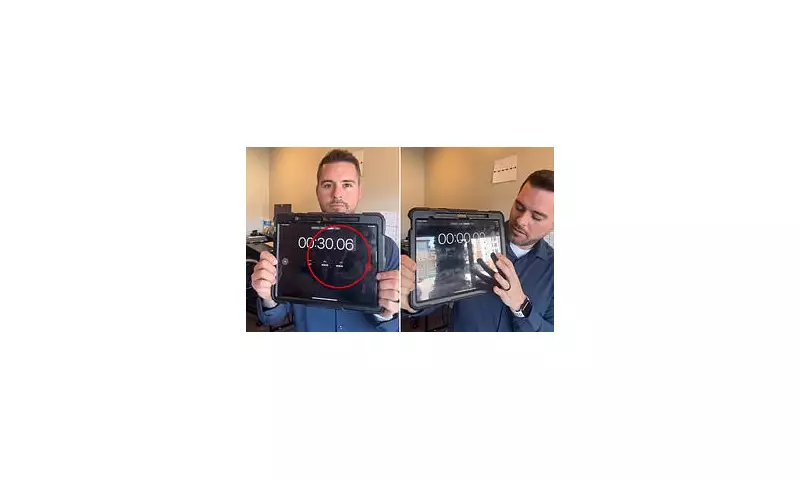
A simple 30-second test shared by a neurologist has captivated millions online, promising to offer a unique window into your brain's current state of function.
The Viral Brain Timer Challenge
The deceptively straightforward challenge was posted by Dr Ryan Worley, a Clinical Neuroscience and Brain Rehabilitation Specialist from the United States. In an Instagram video viewed over eight million times, he instructed followers to close their eyes and open them when they believe exactly 30 seconds have passed.
The crucial rule is to avoid mentally counting, instead relying purely on your brain's innate perception of time. 'How accurate is your brain's internal clock? This is a quick test that can give us insight into how your brain is functioning right now,' Dr Worley explained.

What Your Result Might Mean
According to the specialist, your performance can provide clues about several cognitive and emotional states. Opening your eyes significantly too early may indicate heightened alertness or anxiety, which can speed up your internal sense of time.
Conversely, opening them well after the 30-second mark could suggest slower mental processing, potentially linked to fatigue, brain fog, or poor sleep. Dr Worley reassures that the test's timer runs for a full 60 seconds, so no one truly 'fails'.
He also suggests repeating the test while consciously counting to compare results. 'By doing this with and without counting, you'll notice how much your brain relies on external structure versus internal regulation,' he said.
The Science Behind Your Internal Clock
While the test feels like a social media trend, neuroscientists confirm our perception of time is a complex brain function. It is distinct from the circadian rhythm that governs sleep.
Research from the University of California has shown the brain doesn't use a single internal stopwatch. Instead, it measures short intervals through evolving patterns of neural activity, similar to a line of falling dominoes.
Key areas like the striatum and premotor cortex are involved. This system is highly sensitive to factors like attention, stress, and mental load, which is why your 30-second estimate can vary daily.
The online reaction was swift and revealing. One user admitted, 'Forcing myself not to count in my head was harder than any workout I've ever done.' Others shared wildly inaccurate guesses, with one person opening their eyes at just 13 seconds, and another at 32.
Dr Worley emphasises this is not a diagnostic tool but a fascinating snapshot of your brain's moment-to-moment operation. It highlights how your perception of time often reflects how you're processing the world around you.






