
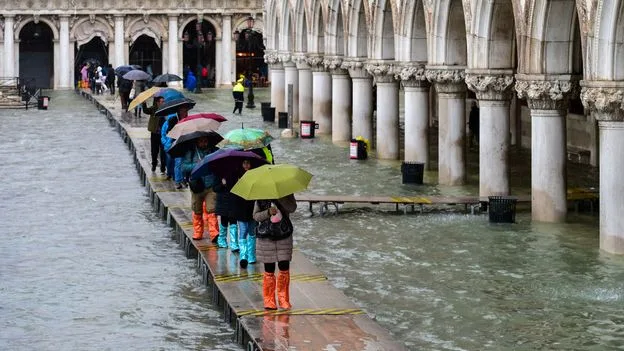
Venice, the iconic Italian city built on 120 islands and crisscrossed by 177 canals, is at serious risk of being consumed by the sea. Without drastic measures, the city could disappear beneath the waves by as early as 2100, according to experts. The city's foundations are sinking, and rising sea levels are exacerbating the threat.
In November 2019, Venice experienced its second-worst flooding event since records began almost 100 years ago. Water levels reached 187cm (6.1ft) above sea level, leaving more than 80% of the city underwater. The damage was estimated at €1bn (£0.9bn/$1bn), and a state of emergency was declared. The worst flood on record occurred in 1966, when water levels rose to 194cm (6.4ft) above sea level.
Recent trends suggest that severe floods are becoming more frequent. Since 1923, water levels have reached 150cm (59in) or more on only ten occasions, but five of these have occurred in the last three years. Climate change is driving sea level rise, making cities built at sea level particularly vulnerable, says Sally Stone, reader in architecture at the Manchester School of Architecture.
A 2021 report warns that even if global temperatures are kept below a 2C rise, Venice's sea level could rise by 32cm (13in) by 2100. In a worst-case scenario of 4C warming, relative sea level could rise by 180cm (5.9ft) – similar to the 2019 flood level. Natasha Barlow, associate professor at the University of Leeds, notes that even small sea level increases can significantly raise the frequency and intensity of coastal flooding.
Venice's buildings are constructed on timber piles driven into the lagoon's mud, but the foundations are not anchored to solid bedrock. The city is also grappling with other issues, including damage from boat wakes, overtourism, and a declining local population. However, given its small size, fame, and access to funding, Venice could serve as a testing ground for technologies to combat rising sea levels, such as ocean barriers and wake-minimising boats.




