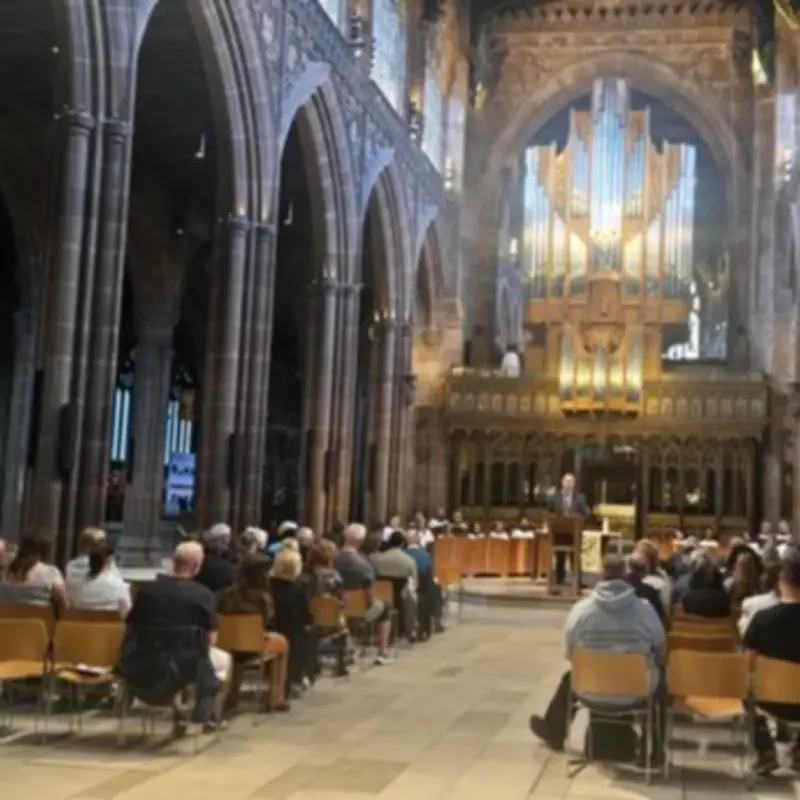
A survivor of the 1996 IRA Manchester bombing fought back tears as he recounted his experience at a special church service to mark the 30th anniversary.
The poignant commemoration was held at Manchester Cathedral this evening (Sunday, June 14) just a few hundred yards away from the scene of the blast on Corporation Street.
Large parts of the city centre were destroyed when a 3,300lb device hidden in the back of a lorry parked on double yellow lines near Marks & Spencer exploded.

It was the UK mainland's biggest bomb since the Second World War. Hundreds of people were injured, and every single building within a half-mile radius was badly damaged.
But remarkably no-one was killed. Around 80,000 were evacuated from the area in the 90 minutes between the warning being delivered and the bomb going off.
No-one has ever been charged over the attack, which is estimated to have caused £700M of damage.
Last week, Counter Terrorism Policing North West said all investigative opportunities had been ‘exhausted’ and that their investigation was ‘no longer active.’
They said that if ‘any further evidence or information’ came to light about ‘new or existing suspects’ then they were prepared to review the position.
This evening’s event, part of the Cathedral’s Evensong, was organised by Northern Ireland-based terror attack survivors charity SEFF (Supporting, Empowering, Fair and Focussed), who described it as a service of ‘acknowledgement, healing and hope.’
A number of dignitaries were in attendance including the Assistant Chief Constable of Greater Manchester Police (GMP), Chris Sykes, and Manchester MPs Afzal Khan and Hannah Spencer.
Survivor Steve Cope addressed the service. Then 20 year-old shop worker Steve, originally from Hyde in Tameside, was working at the Debenhams store and was one of the few people who hadn't been evacuated when the bomb exploded at 11:17am.
He has previously spoken about his ongoing battles with PTSD, anxiety and panic attacks following the atrocity.
He appeared visibly emotional at points as he told the service it ‘takes just a moment to change the direction of someone’s life’ and that it was a ‘day of many moments that have affected so many people.’
He said everyone caught up in it experienced ‘a moment of terror, unexpected, undesired, undeserved.’
He said he was ‘not yet able to leave that day behind’, as he thanked those who had tried to help him ‘make sense of that day.’
Fellow survivor Samantha Shaw read a poem she has written called ‘Thirty Years On - Manchester.’
In it she said: “This city did not bow to fear, nor turn from what was true. In hands held out, in voices strong, in all we chose to do.
“For every life that carried on, through loss, through unseen scars, we honour courage, day-by-day, in shops, in homes, in hearts.”
There were also addresses from Neil Tattersall, a victim of the 1992 IRA Manchester bombing in which 65 were injured, Sarah Drinkwater, a survivor of the 2017 Manchester Arena attack, and Travis Frain, a victim of the 2017 Westminster Bridge attack and a member of the group Survivors Against Terrorism.
Ms Drinkwater said in ‘the face of hatred’ the city had repeatedly shown ‘compassion, generosity and love’ and that all those affected by such atrocities were bonded ‘not by the violence they have endured’ but by ‘resilience, kindness and unity.’
“May the memories of these events deepen our commitment to peace, justice and reconciliation” she added.
SEFF Director, Kenny Donaldson MBE, said when a bomb is detonated ‘it reverberates forever’ and ‘never stops travelling’ adding ‘it does not take the loss of human life from those events’ for its impact to be ‘lasting in the lives of so many.’
He asked the congregation to ‘strike down’ any suggestion that the bomb was the ‘best thing that happened to the city.’
“Because it wasn’t” he said. “It should not take a bomb to regenerate a city. We need to concern ourselves with the regeneration of the lives of those impacted.”

The Revered Canon Grace Thomas recalled services held in the Cathedral in the week following the bombing, and on the 10th anniversary, and said the event was a ‘significant waymaker’ in the city’s history and had ‘changed the lives of many.’
The city, she added, had ‘seen devastation’ but had ‘responded with hope.’
“This is the place where love has been shown profoundly” she said.