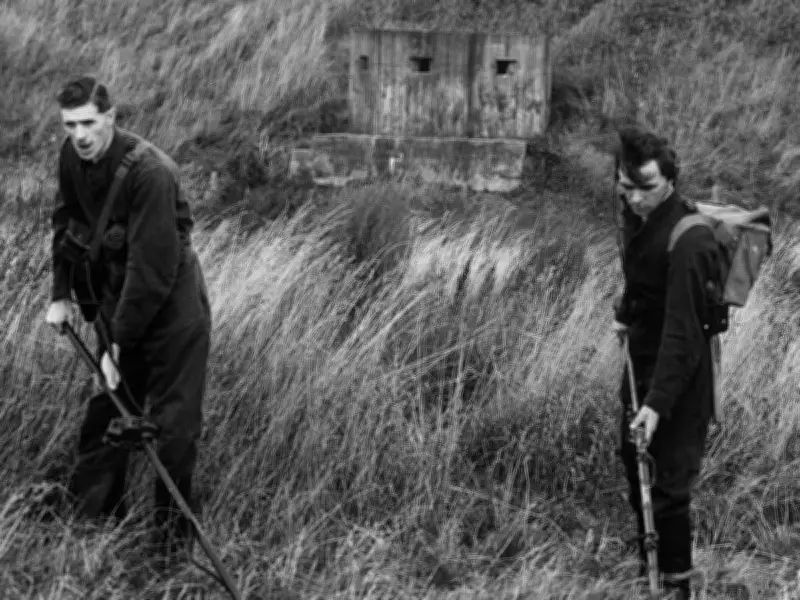
The murder of Alice Barton and the search for the 'pointed chin man' remain one of Merseyside's most haunting cold cases. Very little is known about Alice Barton, whose body was found dumped in a wartime pillbox in Woodchurch, Birkenhead, in September 1955.
The Discovery
It was a quiet autumn morning—a Saturday—and Birkenhead was preparing to relax, the strain of the week behind and a peaceful weekend in prospect. Across the fields at Woodchurch scampered four apple-cheeked boys, jars in their hands and a rich harvest of blackberries in their minds. Two leapt across a brook known grandly as the River Fender. The hum of traffic from the main road, the faint clatter of life from the new housing estate mingled with the rustle of the wind. One of the boys peered inside a concrete pillbox, a relic of the war of which he remembers nothing. Startled by what he saw, he looked again, then ran sobbing across the fields. Inside the communications room the duty sergeant stiffened as a voice over the telephone struggling for control, gasped: 'There is a body in the pillbox.'
These were the dramatic opening lines of an ECHO article dated October 1, 1955, five days after the discovery of a woman's mutilated body inside an old wartime pillbox off the Woodchurch estate in Birkenhead. The victim was 49-year-old Alice Barton, a 'wanderer' who drifted around Merseyside, to Wigan, Manchester, and as far south as Bristol. She had once been married to a John Barton, a colliery worker from Atherton, Lancashire—but the couple had been separated for 12 years. It was later reported that Alice had turned to sex work following the breakdown of her relationship, though contemporary reports made no mention of her profession.
The Investigation
It was believed Alice had been strangled and mutilated two to three days before her body was found. The ECHO reporter remarked: 'Her killer could be any one of the hundreds she knew, he could be a man she met only on the day of her death.' A woodsman at Arrowe Park told police he had found a trail of footprints in the dew-drenched grass, leading out of a wood near to the pillbox, at around 8.10am on September 25. William Shaw, another member of the park ground staff, said he had seen a couple sitting in a shelter by the local bowling greens two days before Alice's body was found. He heard the woman say: 'I am much older than you are.'
After the discovery of the gruesome scene on September 24, 1955, it took the police several days to figure out Alice's identity. Seasoned detectives from Scotland Yard's 'Murder Squad' were called in to assist the investigation—but found precious few clues to work with. Alice lived a transient lifestyle, which made piecing together her final movements a difficult task in the days before CCTV. She was believed to have been staying at St Winifred's Hotel at the junction of Knowsley Road and Rimrose Road in Bootle in the days before her murder. She previously lived in the Kirkdale district of Liverpool, and was also theorised to have lived for a time in a caravan near Moreton beach.
The Pointed Chin Man
On October 3, 1955, the ECHO reported a Scotland Yard appeal for information about two men in connection with their investigation. One of them, known as the 'pointed chin man', was believed to have been seen with Alice in Moreton and Arrowe Park shortly before her death. Detective superintendent George 'Dusty' Miller, leading the investigation, told the ECHO: 'On the morning of Wednesday, September 21, this man was seen in the Moreton and Arrowe Park districts, when he spoke of being the owner of a coach and during the railway strike conveyed workmen from Ramsgate to Margate. Further, while in hospital he lent the coach to another person, and on its return the seats had been slashed.'
Police visited garages and coach proprietors in Wirral in the hope of tracing the 'pointed chin man', who was described as aged 35 to 45, 5ft 4in to 5ft 7in, with a 'medium build, dark hair, clear complexion, medium full face, long nose, dark eyebrows, clean shaven and dressed in a dark suit and brown shoes'. Further inquiries were made in the Ramsgate and Margate areas. Nearly all Birkenhead Corporation bus conductors and drivers were interviewed, and those working on the 77 route between Woodside and Moreton, passing Arrowe Park and Woodchurch, were invited to the police station to make statements. The second man detectives wanted to trace was a man who, at 8pm on October 1, telephoned Birkenhead police station from a phone box at the junction of Manor Hill and Grosvenor Road.
Dead Ends
In total, around 40,000 people were questioned about the murder of Alice Barton. In October 1955, the ECHO optimistically reported: 'Slowly, remorselessly, the police machine is grinding out the answers... The pieces of the jig-saw puzzle are fitting into position and, it may be today, next week or next month, the picture will be complete. It will be a picture which may send a man to the scaffold.' However, this was not to be. Alice's handbag, her lipstick container, and the knife which the murderer used to mutilate her body were never found. Other potential clues—such as a racing paper found near the scene of the crime, dated September 21—led to dismal dead ends. The 'pointed chin man' vanished seemingly into thin air.
Superintendent George Miller returned to Scotland Yard in late October 1955. He returned periodically for renewed investigations in November, and again in May 1956. But these efforts seemed almost half-hearted, as the case quickly faded into collective memory.
Alice Barton's Legacy
Today, the biggest mystery in the case of Alice Barton, aside from her killer, is Alice herself. Very little is known about who she was, the place she grew up, or the people she loved. When she was finally identified three days after her body was found, police were not even sure 'Alice Barton' was her real name. In a 1970 ECHO article recounting the murder, she was uncharitably described as 'a loner—a woman of the twilight' who lived 'a pathetic, insecure life'. She was 'known in waterfront bars on both sides of river' and 'mixed chiefly with sailors.' The man identifying her body, 63-year-old John Robert Robertson from Kirkdale, mentioned she 'spoke with a strong Lancashire accent', and it was understood she spoke of a son.
If such a son existed, he did not attend his mother's funeral, which took place at Landican Cemetery on September 30, 1955. The ceremony earned a short paragraph between an advertisement for choir classes and a report of a man being fined £2 for having an unsafe motorcar. It read: 'The only mourner was her husband Mr John Barton, a colliery worker from Atherton, Lancashire, whom she left nearly 12 years ago. The coffin bore two wreaths, both from the husband.' The funeral was also attended by the investigating police officers, and around 100 women from the Woodchurch estate.