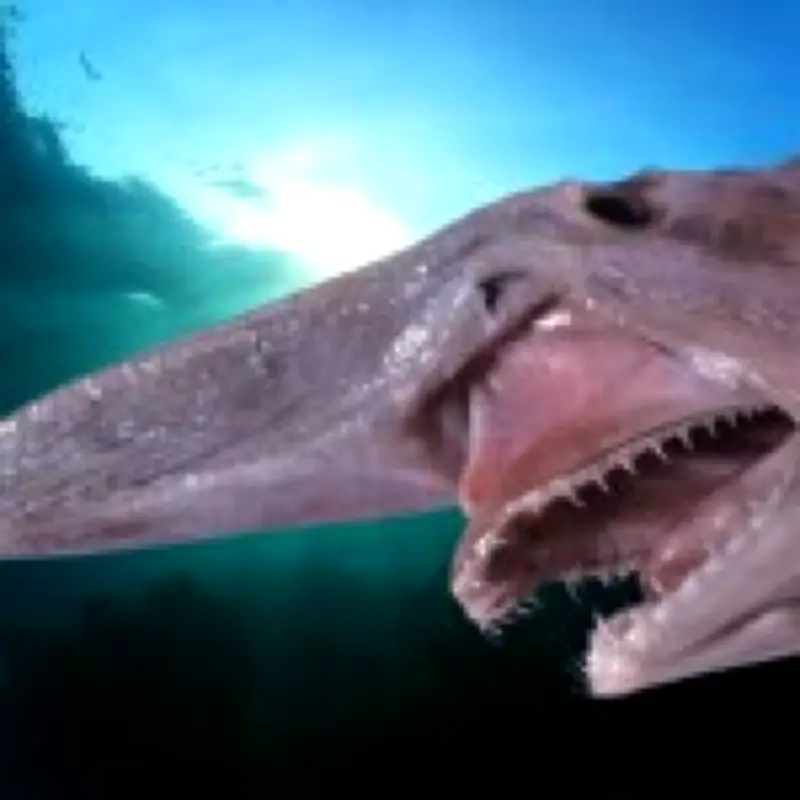
A rare and uniquely grotesque shark has been observed alive in its natural habitat for the first time. The goblin shark, scientifically known as Mitsukurina owstoni, is a deep-sea creature with a long, spear-like snout and a pink, squishy body. These sharks live thousands of feet underwater in total darkness and have inspired the terrifying aliens in the film Alien. Until now, no one had ever seen a goblin shark swimming freely in the wild.
Two Sightings Confirm Existence in the Wild
Two separate research teams have documented goblin sharks in their natural environment: one along the Tonga Trench and another near Jarvis Island, close to Hawaii. Their findings were published in the Journal of Fish Biology last month. The authors described the event as the shark equivalent of spotting the near-mythical colossal squid.
Previously, scientists had only encountered living goblin sharks after they were caught on fishing lines in the Atlantic, western Indian, and Pacific Oceans. Otherwise, researchers relied on washed-up remains. These sharks typically grow to 12 feet in length and possess razor-sharp teeth hidden behind their comically long noses. They can extend their slingshot-like jaws at speeds of 10 feet per second to capture prey.
Living Fossils of the Deep
Goblin sharks are considered 'living fossils' as they are the only surviving members of their family, a lineage dating back 125 million years. Despite their unappealing appearance, study co-author Alan Jamieson, director of the University of Western Australia's Minderoo-UWA Deep-Sea Research Centre, described them as 'charismatic'. He admitted, 'I never thought we'd see one alive.'
Jamieson's team aboard the R/V Dagon spotted a goblin shark moving through the Tonga Trench in 2024. The sighting lasted only 20 seconds and was captured during 50 days of continuous filming, making it a challenging discovery. However, this was not the first recorded sighting. Co-author Aaron Judah from the University of Hawai'i at Mānoa reviewed archived footage from a 2019 Ocean Exploration Trust expedition and identified the unmistakable snout of a goblin shark gliding across the seafloor. Because no one believed goblin sharks lived in the central Pacific, the footage had been overlooked until Judah's recent annotation.
Implications for Research and Conservation
Judah emphasized the importance of such discoveries: 'New discoveries like this demonstrate that there is still so much to explore in our deep ocean home. Given the newly expanded geographic range of the goblin shark, this species can be included in regional management and a nation's biodiversity list.'
Culum Brown, a fish expert at Macquarie University, commented on the shark's appearance, calling it easily the 'ugliest' shark in the world. He added, 'They are ridiculously horrendous to look at. Not even their mother would love their faces.'
These sightings open new avenues for understanding the behavior and distribution of one of the ocean's most enigmatic predators.