Polymarket's War Betting: How Prediction Markets Shape News and Truth
Polymarket's War Betting: Prediction Markets Shape News

Polymarket's Situation Room: Betting on War and Truth

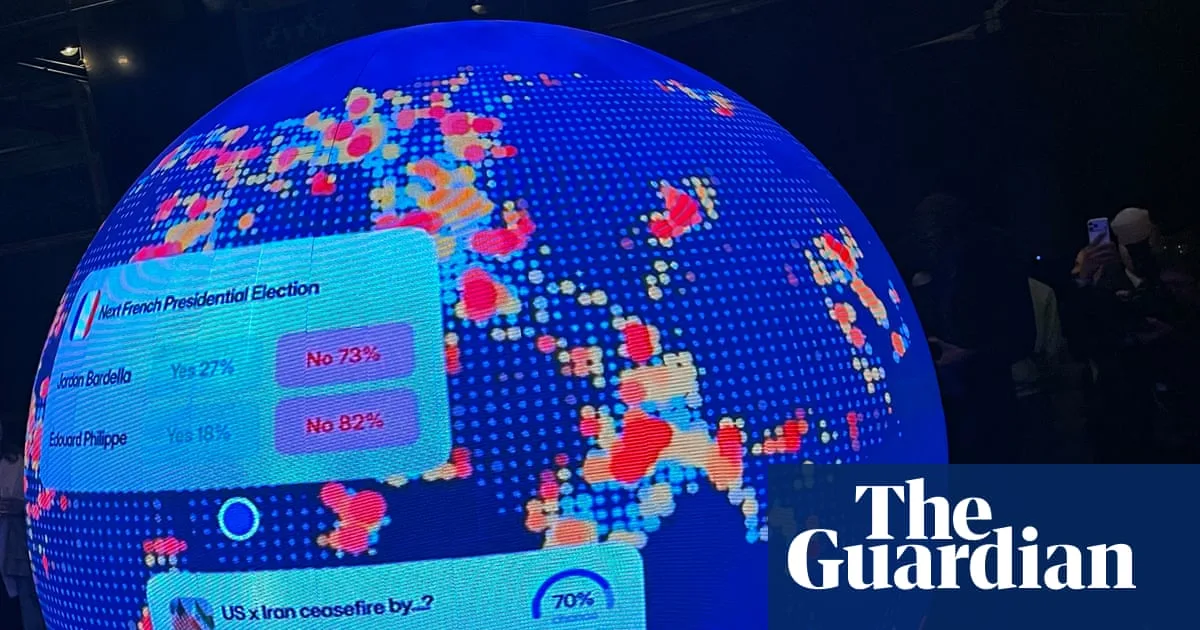
A LED sphere screen displayed information inside Polymarket's 'Situation Room' pop-up in Washington DC last month, symbolising the platform's growing influence. A Guardian investigation exposes how this prediction market is shaping news narratives and arbitrating on 'the truth' through high-stakes gambling on global conflicts.

The Kostyantynivka Wager: Gambling on Ukraine's Frontline

Anonymous user 'Horekunden' expressed frustration with the Institute for the Study of War's daily Ukraine frontline map, describing it as a 'disjointed, incoherent mess'. This dissatisfaction stemmed from a bet on whether Russia will capture Kostyantynivka this year, with over $500,000 staked. The outcome hinges on the ISW releasing a map showing Russia holds the city's train station, a key detail for thousands of civilians enduring shelling and drone swarms.

In thriving online economies, individuals discuss profiting from war, betting on events like the US-Iran ceasefire with $280 million in play or a potential US invasion of Iran with $7.5 million wagered. Discord groups host debates where users speculate on outcomes, with one noting, 'Shit can go really wrong. WW3 may happen,' while another gambled on ceasefire developments.

Wide Pickt banner — collaborative shopping lists app for Telegram, phone mockup with grocery list

Manipulation and Moral Quandaries

Critics label these activities immoral, with US senators calling for regulation. Polymarket, however, positions itself as a truth source, claiming prediction markets offer answers beyond TV news and social media. In a 'Note on Middle East Markets', the platform argued it provides clarity to those affected by attacks.

The rise of Polymarket is staggering: from $400 million traded in early 2024 to surpassing that daily. Longtime users compare it to a casino monetising everything from Trump's speeches to religious prophecies. Players sometimes attempt to shape events for profit, such as threatening an Israeli journalist to alter copy for bet wins. Experts warn this manipulation could ripple into broader markets, affecting institutions and pension funds.

Prediction Hunt: The Community Behind the Bets

Joseph Francia, a former economics student turned prediction market enthusiast, founded Prediction Hunt, a Discord community where thousands trade tips. The Guardian spent weeks in this channel, observing alerts for 'fade' bets, insider tracking, and arbitrage opportunities. For instance, users exploited odds discrepancies between Polymarket and Kalshi on whether Mojtaba Khamenei would succeed his father as Iran's supreme leader, guaranteeing profits.

Francia acknowledged the 'gruesome aspect' of war betting but defended it as a tool for clarity in conflict zones. User Mike Kane added, 'Those are real-world events that are going to happen. And it does have an impact on our lives.' Other users include a high school student profiting from 'mentions markets' and 'Hacker666', who cited privacy concerns due to threats over wealth.

The Anonymous Arbiters of Truth

Polymarket's advisory board includes pollster Nate Silver, who praised its role in understanding the future. The platform accurately predicted Trump's 2024 win, outperforming traditional polls. Major institutions are investing, with the Intercontinental Exchange planning up to $2 billion and distributing sentiment analysis to investors. Goldman Sachs cites Polymarket odds, and Nasdaq seeks SEC approval for similar bets.

Boosters hail prediction markets as a 'truth signal' faster than polls or media. However, dark eventualities loom: small bettor pools could manipulate odds, skewing financial markets. Disputes are settled by anonymous UMA token holders, whose identities and stakes are unknown, raising corruption risks. For example, they ruled on whether US forces 'entered Iran' based on a rescue mission, affecting payouts.

Corruption and Clarity in Modern Markets

Ben Yorke, a former researcher, noted UMA holders 'get it wrong all the time', with votes swayed by large holders. Tens of disputed markets exist, debating definitions like 'strike' or 'ceasefire'. While this system affects anonymous gamblers now, its expansion as a truth signal could have broader implications.

Pickt after-article banner — collaborative shopping lists app with family illustration

Some argue it's no worse than traditional market opacities, such as insider trading in stock portfolios. Yorke added, 'Prediction markets are at least a little bit more clear, because you can track the wallets.' The Intercontinental Exchange and Polymarket did not comment on these concerns.