
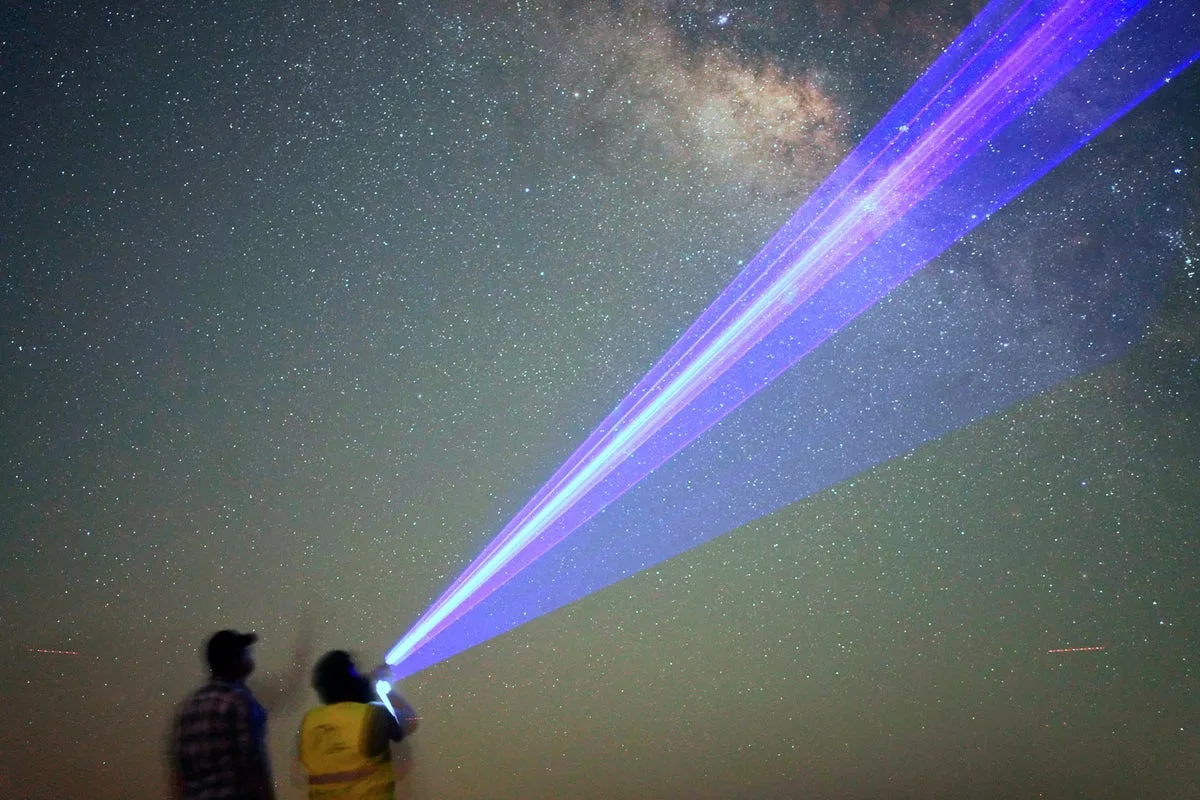
The United Arab Emirates, known for its gleaming skyscrapers and bright lights, has become one of the world's most light-polluted countries. A 2016 study suggested that 99% of the Emirates' population cannot see the Milky Way from their homes due to artificial lighting. However, a group of volunteers from the Dubai Astronomy Group has been helping people reconnect with the night sky by organising excursions to Al Quaa Desert, one of the darkest spots remaining in the country.
Sheeraz Awan, the general manager of the astronomy group, guided participants through a weekend view of the stars in late May. “It causes us to appreciate our existence in this galaxy,” he said. The desert, about 100 kilometres southeast of Abu Dhabi, is easily reachable by vehicle. Despite some overhead road lights and a heavily lit prison along the way, the desert beyond lies in total darkness.
On carpets laid out for the excursion, families speaking Arabic, English and Russian looked up at the sky. The half-moon slowly set, and soon the outline of the Milky Way could be seen by the naked eye. “When you look toward the east, can you see that faint cloud,” Awan asked. “That, ladies and gentlemen, is the Milky Way.” Participants gasped as they spotted meteors streaking across the sky, easily visible without urban light interference.
Some gathered around telescopes to look at individual stars, while others lay on the cold desert sand, learning how to take long-exposure photos of the galaxy on their mobile phones. The experience allowed them to engage with the night sky in the same way as the Bedouin who once traversed the region's vast interior, known as the Empty Quarter.
Authorities in Abu Dhabi have acknowledged the light pollution problem, introducing a “Dark Sky Policy” in 2024. In Dubai, however, LED displays and billboards have become increasingly common, and officials did not respond to a request for comment. The Dubai Astronomy Group plans to continue its excursions, offering a rare chance to see the stars in a country where the night sky is often hidden by the glow of development.




