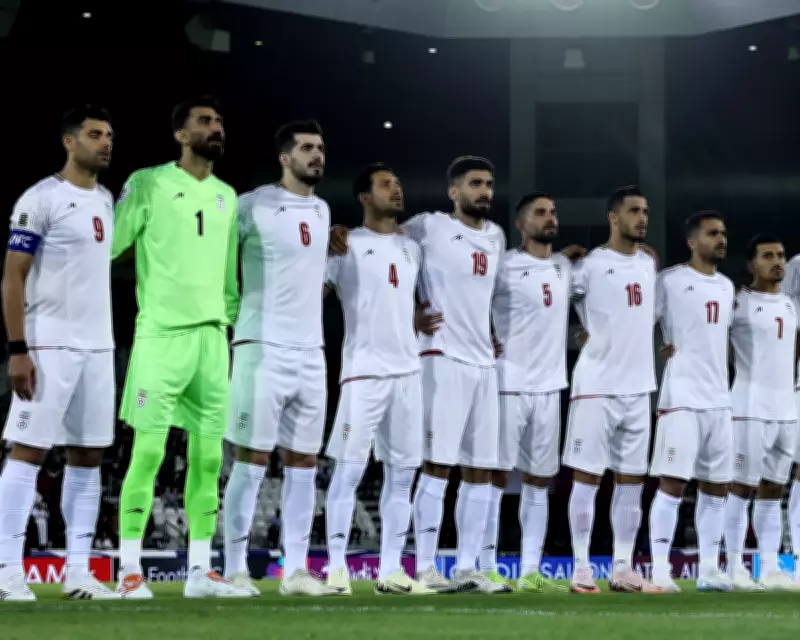
The status of Iran's national football team for the 2026 World Cup has become a rapidly evolving and highly contentious issue, with political tensions casting a long shadow over their potential participation. The situation appears to shift almost hourly, creating significant uncertainty within the global sports community.
Political Statements Fuel Confusion
US President Donald Trump added to the confusion with a recent statement on Truth Social, declaring that he did not believe it "is appropriate that they be there, for their own life and safety." This incendiary post came less than forty-eight hours after FIFA President Gianni Infantino claimed that Trump had told him during a White House meeting that Iran would be "welcome" at the World Cup.
Iran's football federation responded swiftly on Instagram, asserting that "No one can exclude Iran's national team from the World Cup" and suggesting that the United States should be removed as host due to Trump's implicit threat. The following day, Iran's Sports Minister Ahmad Donyamali told state media that his country would not participate, stating: "Under no circumstances do we have the appropriate conditions to participate in the World Cup."

FIFA's Delicate Position
Multiple sources within FIFA have confirmed that no definitive decision regarding Iran's World Cup involvement has been reached. The world governing body has given itself until its annual Congress in Vancouver on April 30th to reach a conclusion. FIFA's official position maintains that they want Iran to participate, with General Secretary Mattias Grafström emphasizing last week that "our focus is to have a safe World Cup with everybody participating."
FIFA's statutes strictly mandate political and religious neutrality, creating pressure on the organization to avoid an Iranian withdrawal. They certainly do not want to be perceived as having played a role in forcing Iran out, despite Infantino's apparent desire to maintain close relations with Trump. There is no modern precedent for a team withdrawing or being removed from a World Cup, though the 1992 European Championship provides a parallel when UEFA replaced Yugoslavia just ten days before the tournament due to United Nations sanctions.
Potential Consequences of Withdrawal
Under FIFA statutes, member associations are not permitted to withdraw from competitions, and Iran would face disciplinary sanctions if they did so. No country has pulled out of the World Cup after the draw was made since France and India declined to participate in 1950, citing travel costs.
FIFA tournament rules include specific protections against withdrawal. The regulations state that withdrawing before the tournament incurs a fine ranging from €275,000 to €555,000, depending on the timing of the withdrawal. This would also trigger a referral to FIFA's disciplinary committee, which could impose additional sporting sanctions, including potential tournament bans.
"The FIFA disciplinary committee may impose additional disciplinary measures, taking into account in particular the timing of the withdrawal or exclusion, the seriousness of the infringement that led to the inadmission or exclusion, possible mitigating factors and any other relevant circumstances," the regulations specify. "These disciplinary sanctions may include the exclusion of the association concerned from a future FIFA competition or the replacement of that association by another."
Possible Replacements and Complications
FIFA's World Cup regulations are notably vague regarding replacing a team that has already qualified for the finals, stating only that the organization has "sole discretion" to "take whatever action is deemed necessary" and that it "may decide to replace the participating member association in question with another association."
Iraq and the United Arab Emirates are viewed as the most likely beneficiaries should Iran withdraw, as they are the next highest-ranked teams from the Asian Football Confederation not to have qualified. However, any replacement scenario would likely prove complicated.

Iran secured their World Cup place by winning Group A of the third round of AFC qualifying. The UAE lost a playoff against Iraq, whose reward was a place in an intercontinental playoff on March 31st against Bolivia or Suriname in Monterrey, with the winners advancing to the finals. As recently revealed, Iraq has asked FIFA to postpone that game because most of their squad remains stranded in Baghdad with airspace closed due to ongoing conflict.
Replacing Iran with Iraq might appear an obvious solution but would carry significant political ramifications. Meanwhile, the UAE, a close strategic ally of the United States and an economic powerhouse, is believed to be actively lobbying FIFA to be awarded Iran's place should it become available.
The situation remains fluid, with Iran's state media reporting conflicting information about whether a withdrawal decision has actually been made, and even expressing surprise at Donyamali's comments. While the sports minister's views carry weight, the ultimate decision will be made at higher levels of the Iranian government, adding another layer of complexity to an already volatile situation.