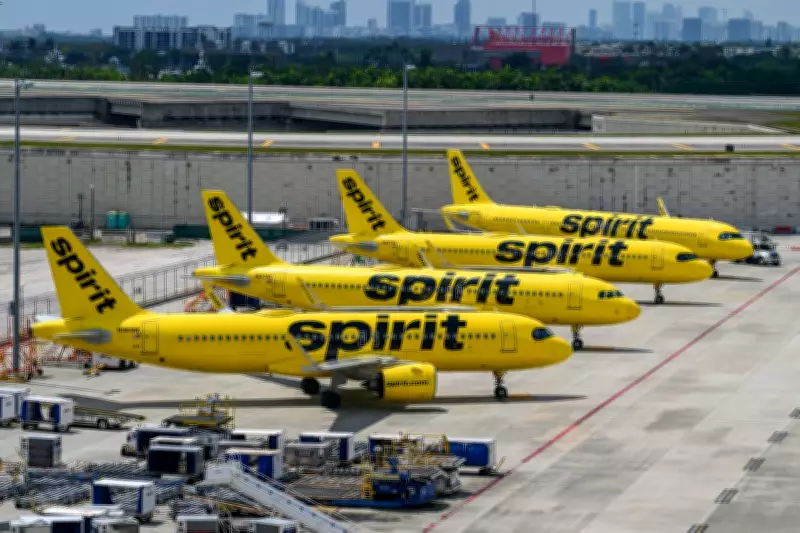
Spirit Airlines' fate was sealed in a New York bankruptcy court on Tuesday as its lawyers sought approval to dismantle the budget carrier, converting its remaining assets into cash for creditors.
This marks a dramatic downfall for Spirit, which initially sought bankruptcy protection in August 2025 in a bid to avert financial collapse. The airline's parent company had been attempting its second business restructuring since November 2024 when operations abruptly ceased over the weekend.
Following the public announcement of its impending closure early Saturday, legal representatives swiftly filed a series of court motions. These outline a rapid wind-down strategy focused on liquidating every available Spirit asset, from its aircraft and engines to spare parts, while simultaneously curbing expenses such as payroll and leasing.

The cessation of operations itself was meticulously planned. Spirit Aviation Holdings Inc. stated that its announcement was made in the middle of the night, a measure taken to ensure all jetliners completing their final routes were safely on the ground and their respective crews accounted for.
Three days later, the sense of urgency carried into U.S. Bankruptcy Court, where the company's lawyers were asking a judge to move quickly. They asked for expedited approval of the proposed wind-down plan, arguing that speed would benefit Spirit's creditors and customers.
“Any delay will cause chaos, confusion and cost the estate significant time and money,” one motion stated, noting the airline was “not generating any revenue.”
Spirit attorney Marshall Huebner said during a Tuesday court hearing that rising jet fuel costs since the U.S. and Israel launched strikes on Iran “engulfed Spirit entirely.” The airline's fuel expenses grew by roughly $100 million “in March and April alone,” and rapidly drained Spirit’s liquidity and derailed its restructuring efforts, Huebner said.
He apologized directly to Spirit’s employees and customers, especially passengers who he said may now be completely “priced out” of certain routes without the ultra low-cost carrier.
Huebner described a swift effort by other airlines and other segments of the aviation industry to assist Spirit's employees and customers once the airline's end looked inevitable. “The entire industry sprang into action to get our people home,” Huebner said. Spirit employed about 17,000 people and carried about 50,000 passengers on its final day of operations. The final flight, which traveled from Detroit to Dallas, landed after midnight Saturday.
With its planes grounded, Spirit said it planned to keep a skeleton crew of about 150 employees initially, eventually shrinking to roughly 40. The group, largely made up of veteran staff and executives, including some “senior management employees,” will be responsible for securing aircraft, coordinating logistics and overseeing the liquidation process.
The company also was seeking Judge Sean Lane's approval to provide retention incentives to keep those workers in place through the liquidation.
In the last two weeks, Spirit was in discussions with the Trump administration about a hoped-for rescue deal that fell through, eliminating what the company described as its last viable path forward. Of the potential bailout, Transportation Secretary Sean Duffy said Saturday, “We oftentimes don’t have half a billion dollars laying around.”
Duffy said other U.S. airlines, including United, Delta, JetBlue and Southwest, were offering $200 one-way fares for a limited time to travelers holding Spirit confirmation numbers and proof of purchase. Airlines also stepped in to assist stranded Spirit crew members, he said, with some offering a preferential hiring process for former Spirit employees looking for work.