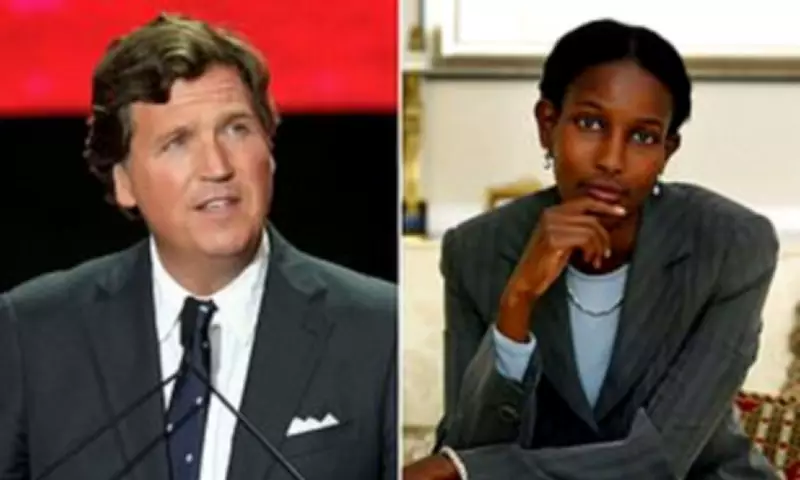
Tucker Carlson has built his reputation on voicing controversial opinions that others avoid. However, few of his recent statements have provoked as much concern as his praise for regimes historically governed by Sharia law and his suggestion that a directionless West could learn from them.
Personal Experience Versus Romanticised View
I spent years living within the civilisation that Tucker admires from afar. Born in Somalia and raised across Saudi Arabia, Kenya, and Ethiopia, I experienced as a child practices conducted in Islam's name, eventually fleeing to the Netherlands to escape a forced marriage. When Tucker observes the Muslim world and perceives a culture ascending, I recognise the world I escaped.
He asserts that all Western cities are deteriorating, yet it is in Europe where the consequences of his confusion are most significant. It is there, in the society Tucker laments, that Sharia is gradually extending its social and legal influence.

Europe's Spiritual and Moral Vacuum
His analysis of Europe's vulnerability deserves attention. The continent is enduring a profound moral and spiritual crisis. Regular church attendance has plummeted so dramatically that repurposed churches are now common urban features, their spires towering above nightclubs and luxury apartments.
In Italy, where the Church has influenced art and politics for centuries, only 19 percent attend Mass weekly, with 31 percent never attending. In the UK, the religiously unaffiliated outnumber Christians for the first time in recorded history—46 percent to 43 percent. In Germany, the unaffiliated have surpassed both Catholics and Protestants combined, a shift unimaginable a generation ago.
Most Western Europeans still identify as Christian, much like claiming to be avid readers—sincerely, but increasingly without practice. This gap between nominal identity and lived faith defines the spiritual crisis church leaders describe, and Tucker accurately observes this phenomenon.
Economic and Demographic Decline
His broader critique also holds weight. Europe once led in productivity growth but now trails the United States by a widening margin. Germany, Europe's economic engine, has teetered on recession for a decade and appears poised to enter one. Finland, France, and Austria each allocate roughly 32 percent of GDP to social benefits, a fiscal burden that stifles other governmental priorities.
The EU, once a geopolitical ambition, has become a bloated bureaucracy more focused on directives than border defence, relying on Washington for security. Meanwhile, fertility rates average 1.34 children per woman, with Spain potentially declining to 1.1 by century's end—too weary or despairing to sustain its population.
The Gulf's Pragmatic Retreat from Sharia
Tucker diagnoses these symptoms correctly, but his proposed remedy is alarming. He witnesses Arab Gulf states projecting global confidence and mistakes what was relinquished for what was preserved. The skylines, sovereign wealth funds, and global ambitions are genuine, but he misunderstands their origin.
Tucker attributes this vitality to Islamic identity and civilisational coherence abandoned by the secular West. He reverses the causation. Gulf states thrive precisely because they retreated from Sharia, not because they embraced it.
For decades, Saudi Arabia and neighbours financed the global export of Wahhabist orthodoxy—blaming Jews and Israel, funding madrassas worldwide, and supporting imams who condemned music, treated women as property, and advocated death for apostates. Oil revenues funded this piety until volatility struck, and youth demanded jobs over theology.
The trade-off became clear: less Sharia, more prosperity. Saudi Arabia marginalised the Muslim Brotherhood. The UAE established a Ministry of Tolerance and Coexistence. Qatar hosts American military bases and serves alcohol in hotels. These governments learned through experience what Tucker fails to grasp.

Sharia's Totalitarian Nature
He imagines Sharia as spiritual seasoning for modern society, but it was never designed as such. Sharia is total, governing diet, dress, commerce, criminal punishment, family law, and foreign policy. You cannot reconcile Sharia with stock exchanges, women in the workforce, or tourism without fundamental compromise. The Gulf chose economy and pragmatism, sidelining Islamists who sought authentic implementation.
Many of those Islamists now operate from Europe, proclaiming ambitions to conquer it. I speak from personal knowledge. My father described Riyadh's Chop-Chop Square—where public beheadings and floggings occurred in God's name—with the trauma of witnessing something unforgettable and regrettable.
Sharia's Devastating Record
Sharia's legacy is extensive and documented. Tucker should examine it closely. Afghanistan under the Taliban bans girls from school at twelve, restricts women's movement, silences music, and sustains its economy through opium and foreign aid. Iran's Shia variant employs morality police, tortures dissidents, strangles its economy with ideology, and faces contempt from its youth.
Hamas in Gaza enforces authentic Sharia through executions of homosexuals, suppression of women, and subordination of institutions to perpetual jihad. ISIS built its caliphate on rigorous Islamic law, resulting in genocide, sex slavery, and mass beheadings. A key feature of Sharia is a pathological commitment to destroy Jews. These outcomes stem from sincere conviction, not deviation.
Europe's Democratic Response
Tucker rightly identifies Europe's exhaustion as evidence of secular liberal failure but wrongly concludes that an Islam-centred civilisation is rising. He misidentifies the variable. What ascends in the Gulf is technocratic authoritarianism draped in Islamic aesthetics—MBS, not the Quran, governs Saudi Arabia, and his first priority was crushing clerics.
Europe's crisis warrants honest confrontation. Its spiritual void, bureaucratic inertia, demographic collapse, economic stagnation, and defence reliance are legitimate concerns. However, romanticising a legal system that produces misery on an industrial scale is not the solution.
The self-hatred Tucker notes among European elites is real, but ordinary Europeans increasingly reject it through democratic votes. In Austria's September 2024 election, the Freedom Party achieved its best result—28.9 percent—by opposing mass immigration from Muslim-majority nations. In France, Marine Le Pen's National Rally secured 31.5 percent in the 2024 European Parliament elections, prompting Macron to dissolve parliament.
These democratic majorities clearly reject elite-imposed policies, suggesting the problem is ideology, not civilisational surrender. Ideology can change, but Sharia's fundamental character cannot. It demands submission of individuals to collectives, women to men, non-Muslims to Muslims, and reason to revelation.
Every society attempting to run a modern economy, military, or state on authentic Sharia principles has either collapsed or abandoned them by necessity. Tucker Carlson has made outlandish and significant claims, occasionally retracting them with courage. This is an invitation to demonstrate that courage once more.