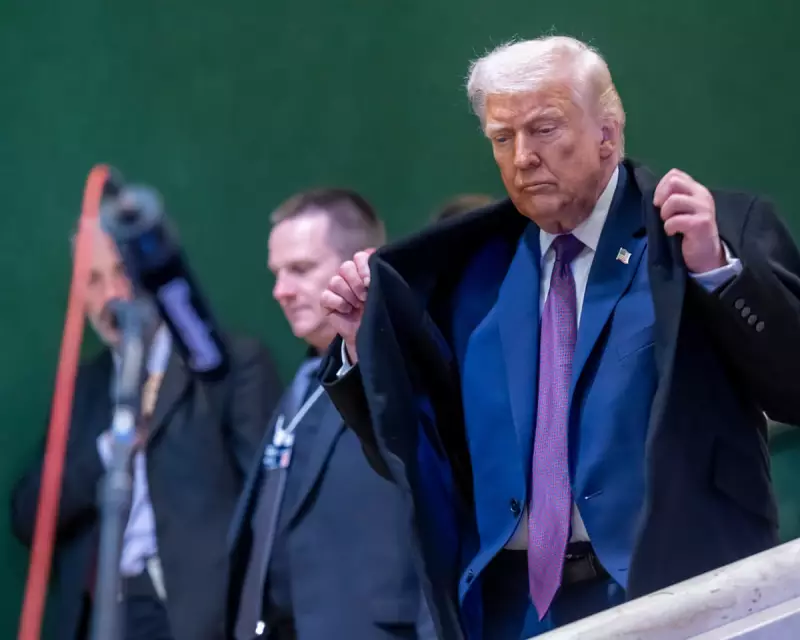
Over the past twelve months, global observers have witnessed Donald Trump's second presidential term deteriorate into what many describe as an unabashed crusade for self-enrichment. The former president has systematically exploited the highest office in the United States to bolster his personal wealth, intimidate both allies and adversaries with his unpredictable foreign policy, and tarnish America's international reputation.
The Greenland Crisis: A Self-Made Bomb Defused
In recent days, Trump demonstrated this pattern vividly by turning the presidency into an instrument for personal glory and retribution. On Saturday, he menaced European nations with tariffs as high as twenty-five percent, contingent on Denmark's agreement to sell Greenland to the United States. The following day, Trump reportedly messaged Norway's prime minister, citing his failure to secure the Nobel Peace Prize as motivation for his determination to acquire the vast Arctic territory.
By Tuesday morning, as European leaders reeled from these threats, the president escalated tensions by sharing an AI-generated meme depicting him planting a US flag on Greenland, accompanied by his vice president and secretary of state. The image bore the caption "Greenland. US Territory. Est. 2026." Trump disseminated another apparently AI-edited visual showing him seated beside a map that incorporated Canada, Greenland, and Venezuela into US territory during discussions with European dignitaries at the White House.

When pressed at a press conference about the extent of his ambitions regarding Greenland, Trump offered a cryptic response: "You'll find out." However, by Wednesday, following a characteristically flamboyant address at the World Economic Forum in Davos, the president retreated from his tariff threats, announcing he had established "the framework of a future deal" on Greenland with the NATO secretary general. This marked a temporary de-escalation of a global crisis entirely of Trump's own creation.
A Transactional Approach to Governance
Trump's campaign to annex Greenland from Denmark represents the culmination of his transactional and corrupt governing style since returning to office. It exemplifies an attempt to leverage America's formidable financial and military might to coerce a property transaction he believes would cement his legacy. No contemporary real estate magnate can boast such an acquisition: a territory spanning eight hundred and thirty-six thousand square miles, triple the size of Texas.
Prior to the Davos meetings, Trump displayed minimal interest in negotiating agreements with Denmark and other NATO allies to expand the existing US military footprint in Greenland through additional bases, radars, or ballistic missiles. His objective was unequivocal: outright US ownership of the Danish territory. In an interview with the New York Times earlier this month, Trump articulated his perspective on Greenland in real estate parlance, favouring ownership over leasing or treaties. "Ownership is very important," he asserted, adding, "Because that's what I feel is psychologically needed for success." When questioned whether this psychological need pertained to himself or the nation, Trump clarified, "Psychologically important for me."
Unleashing Basest Instincts
This episode underscores how Trump, the first convicted felon elected to the presidency, has unleashed his most primal instincts during his second term. His worldview posits that the state exists to serve the leader's ego, and should the world fail to validate him, it will incur consequences. Trump had previously declined to rule out military force to seize Greenland if Denmark persisted in refusing to sell, a stance he only rescinded in his Davos speech.
The president's confidence was bolstered by a swift US military operation on January third that captured Venezuelan president Nicolás Maduro without American casualties. For Trump and his obsequious aides, US foreign policy now operates on the principle that might makes right, with Europe perceived as too feeble to resist American dominance.
To realise his territorial ambitions and assuage his wounded pride over the Nobel Peace Prize, Trump appears willing to jeopardise the nearly eighty-year-old NATO alliance, provoke a transatlantic trade war, and potentially incite military conflict with US allies.

Erosion of Accountability and Norms
How did the United States reach this juncture? Upon resuming office last year, Trump eviscerated federal agencies, dismissed tens of thousands of government employees, and issued numerous executive orders to expand his authority. He rapidly dismantled many anti-corruption safeguards established by Congress post-Watergate, firing seventeen inspectors general who served as ethical watchdogs across agencies.
Trump installed loyalists to lead the Justice Department and FBI, bypassing Congress to appoint allies as top federal prosecutors nationwide. Within months, he had disabled many accountability mechanisms designed to impose ethical and legal constraints on previous presidents.
Congressional and Judicial Complicity
With minimal opposition from Congress and Washington's political establishment, Trump felt empowered to augment presidential authority and disregard norms set by predecessors. Fearful of antagonising the president and his MAGA base, the Republican congressional majority permitted Trump to encroach upon its authority over government spending and agencies.
The US Supreme Court further facilitated Trump's power grab through a July 2024 ruling granting him "absolute immunity" from prosecution for official presidential acts. The court's conservative majority, which Trump helped shape by appointing three justices during his first term, decided six-to-three in his favour. In a dissent that now seems prophetic, liberal justice Sonia Sotomayor condemned the majority's decision as a "mockery" that could elevate the US president to a "king above the law."
"Let the President violate the law, let him exploit the trappings of his office for personal gain, let him use his official power for evil ends," Sotomayor wrote, envisioning scenarios where a leader might order the military to assassinate a political rival, orchestrate a coup to retain power, or accept bribes for pardons—all while enjoying immunity. She added, "Even if these nightmare scenarios never play out, and I pray they never do, the damage has been done... In every use of official power, the President is now a king above the law."
Unprecedented Personal Profiteering
The absence of checks on Trump, coupled with immunity from potential criminal prosecution, has enabled him not only to reshape the US government but also to profit from the presidency in unprecedented ways. The president is exempt from conflict-of-interest laws prohibiting federal employees from leveraging their positions for personal gain. Since Watergate forced Richard Nixon's resignation in 1974, every US president had voluntarily adhered to these rules—until Trump.
During his first term, Trump resisted pressure to divest from his business ventures, claiming his sons managed the Trump Organization. In his second term, he has monetised the presidency to an astonishing degree. Estimates suggest he has utilised the office to generate at least one point four billion dollars for himself and his family, including millions in licensing fees from over twenty foreign real estate projects involving governments seeking US favour.
White House Press Secretary Karoline Leavitt has responded to such allegations by stating, "Neither the President nor his family have ever engaged, or will ever engage, in conflicts of interest."
Cryptocurrency Windfalls and Foreign Entanglements
The most substantial windfall for Trump stems from new cryptocurrency ventures, particularly a two-billion-dollar stablecoin project with an investment fund backed by the United Arab Emirates government. This initiative, potentially yielding hundreds of millions in profits for the president's family, was announced just two weeks before Trump granted the UAE access to purchase advanced computer chips crucial for AI development.
With no guardrails or meaningful opposition to curb Trump's extensive power grab and personal enrichment, his threats of economic warfare against US allies over Greenland appear less surprising. Trump is effectively transforming the United States from a superpower into a protection racket governed by his caprices.
Over the past year, Trump has grown increasingly vindictive, narcissistic, and erratic—posing a grave danger not only to America but to the global order. His Greenland gambit epitomises this perilous trajectory, revealing a presidency unmoored from ethical and diplomatic norms.