RAF Pilot Missing Since 1940 Discovered in French Canal Construction
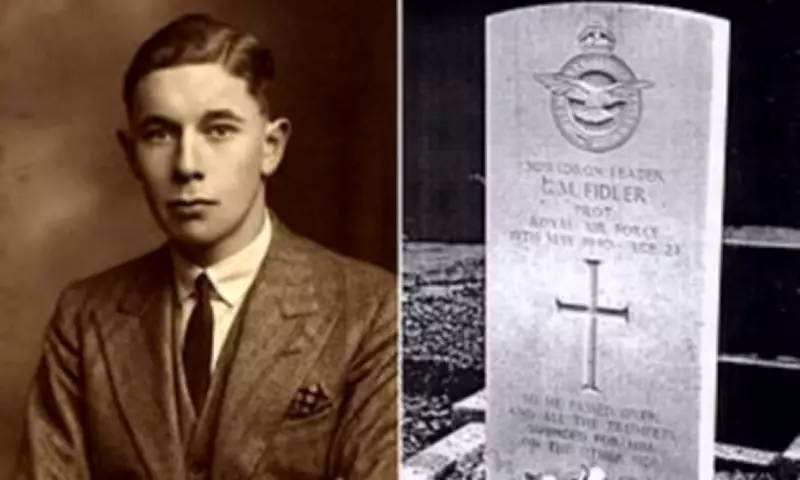
In a remarkable discovery, the remains of a Royal Air Force pilot shot down during the Second World War have been unearthed by engineers working on a canal in northern France. Squadron Leader George Morley Fidler, aged 27, was lost for over eight decades after his Hurricane fighter plane was downed by a German Messerschmitt on May 19, 1940.
The Fateful Mission and Decades of Misidentification
Fidler was part of 607 Squadron, engaged in a critical mission to protect British troops retreating to Dunkirk during the Battle of France. His aircraft was one of twelve Hurricanes lost that day. For years, it was believed his body had been recovered and buried by soldiers who found a Hurricane wreckage, assuming it was his. This led to a grave marked with his name in the French village of Bachy.
However, in 2006, amateur historians excavated that crash site and revealed a shocking twist: the plane belonged not to Fidler, but to James Strickland of 67 Squadron, who had baled out and survived, only to be killed later in 1941. The body in that grave, now inscribed as 'unknown airman,' remains unidentified due to Ministry of Defence policies against exhuming graves for identification.

The Breakthrough Discovery and Identification
Nearly twenty years after that revelation, French engineers working on a canal at Oisy-le-Verger in the Pas de Calais region made a stunning find. They uncovered Fidler's Hurricane, with the pilot still seated upright in the cockpit. Identification proved challenging, as DNA testing was impossible—Fidler had no children, and his two siblings were also childless.
Instead, forensic experts used a process of elimination, comparing samples from three other pilots who crashed on the same day. By ruling them out, they confirmed the remains as those of Squadron Leader Fidler, originally from Great Ayton in North Yorkshire. Nicola Nash, leader of the war detectives team involved, expressed certainty, stating, 'We are 100 per cent certain it is Morley. It has brought him to life for us.'
Fidler's Legacy and Upcoming Burial
Described as an 'exceptional' pilot, Fidler had joined the RAF in 1934 at age 21, after working in his father's building business. He served in Egypt for three years before being promoted to acting flight lieutenant in 1938 and posted to France as part of the British Expeditionary Force. His role in patrolling the skies during the German advance across France, Belgium, and the Netherlands was crucial to the war effort.
The confusion over his identity likely stemmed from the original discovery, where the downed pilot may have been wearing kit or carrying a parachute belonging to Fidler, leading soldiers to mistakenly mark the grave. Now, after 86 years, Fidler will finally receive a proper burial. A ceremony is scheduled for next month, coinciding with the 86th anniversary of his crash, bringing closure to a long-standing mystery and honoring his sacrifice.
Nicola Nash added that connecting with a distant cousin has helped revive Fidler's memory, highlighting the emotional impact of this discovery. As the RAF pilot is laid to rest, his story serves as a poignant reminder of the many unsung heroes of World War II whose fates were lost to time.