Forget distant territories like Greenland. This past week witnessed Donald Trump effectively colonising the prestigious Davos summit and much of what it traditionally symbolises. The Swiss ski resort's annual World Economic Forum has long served as the glittering gathering for globalism's elite networking class. This year, however, the event became entirely about Trump, who absorbed its energy and redirected its focus like a powerful industrial magnet attracting iron filings.
A Forcefield of Attention
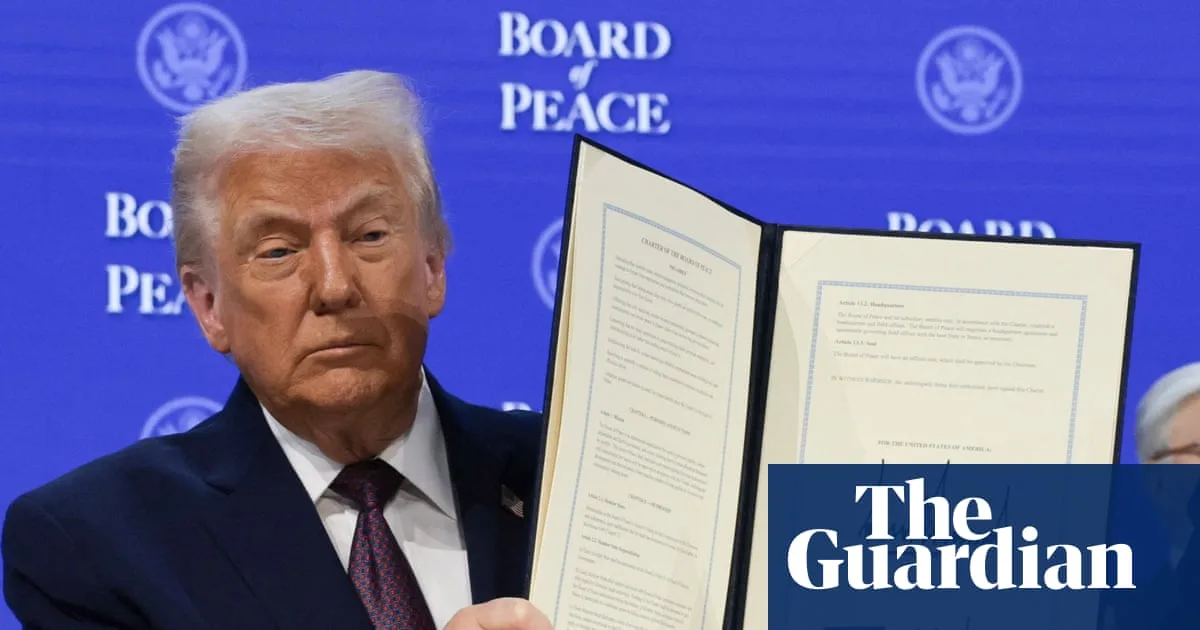
The stooped, older egomaniac created a forcefield of attention that seemed unconcerned by disapproval from middle-power nations. Europe's club-class political leaders could only watch and gawk as the American former president dominated proceedings. Centre-stage, Mr Trump sat surrounded by what he termed his 'Board of Peace' – a controversial assembly tasked with attempting to rebuild the devastated Gaza Strip.
An Unusual Assembly
The composition of this panel presented a remarkable spectacle. It resembled what one might imagine as a collection of Bosphorus masseurs combined with Central-Asian police chiefs. The gathering featured a preponderance of burly moustaches and individuals with rolling gaits and rheumy eyes, alongside Argentina's Javier Milei, whose hairstyle evoked late-era Elizabeth Taylor.
'Everyone here is a star,' drawled Mr Trump during the proceedings, though a more accurate description might have been 'almost everyone here is a bit of an armlifter'. The assembly included Ilham Aliyev, the strongman leader of Azerbaijan with moisture seeping from one languid eye; a busy Saudi prince; Hungary's Viktor Orban; a dapper Pakistani prime minister; and Indonesia's rotund president, for whom human rights have not traditionally been a primary focus.
European Reactions and Absences
European leaders, including Britain's own political representatives, notably boycotted the ceremony. Mr Trump remained entirely undented by these absences. However, Sir Tony Blair, celebrated as an angel of peace in certain circles, did attend, actively networking and cementing connections while distributing business cards. Meanwhile, Foreign Secretary Yvette Cooper remained outside in the snow, expressing concerns about legalities – an honourable position, but one that lacked the momentum clearly centred around Trump.
German Perspectives on Global Change
Germany's beanpole Chancellor, Friedrich Merz, had earlier delivered a metronomically paced speech addressing dizzying geopolitical transformations. He described a world that was 'not a cosy place' but expressed hope that traditional Western powers could still shape its future if they confronted 'harsh realities'. His prescription included investing in defence capabilities and making economies more competitive.
'We are doing this,' declared Herr Merz, suggesting the pfennig might finally be dropping in Berlin, though Westminster appears far from any similar recognition. Sir Keir Starmer's lunge back toward regulation-heavy Brussels will likely exacerbate rather than alleviate these challenges, according to observers.
Farage's Davos Appearance
Nigel Farage participated in a breakfast discussion event with Bloomberg's Stephanie Flanders, an archetypal Davos figure with posh glottal stops, blue nail-varnish, and sceptical expressions beneath a shrewdly shaken fringe. Mr Farage, with his right shin hoicked onto his left knee, repeatedly used 'frankly' while admitting his general dislike of bankers.
Reality appears to be influencing Reform UK's economic policies, with Farage declaring 'We're going to reduce welfare spending' and 'We're going to cut spending' – what computers might term 'installing an upgrade'. He identified Britain's 'moronic energy policy' as one of its biggest problems, a statement that in previous years would have drawn gasps but this time was accepted without demur.
Questioning Global Figures
Regarding Mark Carney, the Canadian former central banker whose pro-globalisation speech had captivated Davos audiences, Mr Farage described him as 'the chap that gets everything wrong and keeps being promoted', earning a distinctly unimpressed 'bad-prawn' glance from Stephanie Flanders.
The Trump Departure Spectacle
Back in the main hall, Mr Trump hailed his grisly associates as 'extraordinary leaders' – certainly one way of characterising them – and called them 'the most powerful people in the world'. As he prepared to depart, they competed to shake his hand, touching their ties and sucking in their tummies in supplicant fashion.
Herr Merz had earlier asserted that 'democracies do not have subordinates, they have allies'. Yet in this cold new world order, opportunist go-getters appeared happy to genuflect before what some might call the great Sol Invictus. As Trump exited through the building's halls, reporters screamed questions about every global trouble spot, with one particularly yelling 'What are you going to do about Yemen?'
The Sun God Trump beamed throughout, clearly in his element and dominating what was once globalism's premier stage, now transformed into his personal theatre of power and influence.