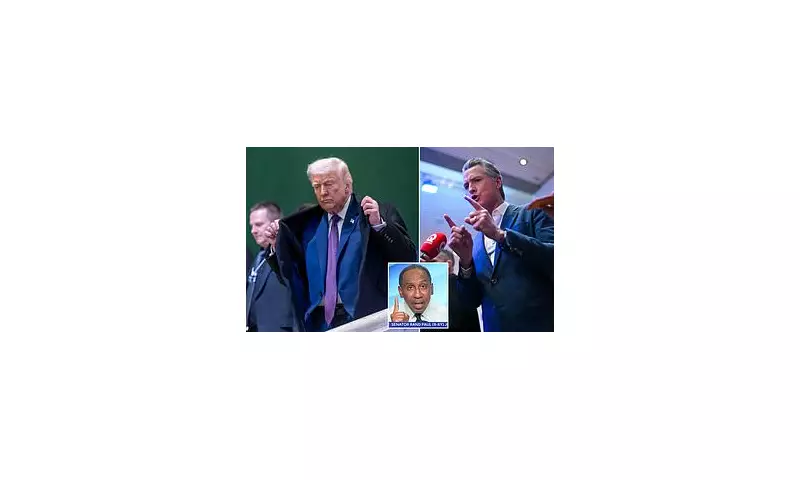
Sports commentator Stephen A. Smith has launched a scathing critique against California Governor Gavin Newsom for his decision to travel to Switzerland and publicly criticise former President Donald Trump on the international stage. The incident unfolded during the annual World Economic Forum gathering in Davos, where global leaders convened to discuss economic and geopolitical matters.
Trump's Davos Address and Newsom's Response
Donald Trump delivered a comprehensive 90-minute speech at the forum on Tuesday, covering a wide range of topics including his administration's security arrangements in Greenland, reflections on his first year back in office, and even touching upon China's wind energy developments. Following the address, Governor Newsom positioned himself before international media cameras to express his disapproval of Trump's remarks.
'It was remarkably boring, it was remarkably insignificant,' Newsom told assembled journalists. 'Really some jaw-dropping and remarkable statements that just fly in the face of facts and evidence and common-sense. My god, there wasn't anything new about that speech.'

Smith's Fiery Critique of Newsom's International Stance
Stephen A. Smith responded with considerable frustration to Newsom's comments, emphasising his belief that American officials should present a more unified front when representing the nation abroad. The prominent sports commentator questioned the fundamental purpose of Newsom's 6,000-mile journey to Switzerland.
'California governor Gavin Newsom. Respectfully, what are you doing?' Smith began his critique. 'You're the governor of the state of California in the United States of America. Why are you over in Davos, Switzerland talking to folks and speaking negatively about the President of the United States of America?'
Smith clarified his position regarding domestic political discourse versus international representation: 'Let me be very clear. I have no problem with Gavin Newsom being candid and open about his feelings about our president on United States soil. To go over to another country, to go over there and to be in the presence of other European leaders speaking against the President of the United States? I'm not down with that. Y'all might be. I'm not down with that at all.'
The commentator articulated a principle of national unity when abroad: 'Say whatever you want here as a governor from the opposite side of the aisle of a state in the United States on American soil, fine. But I'm one of those people when we go somewhere else, it's America first. You know, our problems, yeah are our problems but we ain't taking dirty laundry outside.'
Political Repercussions and White House Response
The political fallout from Newsom's criticism was swift and significant. Trump's team responded by barring the California governor from entering the USA House venue in Davos. The White House escalated the conflict through social media platform X, posting that Newsom had been relegated to 'the corner cuck chair' – a provocative reference to a specific genre of adult content.
This exclusion proved particularly notable as Newsom had been scheduled to participate in a panel discussion at USA House hosted by Fortune Magazine. The governor responded to his exclusion with defiance on social media, writing: 'How weak and pathetic do you have to be to be this scared of a fireside chat?'
Speculation About Political Ambitions
Stephen A. Smith suggested that Newsom's European excursion might be connected to broader political aspirations. 'I think he's lining up his own bid to be president in 2028, hence the trip to Europe,' Smith speculated.
Despite his criticism of Newsom's international conduct, Smith offered some personal praise for the California governor: 'I like him. I like him as a person. I think he looks sharp in those blue suits. I think the number one impediment to his governing ability is his heart because he truly cares and he wants to do right by everybody. I truly believe that about Gavin Newsom. He's trying to do something for everyone, not understanding that you got to allocate.'

The incident highlights ongoing tensions within American politics regarding appropriate conduct for elected officials on the international stage, particularly when criticising political opponents abroad versus maintaining national unity in foreign settings.