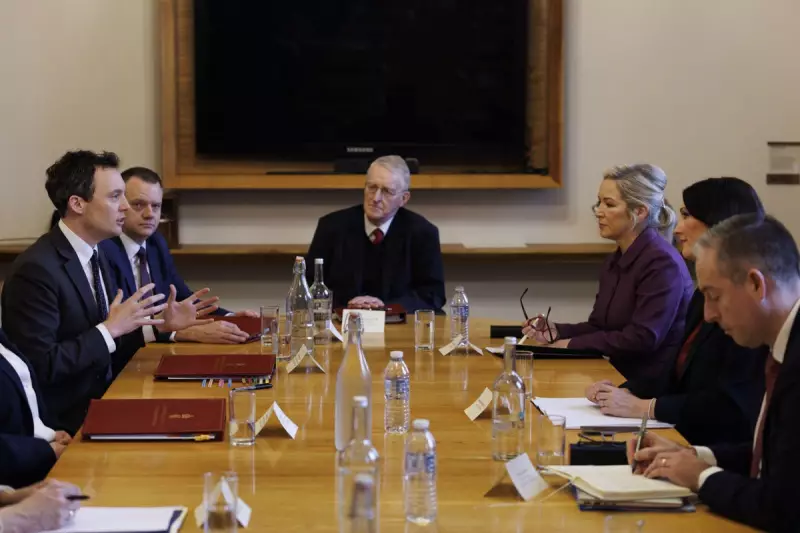
Stormont Leader Confronts Westminster Over Financial Support
Northern Ireland's First Minister Michelle O'Neill has delivered a stark rebuke to Prime Minister Keir Starmer, declaring he has "got it wrong" regarding financial support for the region. The comments emerged following a tense East-West Council meeting in Belfast, where budgetary pressures dominated discussions.
Multi-Year Budget Demands
Ms O'Neill has issued a direct challenge to Westminster, calling for the first multi-year budget for Stormont in over a decade. She emphasised that this framework is essential to properly fund critical public services including healthcare and education, which face unprecedented demand.
"The reality is, whilst we often hear the Treasury and Hilary Benn himself speak about how we've had record allocation of funding, that ignores the reality that we're dealing with years of underfunding," O'Neill stated. "We're trying to build services up from a very low ebb."

Decade of Underfunding
The First Minister argued that Northern Ireland has suffered from systematic underfunding for more than ten years, creating a deficit that cannot be resolved within a single budgetary cycle. She dismissed suggestions that the Executive should simply "get on with it" as inadequate and unacceptable.
"What we need for them to do is step up, actually put more money into public services here, allow us to invest in health and education," O'Neill insisted. "But just to tell us to get on with it isn't good enough and it doesn't wash and we won't accept it."
Executive's Financial Challenges
Deputy First Minister Emma Little-Pengelly echoed these concerns while acknowledging the complexity of the situation. She noted that while funding allocations have increased, demand for services has grown even more rapidly, particularly in education with special educational needs and across the health service.
"While the Secretary of State may reference record levels of spending, we are facing record levels of demand," Little-Pengelly explained. "Our pay bill has never been higher because of inflationary increases, our energy bills, other issues right across government that impact government just as it impacts on hard-pressed households right across Northern Ireland."
Westminster's Response
Northern Ireland Secretary Hilary Benn acknowledged the "clearly very difficult" budget situation while defending Westminster's support. He pointed to the record Spending Review settlement and additional funding provided, noting that Northern Ireland receives more funding per head than England, reflecting its greater needs.
"All governments all around the world, in Westminster, here in Northern Ireland and elsewhere, have to deal with difficult choices about how it's going to spend its money," Benn remarked. "When we come into public life, we have a responsibility to balance the books and to produce a balanced budget."
Collaborative Approach Sought
Both Stormont leaders emphasised the need for a more collaborative relationship with the Treasury, rather than what Little-Pengelly described as a dynamic where "the Treasury makes demands and we simply respond to them." They stressed that transforming public services would require time and sustained investment.
The Deputy First Minister outlined plans to drive efficiency through technological adoption, including artificial intelligence and digital transformation across the public sector. However, she cautioned that such changes require both financial support and patience to implement effectively.
Broader Council Discussions
The East-West Council meeting, established as part of the 2024 deal that restored powersharing, also addressed barriers to east-west trade and budgetary coordination. Cabinet Office minister Nick Thomas-Symonds discussed how funds from the autumn budget were being used to simplify arrangements under the Windsor Framework for businesses.
Notably absent from discussions were former US President Donald Trump's recently scrapped tariffs concerning Greenland, with Benn quipping that "had we met yesterday, we might have had a slightly different discussion."

The meeting concluded with all parties acknowledging the challenging fiscal landscape while maintaining fundamentally different perspectives on how to address Northern Ireland's financial requirements in the coming years.