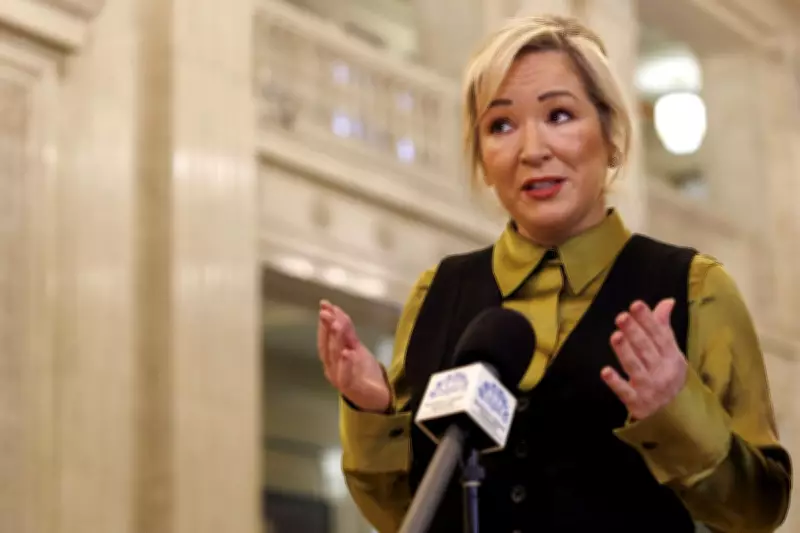
Stormont First Minister Condemns UK's 'Reckless' Military Involvement in Iran
Stormont's First Minister Michelle O'Neill has launched a scathing critique of the UK Government's decision to engage militarily in the escalating conflict in Iran, labelling it "absolutely the wrong call". The Sinn Féin vice-president stated she "fundamentally disagrees" with the British approach, describing the war as reckless and warning of spiralling regional violence.
Executive Division Over Briefing Attendance and Alleged Ties
Ms O'Neill defended her decision not to attend a UK Government briefing on the crisis, which was attended by her Executive counterpart, Deputy First Minister Emma Little-Pengelly of the DUP. While confirming ongoing contact with both Irish and British authorities to support citizens in the region, O'Neill asserted she "will not be part of any briefing by the British government on their military operations."
In a later Assembly session, Ms Little-Pengelly expressed bewilderment that "some appear to support" the Iranian regime, directly claiming that Sinn Féin "have had a long-running relationship with Iran" spanning decades. She characterised Tehran's leadership as a "murderous, appalling regime" that oppresses women's rights, targets LGBTQ+ individuals, and supports global terrorism.

DUP Leader Advocates for Earlier UK Intervention
DUP leader Gavin Robinson presented a contrasting position, arguing the UK "should have been involved earlier" in the conflict. He dismissed legal debates about the weekend's military actions, stating: "I shed no tears for the ayatollah." Robinson linked Iran to terrorists who historically targeted Northern Ireland and suggested the current situation offers Iranians an opportunity to pursue democracy.
"This regime was trying to assassinate the President of the United States, supports terror all around the world, and he's gone," Robinson declared, emphasising practical involvement over procedural concerns.
Escalating Conflict and Regional Dangers
The Middle East conflict has expanded significantly, with Iranian and Iranian-backed militaries launching missile attacks against Israel and Arab states, while simultaneous US-Israeli airstrikes target Iranian positions. The Iranian Red Crescent Society reports 555 fatalities from the air campaign that commenced over the weekend.
Cyprus confirmed a drone attack targeted RAF Akrotiri, a British base, hours after Prime Minister Keir Starmer authorised American forces to use UK bases for strikes against Iranian missile sites. This development underscores the direct threats to British military assets in the region.
Evacuation Concerns for British and Irish Citizens
Approximately 300,000 British nationals are estimated to be in countries currently targeted by Iran, with 102,000 registered with the Foreign Office for emergency updates. Officials are examining all contingency plans, including potential mass evacuation operations.
Deputy First Minister Little-Pengelly revealed she was informed about "many, many thousands of people" from Northern Ireland residing in affected nations, particularly highlighting significant numbers in the United Arab Emirates. She urged all citizens in the region to register for official alerts regarding evacuation procedures and security updates.
"There are people in the region with British passports, Irish passports and both," Little-Pengelly noted, emphasising coordinated communication efforts through social media channels to reach all potentially affected individuals.
First Minister's Humanitarian Focus and Legal Critique
Michelle O'Neill maintained that her primary concern remains the safe extraction of travellers and workers from what she described as "a very dangerous and catastrophic situation." She acknowledged widespread anxiety among families with loved ones in the conflict zone.

While characterising the Iranian regime as "brutal" and "repressive," O'Neill argued that military intervention breaches international law and undermines diplomatic solutions. "What we need to see is dialogue, what we need to see is adherence to international law," she insisted, questioning where the escalating conflict will ultimately conclude.
The First Minister also raised concerns about potential disruptions to supply chains and noted that Northern Ireland residents are serving with UK Armed Forces in the affected region, alongside their concerned families.