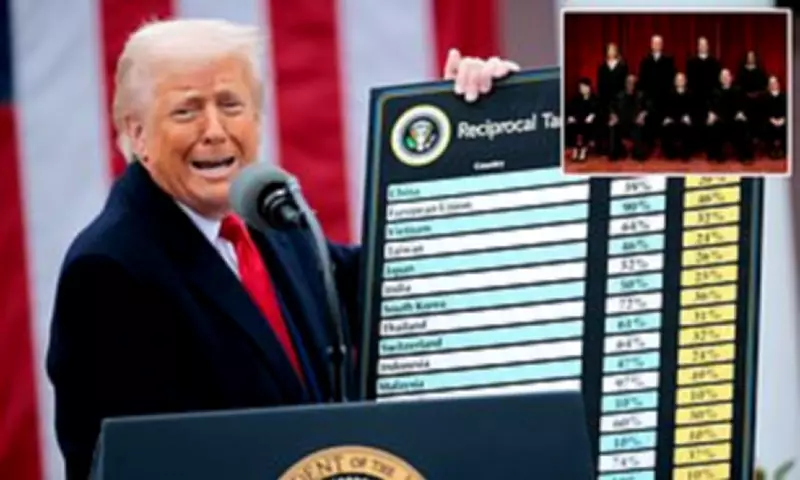
C-SPAN has definitively quashed widespread speculation that a caller who criticised the Supreme Court's recent tariff decision was actually former President Donald Trump using a pseudonym. The network issued a formal statement on Sunday addressing the mysterious caller from Virginia who identified himself as John Barron.
The Controversial Call and Immediate Speculation
On Friday, host Greta Brawner took calls regarding the Supreme Court's controversial ruling that blocked the president's sweeping tariff policies. The decision, released that morning, had already generated significant political debate. During the segment, Brawner introduced a caller saying, 'John in Virginia, Republican, let's hear from you.'
What followed immediately captured viewers' attention. The caller's voice, cadence, and rhetorical style bore an uncanny resemblance to Donald Trump's distinctive manner of speaking. Furthermore, the alias 'John Barron' held particular significance—this was the exact pseudonym that Trump reportedly used when speaking to reporters during the 1980s and 1990s, according to Washington Post records.

Content of the Controversial Call
During his appearance, 'John Barron' delivered sharp criticism of the Supreme Court's decision. 'Look, this is the worst decision you ever made in your life, practically,' he declared. 'And Jack's going to agree with me, right, but this is a terrible decision.'
The caller went on to criticise Democratic leaders, stating, 'You have Hakeem Jeffries, who... he's a dope. And you have Chuck Schumer, who can't cook a cheeseburger. Of course, these people are happy. But true Americans will not be happy.' He also referenced previous callers on the program, commenting, 'And you have the woman earlier — I assume she's a woman, she's a Democrat... But she's … devastated by this.'
C-SPAN's Official Response
In response to mounting speculation, C-SPAN released a clear statement: 'Because so many of you are talking about Friday's C-SPAN caller who identified himself as "John Barron," we want to put this to rest: it was not the president.'
The network provided specific details to support their conclusion: 'The call came from a central Virginia phone number and came while the president was in a widely covered, in-person White House meeting with the governors.' They concluded by directing viewers to 'Tune into C-SPAN for the actual president at the State of the Union Address on Tuesday night.'
The Presidential Schedule and Skeptical Theories
Despite C-SPAN's clarification, some dedicated skeptics analyzed Trump's schedule for that Friday. One observer meticulously outlined the timeline: 'SCOTUS ruling announced about 10 while Trump was meeting with governors. At 12:45, he started his briefing. It ended at 2:06. He went into the Oval Office until 4:34. John Barron called C-SPAN at 3:19.'
This individual further argued that 'Caller ID said where the phone was registered, not where it came from. I call BS.' Other theories proposed by convinced viewers included suggestions that the segment might have been pre-recorded or that Trump could have slipped away with a burner phone during a bathroom break.
Historical Context of the John Barron Alias
The use of the John Barron pseudonym carries particular historical weight. Donald Trump reportedly employed this alias extensively when speaking to reporters during the 1980s and 1990s, using it to promote his business interests and public image. This practice ended in 1990 when Trump was compelled to admit under oath that he had used the fake name.
The Supreme Court Ruling That Sparked the Controversy
The call followed the Supreme Court's significant six-to-three decision against Trump's tariff policies. The ruling determined that his approach was not permitted under the International Emergency Economic Powers Act. Notably, two Trump appointees—Justices Amy Coney Barrett and Neil Gorsuch—joined Justices Elena Kagan, Sonia Sotomayor, John Roberts, and Ketanji Brown Jackson in the majority opinion.

Trump's Official Response on Social Media
While the C-SPAN caller may not have been Trump, the former president did express his displeasure with the Supreme Court decision through official channels. Shortly after the ruling, Trump took to Truth Social to voice his criticism, specifically targeting the justices he had appointed who voted against him.
'What happened today with the two United States Supreme Court Justices that I appointed against great opposition, Neil Gorsuch and Amy Coney Barrett, whether people like it or not, never seems to happen with Democrats,' he wrote. 'They vote against the Republicans, and never against themselves, almost every single time, no matter how good a case we have.'
In stronger language, Trump called the justices who voted against him 'very unpatriotic,' demonstrating his clear dissatisfaction with the court's decision that blocked policies affecting approximately $175 billion in potential tariffs.
Broader Political Context
The controversy occurred against the backdrop of Trump hosting the National Governors' Association on Friday ahead of the Governors' Dinner the following evening. This event itself had been marked by controversy after Trump initially blocked Governors Jared Polis and Wes Moore from attending, only to subsequently re-extend their invitations.
The convincing impersonation, combined with the historical significance of the John Barron pseudonym, created a perfect storm of speculation that required C-SPAN's official intervention to clarify the situation definitively.