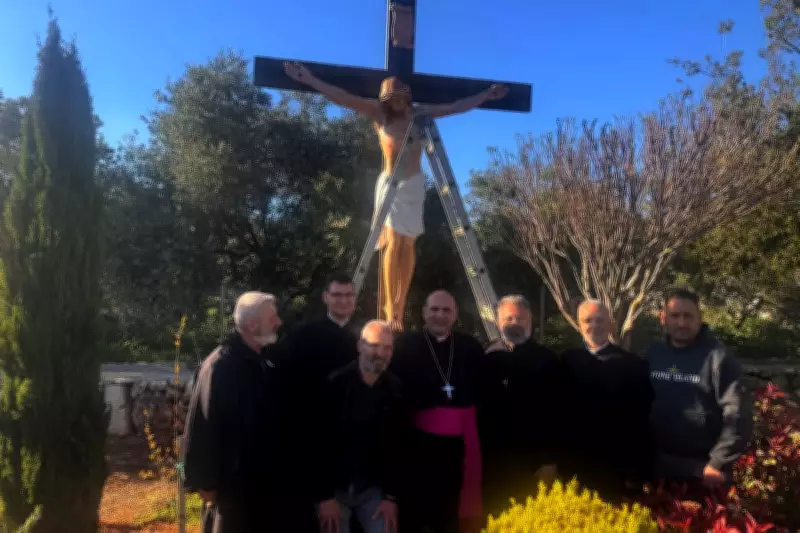
A resident of a Christian village in southern Lebanon says he was shocked to see an Israeli soldier smash a crucifix in his garden. Houssam Naddaf said no words could capture the shock of seeing an Israeli soldier destroy a crucifix in his family’s private garden in the village of Debel — an image he recognized instantly as it spread online.
Background of the Incident
“I saw it on the internet like everyone else,” Naddaf said. He had not been able to visit the house due to movement restrictions imposed by Israeli forces in the area. Israeli forces had taken control of the area as part of the latest Israel-Hezbollah war, which began on March 2 when the Iran-backed Lebanese militant group fired missiles over the border two days after the U.S. and Israel launched their war on Iran. Israel then launched a ground invasion of southern Lebanon and its forces have remained there despite a truce announced last week.
The images of a soldier swinging an ax into a fallen statue of Jesus on the cross in Debel sparked widespread condemnation in Lebanon and internationally. Israel’s military said Tuesday that it had replaced the sculpture, and Naddaf confirmed that the Israeli army brought a similar but smaller crucifix, offered an apology, and installed it in the presence of village priests.

Family’s Decision to Accept Italian Donation
However, Naddaf said his family members, who were not present for that installation, had already been contacted by UN peacekeepers about a crucifix offered by Italy. The family decided to accept the Italian donation — a statue about the same size as the original — and give the Israel-supplied one to a local church instead. The Italian-donated crucifix was erected in a small ceremony Wednesday attended by local priests, residents, UN peacekeepers, and Naddaf with his family. Italian Prime Minister Giorgia Meloni sent a message calling the replaced statue “a powerful message of peace, hope, and dialogue.”
History of the Crucifix
The family had installed the original crucifix in the garden in 2018, part of a shared property that Naddaf and his three brothers divided into four apartments for their families since 2010. Naddaf’s home sits on the edge of Debel, between the village and nearby Rmeish — an area residents consider more exposed than the village center, which is largely outside the main fighting zone. Naddaf moved with his wife and three children to his parents’ home deeper inside Debel when the war reignited on March 2.
Ongoing Occupation and Destruction
Since agreeing to a ceasefire with Hezbollah last week, the Israeli army has been leveling neighborhoods in towns and villages near the Lebanese-Israeli border. The military says it only targets buildings used as outposts by Hezbollah, but in many areas, demolition is almost complete. The wide-scale destruction has Lebanese officials and residents worried that many displaced people will have nowhere to return if the fragile truce holds.
Despite the ceasefire, Naddaf said his family has been barred by the Israeli army from returning to their home. Israeli forces occupy a border strip extending about 10 km into Lebanese territory, describing it as a necessary buffer zone to protect northern towns from Hezbollah rockets. Many Lebanese civilians fear prolonged displacement.
Unlike during the 2024 war, when Naddaf’s family was displaced to Beirut, he said they chose to remain in the village this time. “It was clear that the plan was expulsion, so we say good thing we didn’t leave this time,” he said. Upon visiting his home during the crucifix installation, escorted by UN peacekeepers, he found a “total mess,” though he was grateful the house was still standing, unlike several nearby homes that were demolished.