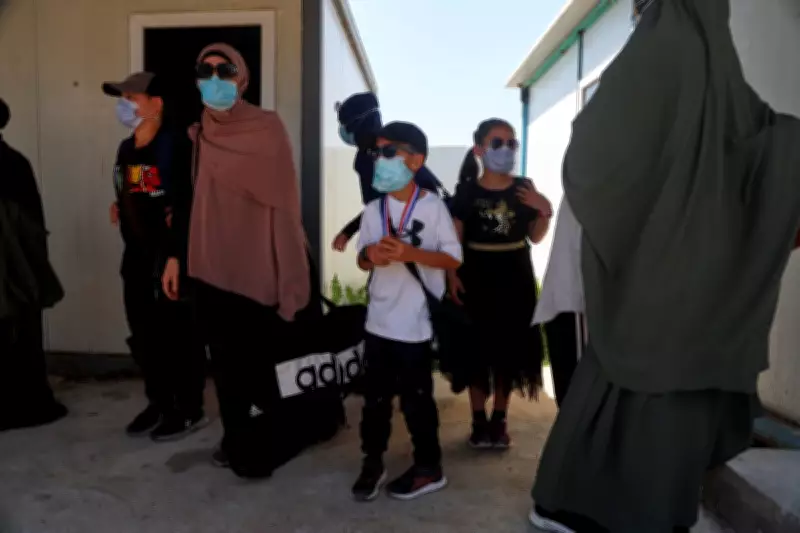
Four Australian families have departed a camp in Syria that houses individuals with alleged ties to Islamic State militants, marking a renewed effort to return to Australia, officials confirmed on Friday.
Departure from Roj Camp
Associated Press journalists observed 13 women and children leaving the Roj camp, a remote facility near the Iraqi border, aboard a bus escorted by Syrian government officials. The camp is known for holding family members of suspected IS militants.
Lana Hussein, an official from the Women’s Protection Units of the Kurdish-led Syrian Democratic Forces (SDF), which oversees camp security, stated that the departure was coordinated with the central government in Damascus. She indicated that the families would remain in Damascus for approximately 72 hours before being deported under security protocols.

Requests for comment from the Syrian foreign ministry and the Australian government went unanswered.
Previous Attempt and Challenges
A prior effort to repatriate 34 women and children from the camp in February was halted when Syrian authorities turned them back. At that time, Australian authorities declined to repatriate the families, and the government later issued a temporary exclusion order barring one woman from returning.
It remains unclear whether the Australian government was involved in coordinating Friday’s attempt.
The Roj camp is situated in northeastern Syria, an area under the control of the Kurdish-led SDF. However, the Australians had planned to depart via Damascus.
Camp officials previously noted that the February repatriation efforts were organized by family members rather than Australian authorities.
Broader Context
Former Islamic State fighters from various nations, along with their wives and children, have been held in camps and detention centers in northeastern Syria since the militant group lost its territorial control in 2019. Despite its defeat, IS retains sleeper cells capable of launching deadly attacks in Syria and Iraq.
The larger al-Hol camp has since been closed, and thousands of suspected IS militants were transferred to Iraq by the U.S. military for trial. These developments followed clashes in January between government forces and the SDF, during which government forces seized significant territory. The chaos led to numerous detainees fleeing al-Hol and some prisoners escaping from a detention center.
Australian governments have previously repatriated Australian women and children from Syrian detention camps on two occasions, while other Australians have returned without official assistance.
Associated Press writer Abby Sewell in Beirut contributed to this report.