

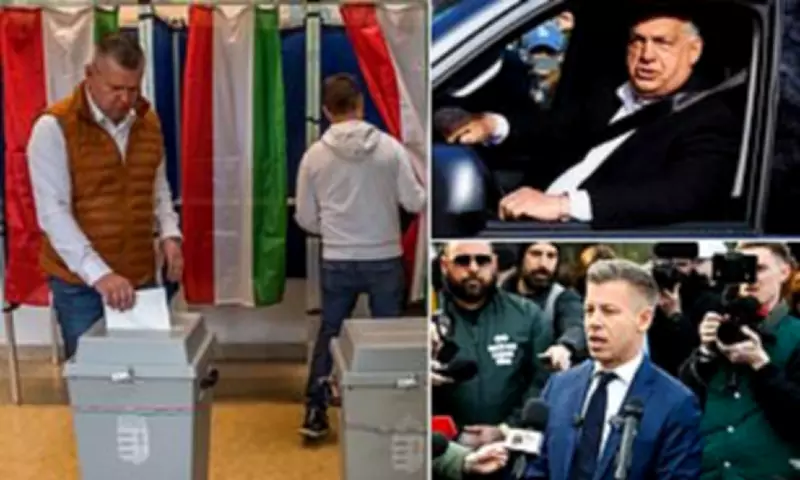
Hungarians Cast Ballots in Pivotal Election That Could Topple Orban
Hungarians are participating in a crucial election today, which may mark the conclusion of Viktor Orban's 16-year tenure as prime minister. Polling stations opened at 6am local time and will close at 7pm, with early data indicating an unprecedented voter engagement.
Record Turnout Signals High Stakes
After the initial five hours of voting, the National Election Office reported a remarkable 66% turnout, significantly surpassing the 2022 election figures where 900,000 fewer ballots had been cast by 3pm. This surge in participation underscores the election's critical importance for Hungary's future direction.
Orban's Controversial Legacy Under Scrutiny
Viktor Orban, Europe's longest-serving leader and a staunch critic of the European Union, has governed Hungary with an authoritarian approach for over a decade and a half. His administration has implemented severe restrictions on minority rights and media freedoms, undermined institutional integrity, and faced allegations of diverting public funds to allied business elites—claims he consistently denies.

Orban's relationship with the EU has been notably strained, as he frequently employs Hungary's veto power to obstruct key bloc decisions. Most recently, he blocked a €90 billion EU loan to Ukraine, drawing accusations from partners of sabotaging essential aid efforts.
Peter Magyar Emerges as Formidable Challenger
The primary opposition figure is Peter Magyar, leader of the centre-right Tisza party, which currently leads in independent polls. Magyar, a 45-year-old former insider of Orban's Fidesz party who defected in 2024, has focused his campaign on issues resonating with ordinary citizens, including deteriorating public healthcare, transportation systems, and pervasive government corruption.
Magyar has framed the election as a "referendum" on Hungary's geopolitical alignment, questioning whether the country will continue its drift toward Russia under Orban or rejoin Europe's democratic community. After casting his vote, he emphasized the choice as one between "East or West, propaganda or honest public discourse, corruption or clean public life," urging all eligible Hungarians to participate.
Structural Advantages and Electoral Challenges
Despite Magyar's momentum, Orban retains significant advantages. His control over Hungary's public media, transformed into a partisan outlet, and extensive influence in private media sectors provide a powerful platform for disseminating his message. Additionally, electoral reforms and gerrymandering implemented by Fidesz necessitate that Tisza secure approximately 5% more votes than Orban's party to achieve a simple parliamentary majority.
Furthermore, hundreds of thousands of ethnic Hungarians residing in neighbouring countries, who traditionally support Orban, are eligible to vote, potentially bolstering his position.
Allegations of Interference and Fraud
The election has been marred by accusations of external meddling and internal irregularities. Both Fidesz and Tisza have established platforms to report electoral abuses, each accusing the other of planning misconduct. Reports from outlets like The Washington Post suggest Russian secret services have attempted to influence the outcome in Orban's favour, while Orban himself has alleged that Ukraine and EU allies are interfering to install a pro-Ukraine government.
International Implications and Observers
This election is being closely monitored across Europe and beyond, reflecting Orban's prominent role in global far-right populist movements. Within the EU, many view Orban as a threat to the bloc's cohesion and hope for a Magyar-led government to foster better cooperation. Internationally, figures like former US President Donald Trump and Vice President JD Vance have expressed support for Orban, with Vance recently visiting Hungary to bolster his campaign.
As voting continues, the outcome will not only determine Hungary's domestic policies but also significantly impact its international relationships and the broader European political landscape.






