Massive Anti-Government Concert Draws Over 100,000 in Budapest Ahead of Elections
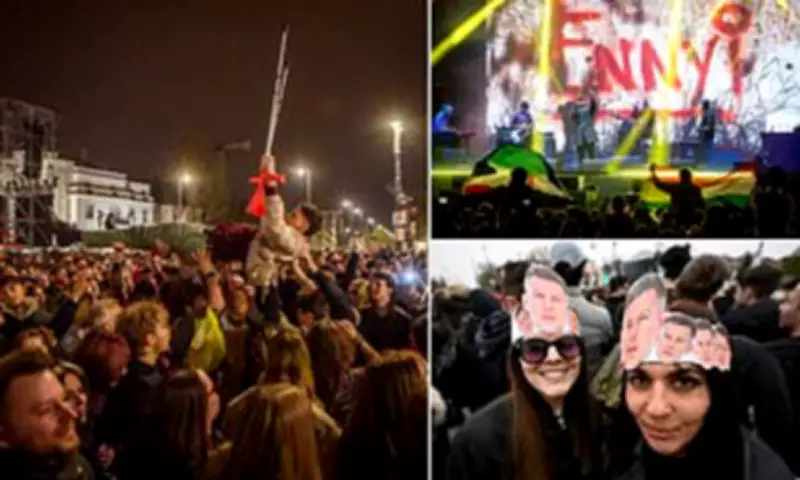
More than 100,000 people converged on Budapest's Heroes' Square on Friday for a monumental concert urging citizens to vote out Prime Minister Viktor Orban in the upcoming elections. The event, organised by the Civic Resistance Movement and dubbed the 'Demolition of the System' concert, featured over 50 bands and spanned seven hours, with each performer delivering a song critical of Orban's nationalist-populist government.
A Youthful Crowd Voices Dissent with Historic Chants
The crowd, predominantly composed of young people, frequently erupted into anti-government chants, including the powerful cry of 'Ruszkik haza!' or 'Russians go home!' This refrain, harking back to Hungary's 1956 anti-Soviet revolution, has gained renewed significance as Orban has cultivated increasingly close ties with Moscow. The concert's timing was strategic, occurring just two days before Hungary's pivotal national elections.
One attendee, 19-year-old Helena Sugar, articulated the dual appeal of the event. 'I listen to these performers every day. But now the most important thing here is the political goal,' she stated. 'I think it is important to show how many of us think this way, how many of us think that the time for this system is over, and it is time for us to change.'

Organisers and Performers Amplify Calls for Regime Change
The Civic Resistance Movement, the group behind the event, declared that each song performed was 'critical of the corrupt regime' and aimed to 'demonstrate to the masses of voters and make them realise that the era of impunity is over.' The massive turnout and fervent anti-government atmosphere in Heroes' Square underscored a broad and deep-seated dissatisfaction with Orban's administration, particularly among Hungary's younger generation.
In addition to the immense physical crowd, more than 100,000 viewers followed the event via livestream online, amplifying its reach and message. This reflects a widening generational divide in Hungary, with youth overwhelmingly pushing for an end to Orban's autocratic rule, while older citizens largely remain loyal to the prime minister.
Political Context: Economic Woes and a Rising Opposition
Orban and his Fidesz party are facing declining popularity amid economic stagnation, a series of political and corruption scandals, and the emergence of a formidable new opposition challenger. The centre-right Tisza party, led by Peter Magyar, has galvanised significant numbers of voters across Hungary, posing the most serious threat to Orban's 16-year grip on power in nearly two decades.
A recent survey by the 21 Research Centre pollster revealed stark generational voting intentions: 65% of voters under 30 support Tisza, compared to just 14% backing Orban. This sentiment was palpable at the concert, where many attendees wore hats featuring opposition leader Peter Magyar.
Noel Ivan, a 22-year-old concertgoer who had immigrated to Austria, expressed a desire for change. 'I would like to move back and plan the future at home, which is currently hopeless and deeply sad,' he said, adding that he intends to 'contribute to regime change by voting for the Tisza party.'
Artists Voice Frustration and a European Vision
Friday's lineup included some of Hungary's most popular acts, such as singer Azahriah, rappers Beton.Hofi and Krubi, and alternative rock bands Quimby and Ivan and the Parasol. Benedek Szabo, frontman of the band Galaxisok, told The Associated Press that Hungary's deepening connections with Moscow equate to 'selling out the EU allies to Russia.'
'Everyone's fed up, and everyone's ready to finally change this system, to finally send a message,' Szabo asserted. 'Not only today, but the day after tomorrow, that we've had enough, and we want to belong to Europe.' Galaxisok performed a song lamenting what they view as missed opportunities and wasted years under Orban's rule.

The concert served as a powerful visual and auditory manifestation of the political unrest simmering in Hungary, with symbols of dissent on full display, including placards depicting Orban and Russian President Vladimir Putin as a Matryoshka doll. As the nation heads to the polls, this massive gathering has unequivocally signalled a potent demand for political transformation.