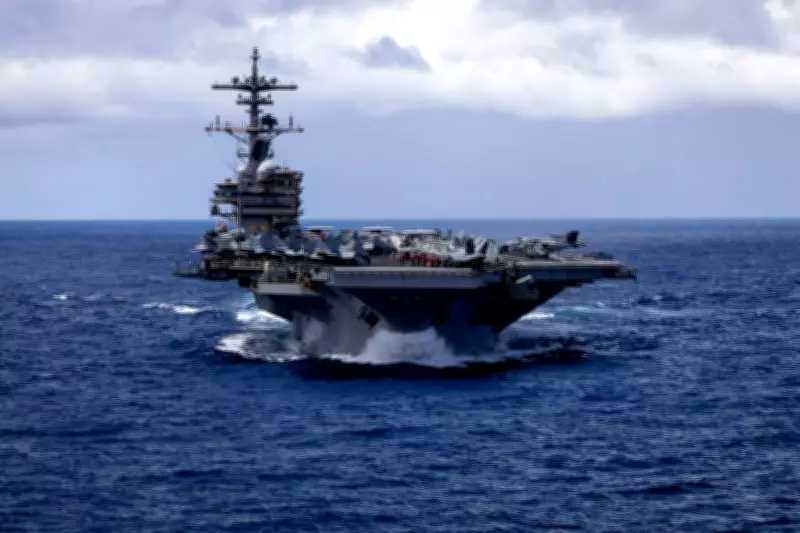
A third US aircraft carrier arrived in the Middle East on Thursday as Washington and Tehran continue to vie for leverage over the Strait of Hormuz, complicating efforts to end the ongoing conflict.
USS George H.W. Bush Joins Growing US Naval Presence
The USS George H.W. Bush, escorted by a strike group of warships, reached US Central Command’s area of responsibility in the Indian Ocean. This deployment represents a renewed show of force as the US maintains its blockade of Iranian ports and vessels.
The arrival of the 1,092-foot supercarrier, along with thousands of personnel and dozens of fighter jets, bolsters a growing US military presence in the region. Uncertainty surrounds the prospect of peace talks to end the conflict with Iran, now approaching its ninth week.

Timeline of Deployments
The carrier was deployed to the region at the end of March, a week before the formal ceasefire was announced, to join the USS Gerald R. Ford and USS Abraham Lincoln. It remains unclear what role the Bush will play, with Trump now committed to an indefinite ceasefire extension until a long-term peace deal can be brokered with Iran.
Blockade and Stalled Talks
Many US ships in the region are upholding a blockade on Iranian imports and exports, an issue Iran says is preventing it from sitting down for talks. Asked on Thursday how long he was willing to wait for a deal with Iran, Trump said: "Don't rush me."
He suggested Iran might have loaded up their weaponry “a little bit” during the two-week ceasefire, but added that the US military could knock that out in about one day. “Their navy is gone. Their air force is gone, their anti-aircraft is gone ... maybe they loaded up a little bit during the two-week hiatus, but we'll knock that out about one day, if they did,” Trump added.
Iranian Naval Capabilities
Washington claims to have destroyed more than 150 Iranian naval vessels over the last two months. Iran’s military and paramilitary forces continue to use so-called ‘fast attack boats’ - light, armed speedboats designed to swarm targets - as part of a layered system of threats. These are complemented by shore-based missiles, drones, mines, and electronic interference to “create uncertainty and slow decision making,” according to Greek maritime security company Diapolous.
Iran was estimated to have hundreds, if not thousands, of these boats before the war, often hidden in coastal tunnels, naval bases, or among civilian vessels, according to maritime security specialists.
Shipping and Economic Impact
Despite the continued Iranian blockade on shipping, Hapag-Lloyd, a German international shipping company, said on Friday that one of its ships had crossed the Strait of Hormuz. A spokesperson said they did not have any information on the circumstances or timing.
Global stock markets faltered and oil prices remained above $100 a barrel on Friday, as fears of a renewed military escalation kept investors on edge heading into the weekend.