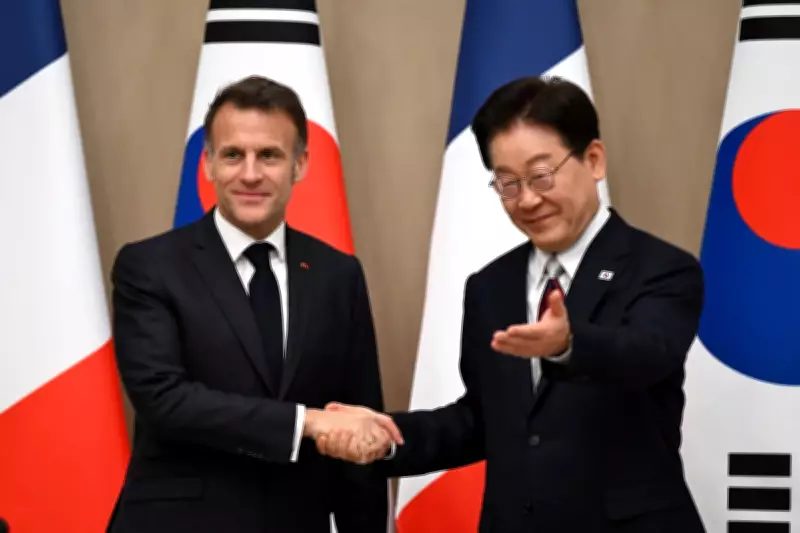
France and South Korea Unite to Tackle Strait of Hormuz Crisis
In a significant diplomatic move, French President Emmanuel Macron and South Korean President Lee Jae Myung have announced a joint initiative to help reopen the Strait of Hormuz. This agreement, forged during Macron's first visit to South Korea since 2017, aims to mitigate global economic uncertainties stemming from the ongoing war in the Middle East.
Summit in Seoul Addresses Global Shipping Concerns
The leaders convened in Seoul as part of Macron's Asian tour, which included a stop in Japan. At the outset of their meeting, Macron emphasized that both nations could play a pivotal role in stabilizing the Middle East, particularly focusing on the strategic Strait of Hormuz. South Korean media reported this statement, highlighting the urgency of the situation.
During a joint televised briefing, Macron stressed the necessity for Franco-South Korean cooperation to de-escalate regional hostilities and facilitate the strait's reopening. President Lee echoed this sentiment, affirming their shared commitment to securing safe shipping routes through the critical waterway. However, neither leader provided specific details on the methods or strategies they plan to employ.

Strategic Waterway and Economic Implications
The Strait of Hormuz, a narrow passage between Iran and Oman, is a vital conduit for global oil transport, handling approximately one-fifth of the world's supply. Its closure or disruption has far-reaching consequences for international markets, making this collaboration a high-stakes endeavor. The leaders' agreement comes amid heightened tensions, with U.S. President Donald Trump criticizing allies for insufficient support in the U.S. and Israeli conflict against Iran.
In a recent speech, Trump expressed frustration, suggesting that countries reliant on the strait, such as South Korea and Japan, should take the lead in securing it, rather than the United States. He inaccurately cited 45,000 U.S. troops in South Korea, whereas the actual number is around 28,000, deployed primarily to deter North Korean aggression.
Expanding Bilateral Cooperation Beyond the Strait
Beyond the immediate focus on the Strait of Hormuz, Macron and Lee agreed to enhance cooperation in technology, energy, and other sectors. Officials from both countries signed agreements to collaborate on nuclear fuel supply chains, jointly invest in an offshore wind project in southern South Korea, and work together on critical minerals. These initiatives underscore a broader strategic partnership aimed at fostering innovation and energy security.
Macron has previously dismissed the feasibility of a military operation to reopen the strait, advocating for diplomatic solutions instead. South Korean officials have clarified that they are in communication with Washington on the issue and are not considering paying transit fees to Iran for fuel shipments, reinforcing a stance of principled engagement.
This Franco-South Korean alliance represents a concerted effort to address one of the world's most pressing geopolitical challenges, balancing economic interests with regional stability in a volatile global landscape.