

The discovery of ancient ceramic fragments near a site long associated with the biblical story of Noah's Ark has sparked fresh debate about the legend's historical roots. Archaeologists say the find points to significant human activity in the region during the timeframe traditionally linked to the Great Flood.
A Discovery on the Slopes of Mount Ararat
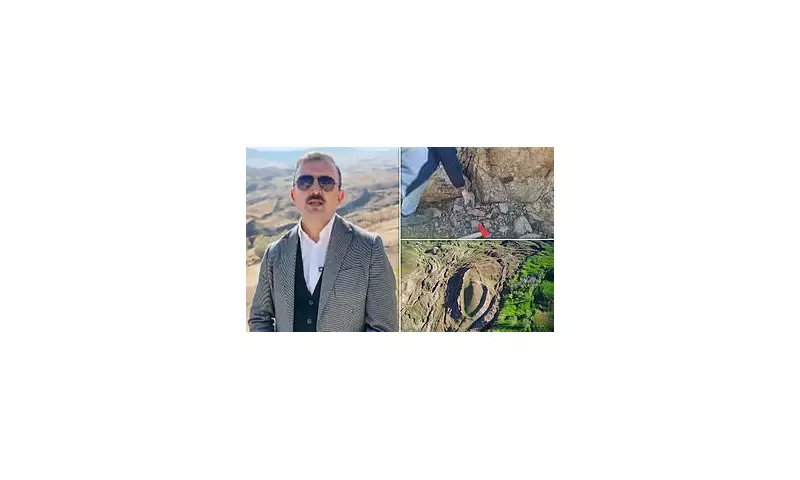
The pottery pieces were unearthed during road construction work close to the Durupinar Formation in Agri province, eastern Turkey. This distinctive, boat-shaped geological structure has been at the heart of Noah's Ark claims for over six decades. According to reports in Turkish media, Prof. Dr Faruk Kaya of Agri Ibrahim Cecen University stated the fragments were found near the alleged outline of the Ark at the Dogubayazit site on Mount Ararat.
Analysis by academics involved in the research dates the ceramic material to the Chalcolithic period, between approximately 5500 BC and 3000 BC. Prof. Dr Kaya confirmed, 'The ceramic fragments show that there was human activity in this region during the Chalcolithic period.' This timeframe is notable as it broadly aligns with the era in which the prophet Noah is believed to have lived, according to some scholarly and religious traditions.

The Durupinar Formation: A Site of Enduring Fascination
The site's modern story began on 11th September 1959, when Turkish survey engineer Captain Ilhan Durupinar first identified the formation from an aircraft. Subsequent heavy rains and earthquakes eroded the surrounding earth, making its boat-like outline more pronounced. Its proximity to Mount Ararat—the peak named in the Book of Genesis as the resting place of the Ark—has fuelled speculation for centuries.
Biblical descriptions give the Ark's dimensions as 300 cubits long, 50 wide, and 30 high. Some researchers argue these measurements correspond roughly to the scale of the Durupinar site, adding to its intrigue. In 2022, the Mount Ararat and Noah's Ark Research Team was formally established, combining expertise from Agri Ibrahim Cecen University and Istanbul Technical University to study the area with geophysical and geoarchaeological methods.
Preservation Concerns and Calls for Protection
This new discovery has intensified calls for the site to be formally protected. Prof. Dr Kaya issued a stark warning about the impact of tourists and natural erosion. 'This formation and its surroundings must be protected, and the removal of stones, rocks or similar material from the site must be prevented,' he urged. He reported that visitors have been taking stones, some with markings, as souvenirs, potentially damaging what researchers consider a vital archaeological and religious heritage location.
Beyond human interference, the professor highlighted natural threats, noting that landslides, particularly during spring rains, are eroding the formation's sides. As part of a preservation solution, he suggested establishing a dedicated Noah's Ark museum or research centre near Mount Ararat, citing similar themed attractions in countries like the United States and the Netherlands.
Scientific Scrutiny and Scholarly Skepticism
While the find is significant to archaeologists—as ceramics are a clear indicator of human settlement—many scholars remain cautious about linking it directly to the biblical narrative. Past claims, such as a 2010 expedition that reported finding 4,800-year-old wood on the mountain, have been met with scepticism from the wider academic community.
Critics like Nicholas Purcell, a lecturer in ancient history at Oxford University, have previously dismissed such claims, questioning how a global flood of the described magnitude could leave no corroborating geological evidence worldwide while ancient civilisations continued uninterrupted. Nonetheless, for the researchers on the ground, the pottery provides tangible proof that the region was inhabited during the key period, adding a new layer to one of history's most enduring mysteries.






