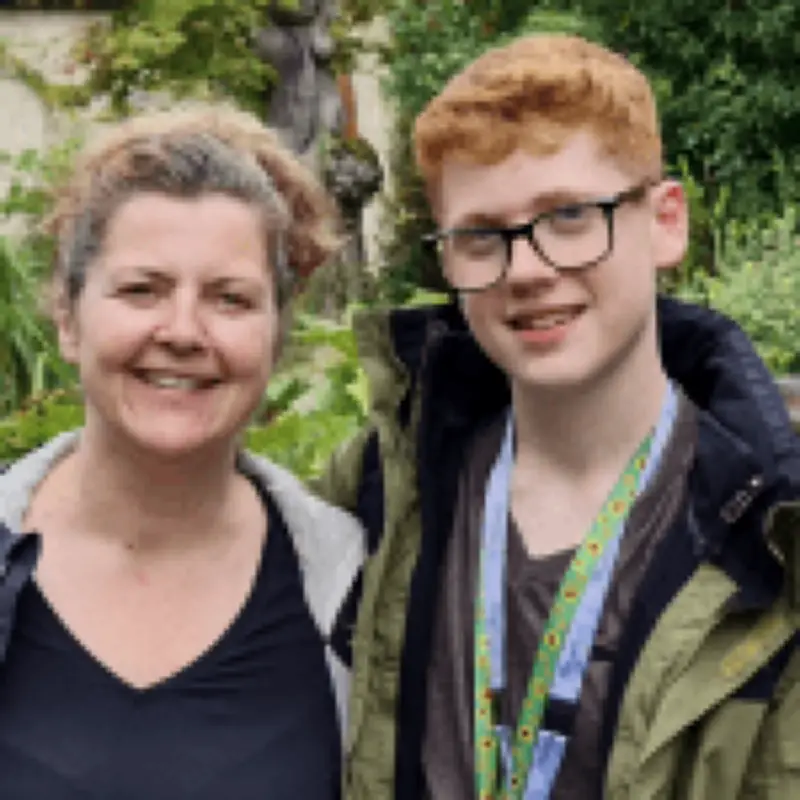
When Sophie Muir's son Calvin was a baby, she instinctively knew something wasn't right. 'He wasn't babbling like my eldest son had,' she remembers. 'It was frustration more than anything – and for both of us. I was constantly wondering, “Is he hungry? Is he thirsty?” and he just couldn't tell me.'
A Long Road to Answers
After reaching the 12-month milestone and still struggling to talk, Sophie decided to take Calvin to her GP to find out what was causing the delay. 'From then on, it was just appointment after appointment,' she tells Metro. As Calvin's development continued to fall further behind and Sophie and her husband Nick were constantly told 'we don't know' by doctors, the family was left searching for answers as their son endured endless tests, hospital visits and uncertainty.
Desperate to communicate with her little boy, Sophie even taught herself and her family the sign language Makaton after watching the children's programme Something Special, with Mr Tumble. 'We used to sit and watch it together and learn the signs,' she remembers. 'It was life changing. Suddenly he could tell us what he needed.'

'By the time Calvin started nursery, I made sure he had support from someone who could sign. The school even taught the other children. I've got videos of them all signing together – it was amazing.'
Extensive Testing
Calvin underwent extensive testing for genetic, neurodevelopmental disorders including Fragile X, the most common inherited cause of learning disabilities, and Angelman syndrome – but still no answers came. 'He had physio, speech therapy, neurology appointments – everything,' Sophie, who lives in Gloucestershire recalls. 'I was a mechanical engineer and had to give up work because there were just too many meetings and I didn't feel like I could keep asking for time off.'
Meanwhile, her little boy still continued to struggle. 'It was hard watching our youngest son Henry overtake Calvin,' says Sophie. 'They're best buddies and he helps with Calvin's speech, but he's four years younger, so it was still difficult.'
Eventually, Calvin's speech slowly began to develop with intensive therapy. 'It was very gradual. He'd say a word once and then never say it again,' his mum remembers. 'I remember “butterfly”, and then nothing. But slowly over time he began putting two or three words together, which was really sweet.'
A Breakthrough in Research
When he was six, Sophie convinced their doctors to enrol Calvin in the Deciphering Developmental Disorders study, a nationwide research initiative that uses advanced genetic technology to diagnose children with severe, undiagnosed developmental disorders. After four years of being in the study, tests revealed a change in Calvin's CACNA1C gene – which is critical for brain development – but doctors still weren't able to confirm whether it was what was causing his symptoms. 'To be told “we've found something, but it doesn't really count”, was a strange place to be in,' Sophie says.
Taking Matters into Their Own Hands
Unwilling to accept a life of uncertainty, Sophie began looking for answers herself and even travelled with Calvin to the US. Meanwhile Calvin also received cardiac testing, where he had a matchstick sized device called a loop recorder implanted just under his skin to monitor his heart, as the gene is known to be linked to a condition called Long QT Syndrome. At the same time, she started doing her own research into his neurological symptoms, including delayed speech, intellectual disability and hypotonia (low muscle tone). 'I'm trained in mechanical engineering – this is not what I thought I'd be doing. But if you don't know what is going on, you can't advocate for your child,' she explains.
Trawling the internet, Sophie discovered that the CACNA1C gene was linked with a rare, life-threatening genetic disorder called Timothy syndrome, so got in touch with genetic researcher Katherine Timothy, who was among the first to identify this disorder. Soon, Sophie discovered there were other families like hers whose children had variants found in the CACNA1C gene. 'I found another person in the world with the exact same genetic change as Calvin – that was my 'N equals two', when things started to shift,' she remembers.

In 2017, Sophie decided to join another study called Imagine ID, working with researchers in Cardiff. Armed with fresh knowledge from all the people she'd spoken to about CACNA1C and Timothy syndrome, Sophie pushed for a reclassification of her son's condition. Even so, it was still an excruciatingly slow process that took another five years for Calvin to finally be diagnosed with a pathogenic (disease causing) variant of the syndrome. 'It was a relief,' admits Sophie, 'but also, I knew I was right. It had taken so much work to prove it.'
What is the CACNA1C Gene?
The CACNA1C gene provides instructions for a protein that controls the flow of calcium into cells. Variants can disrupt this process, potentially leading to serious conditions including heart problems, developmental delay and neurological issues. For more information, you can visit the Timothy Syndrome Alliance here.
One Step at a Time
Over time, Calvin has learned to form short phrases and now at 18, the teenager uses visual aids to help him communicate. 'His expressive language is still delayed,' Sophie adds. 'He uses picture cards and routines as it just makes life easier for him.' Calvin has also since been diagnosed with apraxia of speech, a condition affecting the brain's ability to plan speech movements.
Looking back, Sophie admits that there were times when Calvin's condition impacted family life. 'Sometimes his brother struggled and we couldn't do what other families did,' she explains. 'Going to the cinema or out for meals just wasn't possible.' Despite this, she says Calvin's two brothers have grown into compassionate, supportive individuals. 'They're amazing with him. I think it's made them more understanding of other people's needs,' says the boys' mum.
Today, Calvin attends a specialist college where he works outdoors on a farm, which he 'loves' says Sophie. 'He helps with animals, collects eggs, works with fish – it's the most amazing place.' But his condition still affects daily life. 'He's quite vulnerable. He doesn't understand danger. I wouldn't let him cross the road alone.' And now that Calvin is legally an adult, the family faces new challenges. 'We're having to look at capacity assessments because he doesn't understand things like online safety,' she explains. 'That's a whole new world to navigate.'
Sophie also admits that there were times when she also struggled and felt incredibly lonely. 'I used to cry in the shower,' she remembers. 'It was the only place you could hide the tears.'
Founding a Charity
Feeling isolated in her battle to find out what was wrong with her son, in 2019, she founded the Timothy Syndrome Alliance bringing together families affected by CACNA1C-Related Disorders. At the time, only 43 people living with the condition were known worldwide. Today, the charity supports more than 250 families across 43 countries. 'We're finding a new family every week,' says Sophie, who adds that while her son's future remains uncertain, her focus is clear. 'I don't think too far ahead. There are too many unknowns – but I want families to know they're not alone,' she says. 'There's a huge comfort in speaking to someone who understands. 'This isn't what I planned in life, but I can see we're making a difference – and that means everything.'