Archaeologists have made a landmark discovery in Ireland, unearthing what is now considered the largest clustered village from prehistoric times ever found in Britain and Ireland. The site, located in County Wicklow, shows evidence of continuous habitation and monumental construction over millennia.
A Settlement of Unprecedented Scale
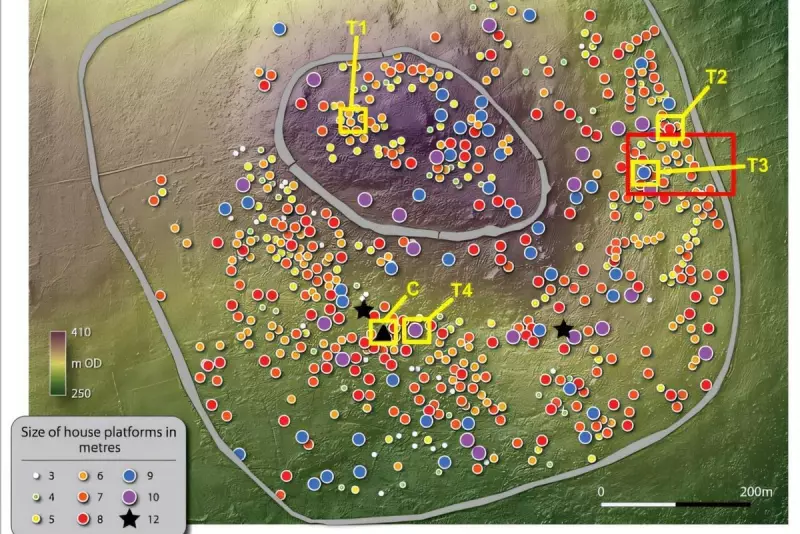
The discovery centres on the Baltinglass hillfort cluster, an area at the south-western edge of the Wicklow Mountains featuring up to 13 large hilltop enclosures. Within this cluster lies the Brusselstown Ring, a unique structure with two widely spaced ramparts. Airborne surveys suggest this enclosure once contained over 600 suspected house platforms.
Researchers from the University of Cambridge state that 98 of these platforms were inside the inner enclosure, with a further 509 located between the inner and outer walls. This dwarfs the previous largest known settlement, Mullaghfarna in County Sligo, which had an estimated 150 houses. The Brusselstown Ring site shows signs of use from the Early Neolithic right through to the Bronze Age, between 3700 and 800 BC, with the dense village emerging around 1200 BC.

Insights into Late Bronze Age Life
Lead researcher Cherie Edwards, whose study was published in the journal Antiquity, explained that excavation trenches were strategically placed over house platforms of varying sizes to understand social structures. The settlement dates definitively to the Late Bronze Age and Early Iron Age (1193–410 BC) and is classified as a nucleated site due to its high density of dwellings.
One of the most intriguing finds was a unique structure near a trench, with a flat interior outlined by large stones. As previous surveys indicated a stream once flowed into it from uphill, scientists hypothesise it could be a Bronze and Iron Age water cistern. If confirmed, this would be the first such feature discovered within an Irish hillfort, though more research is needed to understand it fully.
Rewriting the Timeline of Urban Development
The scale and complexity of this prehistoric village have significant implications for our understanding of early urbanisation in Northern Europe. The findings indicate that early city development in this region likely began nearly 500 years earlier than historians previously believed.
Dr Edwards notes that the site's abandonment followed a broader regional pattern of gradual decline during the Iron Age, around the third century BC. Interestingly, this decline appears unrelated to the climatic shift toward cooler, wetter conditions that began around 750 BC during the Bronze Age–Iron Age transition. The discovery of the Brusselstown Ring settlement fundamentally reshapes our perception of social complexity and settlement patterns in prehistoric Britain and Ireland.