
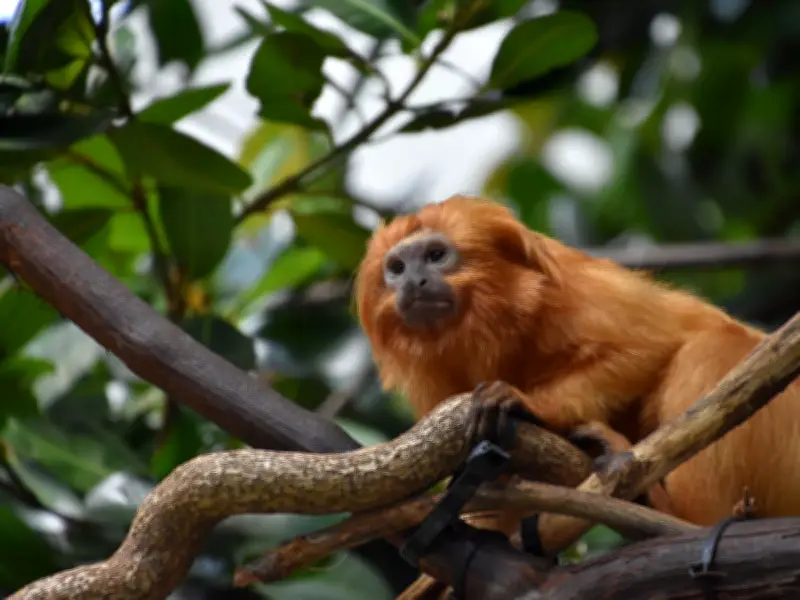
Wild monkeys in the Amazon have been discovered harbouring a lethal human illness for the first time - an alarming find that scientists believe is probably driven by civilisation encroaching further into the rainforest.
A collaborative research team from the University of Salford in the UK and Brazil's Federal University of Amazonas discovered the hepatitis B virus in blood and liver specimens from 88 'new world' primates across 28 species.
The results demonstrate evidence of human-to-monkey transmission in zones most affected by deforestation and urban expansion.
In Brazil's Rondonia and Mato Grosso states - areas where woodland has been extensively cleared, and settlements border the forest edge - 17 of 49 monkeys tested positive for hepatitis B virus (HBV), with the genetic markers matching the strains circulating amongst local residents.
Nevertheless, in an isolated section of the upper Japurá River, deep within Amazonas state, none of the 39 monkeys sampled tested positive for infection.
The difference, researchers argue, serves as a warning sign: the nearer humans venture to wildlife, the greater the likelihood we exchange diseases - with ramifications neither party is prepared for.
Amazon Deforestation Drives Human-to-Monkey Disease Transmission
HBV targets the liver and can trigger cirrhosis and cancer in humans. It usually transmits through blood and certain other bodily fluids, not casual interaction, which makes the jump into wild primates even more baffling. The research, published in the journal EcoHealth, marks the first study of its kind to report HBV in New World primates, which are found in Central and South America, sparking pressing concerns about its origins and future implications.
Principal investigator Professor Jean Boubli, from the University of Salford, explained that the transmission pathway remains enigmatic.
"As yet, it is very hard to ascertain," he stated, observing that human-to-human transmission typically occurs through blood or particular bodily fluids.
One credible route involves the area's flourishing pet industry: young monkeys are occasionally housed as companions, potentially becoming infected, before being freed or discarded when they mature and become more challenging to manage.
How Hepatitis B is Jumping from Humans to Wild Primates
Geography presents another element: urban centres and communities now border woodland margins, establishing continuous interaction points that simply weren't present on this scale previously.
Deforestation, Boubli cautions, represents the "number one threat". As forests disappear and highways carve through previously undisturbed environments, humans, farm animals and wild creatures are channelled into identical areas, increasing the likelihood of inter-species transmission.
The researchers suggest that preventing deforestation and establishing protective zones between communities and natural woodlands would help minimise dangerous encounters, offering both creatures and humans a better chance of remaining well.
At present, no one knows whether the infected primates are unwell. The creatures don't display clear clinical symptoms in their natural habitat, but considering how severe HBV can prove for people and apes, researchers worry there might be concealed damage.
The research demands cautious, ethical monitoring in captivity to determine whether HBV triggers disease in New World primates, how grave it could become, and whether it reduces survival chances when creatures are released back into the wild.
Demonstrating primate-to-primate transmission, though, will prove far more challenging, both morally and logistically, particularly if the required circumstances cannot be safely or realistically recreated.
Public Health Risks and the Future of Amazon Ecosystems
There's additionally a broader public health worry. Throughout the Amazon, Indigenous communities and local populations are estimated to eat around three million primates for sustenance.
For millennia, those groups were small and comparatively isolated, with minimal disruption to the woodland.
Currently, the situation has changed: millions of arrivals, growing settlements, and a continuous movement of individuals and merchandise are introducing fresh microorganisms into the area - and potentially establishing new pathways for pathogens to transfer between species.
This doesn't suggest a new pandemic is imminent, but it is a clear warning that human activity is transforming disease threats in the planet's most extensive rainforest.




