
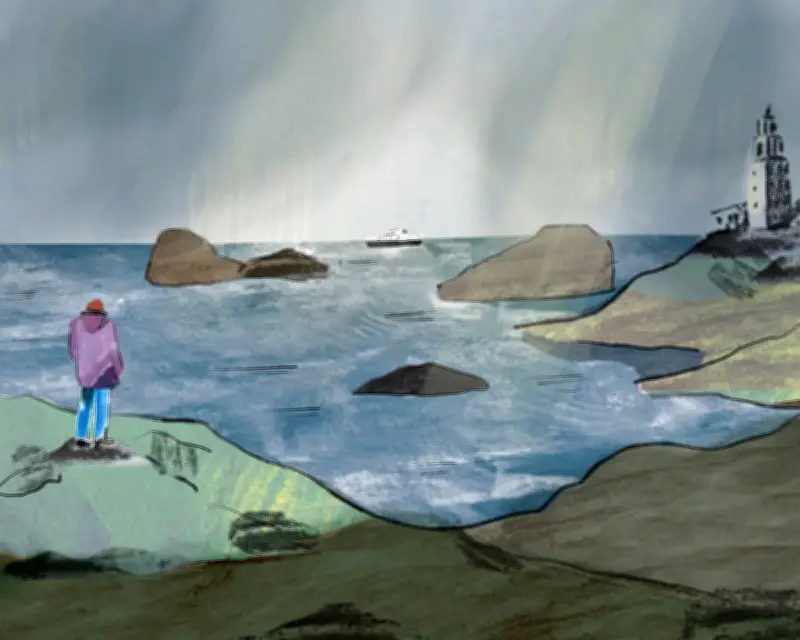
Illustration: Danielle Rhoda/The Guardian
After losing both my parents, I realised what I needed: the total isolation of a Hebridean island. Graham Snowdon explains how complete solitude may not be for everyone, but walking the windswept Harris hills by himself gave him the space to contemplate a difficult year.
Sitting in a remote cabin earlier this year on the Hebridean isle of Harris, watching the fishing boats come and go in the little harbour, I felt the fog of the previous months finally beginning to clear. I kept thinking back to a cold November night, returning from Leeds to south London, when I finally admitted to myself that something needed to change.
I was exhausted from the long, frequent and often unrewarding round trips to visit my mum. At her care home in Leeds that autumn day, I had tried the usual tricks to summon a reaction from her – news of the grandkids, or re-reading poems and songs she’d written in her days as a primary school headteacher. But for the most part, she remained still and silent.
A nurse at the care home had asked me to remove Mum’s wedding rings before her fingers swelled further. “This doesn’t mean you’re not still married,” I whispered as I eased them off. “Don’t say it so loudly,” she shot back under her breath. Those small glimpses of her sparky old self would remind me she was still listening to every word.
Last July my dad passed away, soon after being diagnosed with liver cancer. As my sisters and I arranged the funeral and tried to set Mum up in the hope she could remain at home, she suddenly lost the ability to walk. We thought at first it might be a grief reaction, but a hospital scan revealed a brain tumour. Mum went directly into palliative care, too ill to attend Dad’s funeral.
None of us live close to Leeds, so the rest of the year became a blur of weekly train dashes and service station dinners. These were melancholic times for me but I also found unexpected solace in the journeys. On motorway drives, I called old friends. I relistened to long-forgotten albums, soundtracks from growing up in 1980s Leeds. I was alone with my thoughts in a way that I began to see was unusual for me.
What I realised that November night was that I needed to carve out some proper time to myself. I’m not someone who finds that easy – there’s always work to think about, or a middle-aged men’s football game to organise, or some job to do around the house. But at that moment, after the loss of Dad and in the midst of Mum’s illness, I felt overwhelmed. I knew I needed to go somewhere where I could try to process things properly.
Mum passed away in early January and once the funeral was over, I found a perfect-looking cabin on Harris and booked it for two weeks. It seemed suitably distant from normality – and I hoped the empty, lunar landscapes might help me clear my head.
The 700-mile, 20-hour drive up was an adventure in itself. I had coffee with my cousin at Leeming Bar services on the A1 – possibly one of the grimmest places on Earth – but my faith in beauty was restored while driving over spectacular Bowes Moor in the North Pennines. I hiked up Cat Bells in Keswick, had curry with an old friend in Cockermouth, video-called my family over breakfast from the banks of Loch Lomond.
On Harris I squelched over the boggy but insanely beautiful moorlands and embraced the madcap Atlantic weather, which flipped constantly from driving rain to dazzling sunshine. Wandering through rugged, boulder-strewn hills and jet black lochans, I thought about everything and nothing: memories of my parents and their dignified, meaningful lives, and the new shape of my own life without them. For the first time in months, it felt like I wasn’t reacting to a crisis; I was just remembering.
Some of my happiest days were when the rain piled in sideways and I was forced to stay indoors. I’d made worthy plans for such occasions, having lugged along a doorstep-like Dostoevsky novel. What I actually achieved was to almost finish a Christmas jigsaw while working my way through Mojo magazine’s 100 greatest albums of all time (a mostly rewarding experience, though I advise skipping Captain Beefheart’s Trout Mask Replica). But that was more than fine.
There was so little going on in my small world that I sometimes found myself seeking out conversation in strange places. I bombarded the friendly local fishers with questions as they unloaded their catch and came away with a big bag of langoustines. Another time I drove 50 miles for a sauna on a pitch-dark beach, where some bemused local ladies cajoled me into the freezing sea. I went to a pub quiz by myself (predictably finishing last) and had some lovely conversations at the bar about the highs and lows of island life. But mostly I tried to embrace the solitude. On Sundays everything closed, but nearly everything was shut for the winter anyway.
There were also times when I was definitely out of my comfort zone. One day, alone in the middle of nowhere, I sank up to my knees in a bog and then it started hailing ferociously into my face. That was a long, damp trek back.
I know I’m lucky to have two wonderful sisters with whom I’ve shared the load of the past year. There is also the luxury of having older children who don’t need me around so much any more. But from my wooden cabin on Harris, alone except for an unread Dostoevsky, I found a peace of mind that I’d hoped for. Graham Snowdon is the editor of Guardian Weekly.




