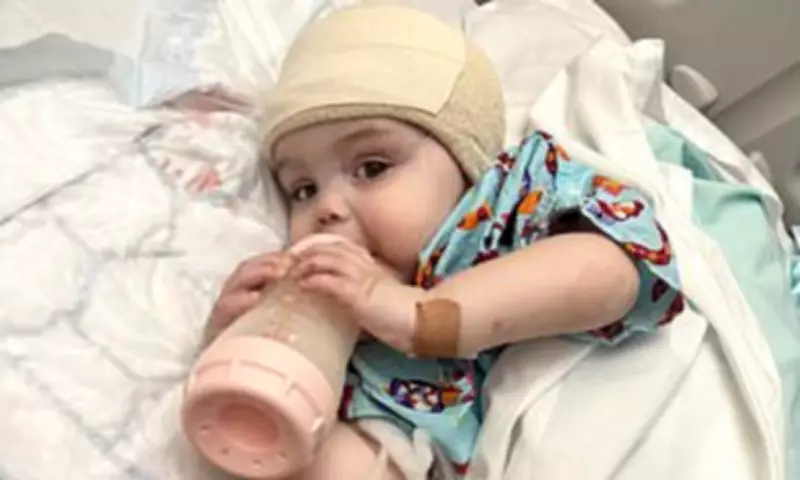
A baby was left to battle an aggressive brain tumour after doctors repeatedly misdiagnosed her persistent vomiting as tonsillitis. Nancy Dakin, now three years old, began suffering from constant sickness and tremors when she was just 12 months old in September 2023.
Her parents, Gemma and Sam Dakin, from Castle Donington, Leicestershire, took their daughter to doctors who attributed the symptoms to a common childhood illness. However, when antibiotics failed and Nancy's condition deteriorated markedly, she was finally referred to the Royal Derby Hospital.
Ms Dakin, 33, who sensed something was 'seriously wrong', described how Nancy began regressing completely. Her complexion turned pale, grey, and lifeless, and she lost the ability to sit up, crawl, walk, and speak properly. A neurological assessment eventually revealed a large tumour in her left frontal lobe, diagnosed as a grade 3 ependymoma—a rare and aggressive form of brain cancer.

'Nancy is our little whirlwind,' Ms Dakin said. 'She's cheeky, funny, and completely full of life. This all started with vomiting that just wouldn't go away.' Initially told it was tonsillitis, Nancy was given antibiotics but only grew worse. 'She developed tremors in her arm and became pale and lifeless. It felt like she was slipping away, and I knew something was seriously wrong.'
At A&E, Ms Dakin felt dismissed but refused to leave. 'I know my child, and I knew this wasn't just a sickness bug or dehydration. Watching her get worse while not being listened to was both terrifying and frustrating.'
The family was devastated to learn that surgery might not be possible due to the tumour's size. 'We were told to prepare for the worst and make her comfortable. In that moment, our whole world came crashing down,' Ms Dakin recalled.
That same night, Nancy was transferred to Queen's Medical Centre (QMC) in Nottingham, where specialists placed her on fluids, IV morphine, and steroids to reduce swelling. A neurosurgeon explained that the tumour had not overtaken her brain and outlined a surgical plan, giving the family hope for the first time.
Nancy underwent two procedures: the first removed 95 per cent of the tumour, and a second, a week later, removed the remainder to avoid any risk to mobility. In December 2023, when she was 15 months old, she began high-dose chemotherapy to ensure the cancer was eradicated.
'The treatment was extremely challenging,' Ms Dakin said. 'She wasn't able to get out of her cot and play while the chemotherapy was running. It made her very poorly, drowsy, and constantly sick. She began to associate sickness with food and stopped eating altogether, leading to an NG tube for feeding.'
During treatment, Nancy also had one of her ovaries removed and preserved to mitigate chemotherapy's potential impact on future fertility. Ms Dakin called it an 'incredibly difficult decision' but one that would give Nancy 'the best chance for the future.' After the operation, Nancy was in severe pain and inconsolable, even with medication. 'As parents, all you want to do is take their pain away, but we couldn't, and that was the hardest part,' Ms Dakin said.
On January 6, 2025, Nancy completed chemotherapy and rang the bell to celebrate being declared cancer-free. She continues to have regular follow-up scans to monitor her condition.
The Dakin family is now sharing Nancy's story to raise awareness of brain tumour symptoms in children and to support Brain Tumour Research. Ms Dakin is also taking on the '200k in May Your Way' challenge to raise funds for research. 'I learned that brain tumour research receives the least funding of all cancer types, yet it kills more children than leukaemia. If sharing our story helps even one family, it will be worth it,' she said.
Ashley McWilliams, community development manager at Brain Tumour Research, commented: 'Nancy's story highlights how easily brain tumour symptoms in children can be mistaken for more common illnesses, leading to delays in diagnosis. The strength shown by Nancy and her family is truly inspiring.'