UK's First Geothermal Power Plant Launches in Cornwall
Cornwall's picturesque landscape, once famed for its lucrative mining industry, is now the site of a groundbreaking renewable energy project. From today, the United Downs deep geothermal plant, situated near Redruth, will commence operations, producing clean electricity continuously, 24 hours a day. This marks Britain's first foray into geothermal power generation on a commercial scale.
How the Geothermal Plant Operates
Developed by Geothermal Engineering Ltd (GEL), the project harnesses heat from an underground reservoir located more than three miles (5.2 km) beneath the surface. Water is drawn from this reservoir, reaching temperatures of approximately 190°C (374°F) upon surfacing. This hot water is then channeled through a heat exchanger to create steam, which drives an electric turbine to generate electricity. After use, the water is reinjected into the ground via a second well, where it percolates through natural rock fractures and eventually replenishes the reservoir.
The system offers a remarkably efficient and consistent power source, operating effectively for about 96 percent of the year, regardless of weather conditions. This makes it a highly reliable alternative to other renewables like solar and wind, which are often intermittent.

Earthquake Concerns and Safety Measures
Despite its advantages, the project has raised concerns about induced seismicity, or minor earthquakes, resulting from the drilling and water injection processes. During drilling in 2020, GEL recorded 15 mini-quakes with magnitudes up to 1.5, causing nearby residents to report rattling windows and sounds akin to thunderstorms. Similarly, a geothermal project at the Eden Project in Cornwall was temporarily halted in 2022 after triggering a magnitude 1.6 tremor.
Ryan Law, CEO of GEL, explained to the Daily Mail that these tremors occur because water lubricates tiny fractures in the rock, causing them to slip. However, he emphasized that the UK's stable geological conditions, unlike tectonically active zones like the San Andreas Fault, pose no significant danger. Dr. Alison Monaghan, Head of Geothermal at the British Geological Survey, noted that while small tremors were observed during construction, they are unlikely to be felt once the plant is operational.
Benefits of Geothermal Energy in Cornwall
Cornwall offers unique advantages for geothermal power, primarily due to its geology and historical research. The region's granite-rich subsurface generates substantial heat, providing a nearly limitless thermal energy source when tapped through deep drilling. Additionally, groundwork from the 1980s fuel price crisis laid the foundation for this project, facilitating its development.
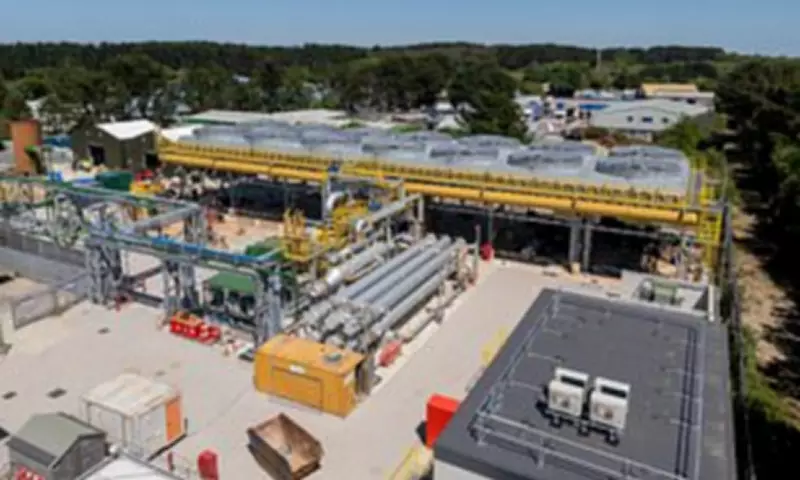
Unlike sprawling solar or wind farms, the United Downs plant occupies only 6,000 square metres (1.5 acres), making it a compact yet powerful energy solution. Its ability to produce electricity continuously is crucial for meeting rising demands from data centres, electric vehicles, and industrial applications, supporting the UK's net-zero goals.
Lithium Extraction as a Valuable Byproduct
An unexpected benefit of the project is the discovery of high lithium concentrations in the extracted water. With levels around 360 parts per million—twice that of some European sites—the water is ideal for lithium extraction after cooling to 60°C (140°F). This byproduct can be processed for use in electric vehicle batteries, adding economic value to the energy generation.
GEL has secured £1.8 million in government funding for critical minerals and an electricity contract at £119 per megawatt-hour. The company plans to expand with two additional combined lithium-power projects in Cornwall, aiming to meet half of the UK's lithium demand within a decade. By 2030, these sites could produce up to 20,000 tonnes of lithium carbonate annually, enough for 250,000 electric vehicles.

Future Prospects and Economic Impact
Colin Walker, Head of Transport at the Energy and Climate Intelligence Unit, highlighted this project as a model for net-zero-driven economic growth, creating jobs and boosting the UK economy. With potential for local lithium mining, refining, and battery production, geothermal power could foster a sustainable industrial chain across regions like Cornwall, Teesside, Somerset, and the West Midlands.
Despite seismic concerns, the positives of geothermal power—such as its reliability, minimal land use, and lithium extraction potential—are seen as outweighing the risks of minor tremors. As Britain embraces this innovative energy source, the United Downs plant sets a precedent for future geothermal developments, contributing to a greener and more resilient energy grid.