
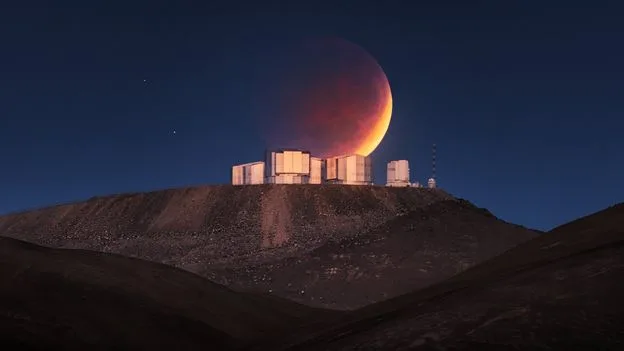
Chile's Atacama Desert, one of the darkest places on Earth, is under threat from encroaching artificial light. Astronomers who flock to this remote region for its unparalleled night sky are now fighting to preserve the view. 'There are very few places on Earth with these conditions,' says Itziar de Gregorio-Monsalvo, a senior astrophysicist with the European Southern Observatory.
From Paranal, an astronomical base in the desert, the Milky Way appears as a pale white stripe and the Magellanic clouds – two dwarf galaxies – are visible to the naked eye. In contrast, from London, artificial glow obscures all but the brightest stars. The irony is captured by Lord Byron's apocalyptic poem 'Darkness', written 200 years ago, which feared a world without light; today, the opposite problem prevails.
Every year, artificial light from nearby cities, industrial complexes and mining operations creeps closer to Paranal. Globally, around 80% of Earth's population lives under light-polluted skies, and a recent study found that the sky brightened by almost 10% per year between 2011 and 2022. A person who could see 250 stars at the start of the period would only see 100 by the end.
Psychologists warn that disappearing stars could worsen mental wellbeing by removing a long-standing human connection to nature. Ecologists note that artificial light disrupts ecosystems by tricking animals into believing it is daytime. Some researchers argue that excess light should be classified as a 'hard' pollutant, alongside chemical pollution of air or water.
Astronomers first sounded the alarm in the 1970s when San Francisco's lights clouded California observatories. They predicted that a 10% increase in night-sky brightness above natural levels would severely impact ground-based astronomy. By 2022, two-thirds of the world's major telescopes had already surpassed that threshold.
What is at stake is our understanding of the Universe itself. If the Atacama Desert's skies become too bright, one of the last untainted windows to the cosmos will be lost.




