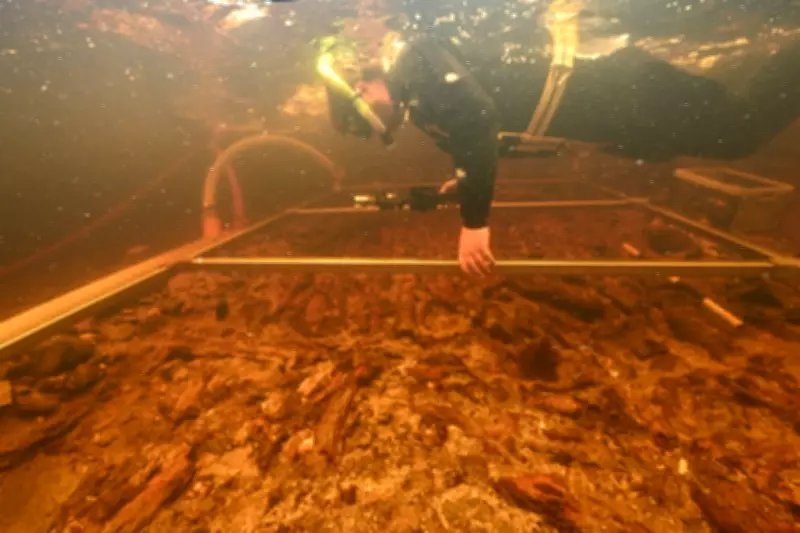
Archaeologists have unearthed a substantial timber platform concealed beneath a stone artificial island, known as a crannog, in Loch Bhorgastail on the Isle of Lewis, Scotland. This remarkable structure predates Stonehenge, with initial construction occurring over 5,000 years ago during the Neolithic period, around 3500 to 3300 BC. Subsequent additions were made in the Middle Bronze Age and Iron Age, indicating prolonged use and modification.
Uncovering the Hidden Structure
Researchers from the University of Southampton and the University of Reading employed a combination of excavation, radiocarbon dating, and innovative stereophotogrammetry to reveal the crannog's hidden details and its developmental phases. The discovery of a coherent, large timber base, along with numerous Neolithic pottery fragments, points to the existence of complex ancient communities capable of significant engineering feats in Scotland.
Innovative Survey Technique
A novel technique for shallow-water photogrammetry was developed during the fieldwork, utilizing two waterproof cameras mounted on a frame to accurately map the submerged sections of the crannog. This method allowed the team to create precise three-dimensional models of the underwater structure, providing insights into its construction and evolution over millennia.

The findings challenge previous assumptions about the technological capabilities of Neolithic societies in the region, suggesting a high level of organization and skill in timber construction and water-based infrastructure. The platform's preservation offers a unique window into prehistoric life and engineering practices in the British Isles.