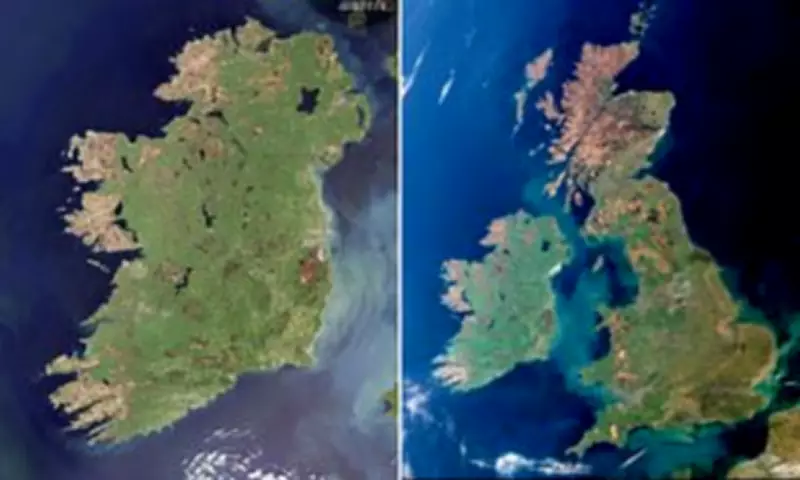
It is often called the Emerald Isle, and a stunning new satellite photo confirms that Ireland truly lives up to its green reputation. The image was captured by one of the Copernicus Sentinel-3 satellites as it passed over the island on 29 April 2026. Remarkably, Ireland appears entirely cloud-free in this incredibly rare snapshot.
An Exceptional View of Ireland
'This rare cloud-free image of Ireland, acquired by one of the Copernicus Sentinel-3 satellites on 29 April 2026, provides an exceptional view of the island, revealing its surface in full spring detail,' Copernicus explained. The photo highlights bright green tones dominating the landscape, indicating widespread vegetation growth. Along the eastern seaboard, milky turquoise waters are visible, suggesting suspended sediments.
Comparison with Previous Images
The image comes one year after Copernicus captured a rare cloud-free satellite photo of Britain. The EU's Copernicus Sentinel satellites are designed to monitor Earth, with Sentinel-3 specifically used for sea and land observation. 'Sentinel-3 is a multi-instrument mission to measure sea-surface topography, sea- and land-surface temperature, ocean colour and land colour with high-end accuracy and reliability,' the European Space Agency explains. 'The mission supports ocean forecasting systems, as well as environmental and climate monitoring.'

Details of the Image
In the latest snapshot, Ireland is seen in all its glory. 'Across the island, bright green tones dominate, indicating widespread vegetation growth associated with mild temperatures and ample moisture typical of the season,' Copernicus noted. 'The central plains appear as a continuous agricultural mosaic, while darker upland areas suggest thinner vegetation cover and more exposed terrain. Along the eastern seaboard, milky turquoise plumes indicate suspended sediments in coastal waters, shaped by river outflows and marine currents.'
Public Reaction
The photo has been featured as Copernicus' Image of the Day and has attracted attention on social media. 'Good catch! Cloud free is indeed rare,' one viewer wrote on Facebook. Another added: 'Also visible is the plumes of smoke on the Mourne Mountains in the North East of the country, these were sadly the fires that caused such devastation to plant and wildlife during this recent dry spell.'
About the Copernicus Sentinel-3 Satellite
Sentinel-3 is primarily an ocean study mission, developed by the European Space Agency (ESA) as part of the Copernicus Programme. However, it also provides data on the atmosphere and land masses. Sentinel-3A was launched on 16 February 2016, with its twin, Sentinel-3B, arriving in orbit on 25 April 2018. The two satellites orbit 506 miles (815 km) above Earth on opposite sides of the planet.
The multi-billion Copernicus programme aims to help predict weather phenomena such as El Niño and track global warming. Its data can assist shipping companies in charting efficient routes and monitor forest fires, water pollution, and oil spills. The project is described by ESA as the most ambitious Earth observation programme to date, with funding of over €8 billion (£7.12 billion / $9.8 billion) committed until 2020.
Sentinel-3 uses multiple sensing instruments, including the Sea and Land Surface Temperature Radiometer (SLSTR), Ocean and Land Colour Instrument (OLCI), SAR Altimeter (SRAL), Doppler Orbitography and Radiopositioning Integrated by Satellite (DORIS), and a Microwave Radiometer (MWR).