Across the United States in 2025, public spaces became canvases for dissent as a wave of powerful and provocative protest art brought visual force to political movements. From the National Mall in Washington DC to the streets of Minneapolis and Los Angeles, murals, statues, and performance installations provided a focal point for collective action on a range of issues, including the conflict in Gaza, immigration policy, and demands for social justice.
Symbols of Dissent: Statues and Sculptures on the National Mall
Some of the most striking imagery emerged in the nation's capital. On 23 September, a controversial statue linking former President Donald Trump and the late financier Jeffrey Epstein was erected on the National Mall, a bold piece designed to provoke conversation about power and accountability. Earlier, on 15 October, an ice sculpture placed on the Mall served as a potent, transient metaphor for what protesters termed 'melting democracy', its inevitable disappearance mirroring concerns over eroding democratic norms.
Other visual protests in Washington DC included Banksy-style posters appearing in Georgetown on 31 August, which depicted a protester throwing a sandwich at commentator Pete Hegseth. Furthermore, an emergency rally on 27 August saw demonstrators gather to protest an Israeli airstrike in Gaza that reportedly killed journalists and health workers.

Memorials and Human Art: Personalising Political Struggle
Beyond the capital, protest art took deeply personal and communal forms. In Minneapolis, Minnesota, the fifth anniversary of George Floyd's death on 25 May was marked by 'The Say Their Names' cemetery, a temporary installation created by two University of Pennsylvania students near George Floyd Square. Leesa Kelly, founder of Memorialize the Movement, was also present at Phelps Field Park that day, underscoring the ongoing fight for racial justice.
On both coasts, human bodies became the medium for powerful messages. In San Francisco on 14 June, participants at Ocean Beach formed a massive human banner during the 'No Kings' protests. Meanwhile, in Los Angeles on 17 July, a performance art installation titled 'The Disappeared/Los Desaparecidos' used actors to depict individuals sent to El Salvador's Cecot prison, highlighting international human rights concerns.
Targets of Protest: From ICE to the Supreme Court
Immigration and enforcement agencies were a repeated focus for artistic critique. In Los Angeles, an art installation on 17 July depicted people taken by Immigration and Customs Enforcement (ICE). This was followed by a press conference on 8 September after the US Supreme Court cleared the way for sweeping immigration operations to continue. Weekly vigils continued, such as the 24th 'Bearing Witness' demonstration at the Burlington, Massachusetts ICE facility on 1 October.
Other specific grievances were visualised, such as in San Juan, Puerto Rico, where protest art on 6 August referenced the Financial Oversight and Management Board and the island's ongoing energy crisis. In Fort Lauderdale, Florida, an LGBTQ+-themed mural created on 25 August was ordered painted over by state officials, itself becoming a symbol of the cultural battles being waged.
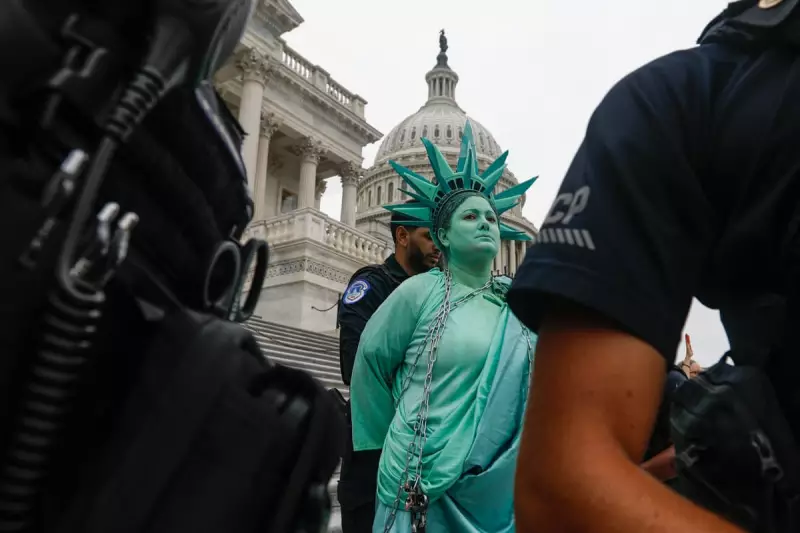
The year also saw direct action intertwined with these artistic expressions. A demonstrator was taken into custody by US Capitol Police during a pro-Palestinian protest in Washington DC on 24 September. Earlier, in New York City's Times Square on 12 April, demonstrators demanded the release of Mahmoud Khalil, while in Los Angeles on 1 May, protesters called for the release of Kilmar Ábrego García.
Together, these images from 2025 chart a year where American protest moved beyond slogans and signs, employing symbolism, satire, and stark memorialisation to challenge authority and galvanise public attention on a host of domestic and international issues.