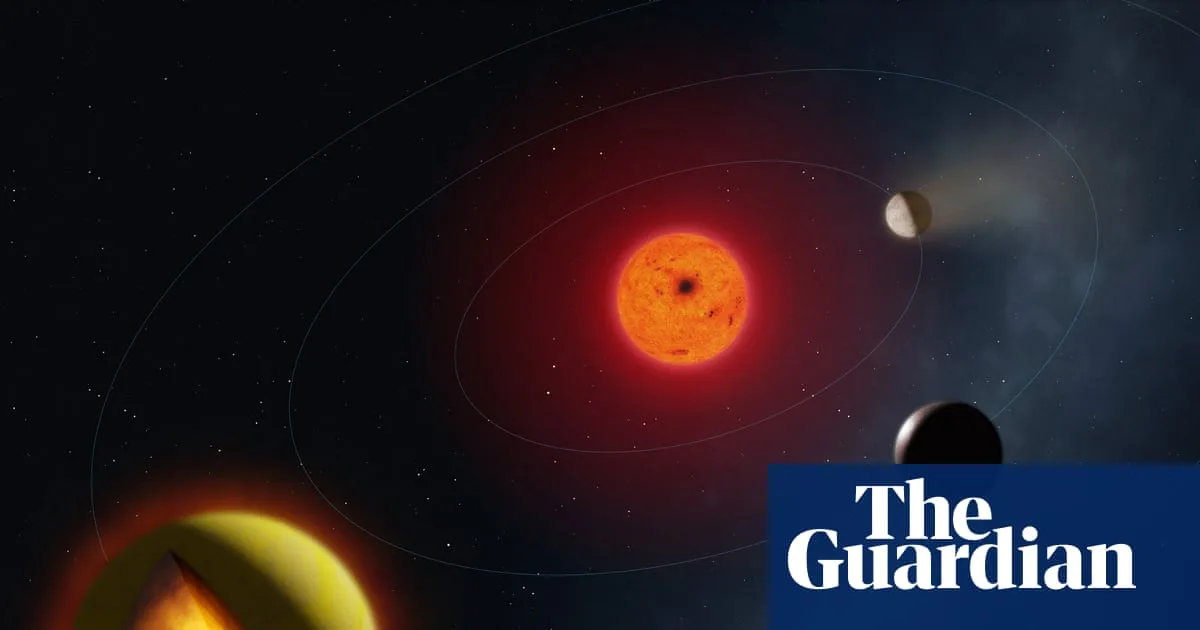
Astronomers have identified a planet composed of molten lava, suggesting the existence of an entirely new category of liquid planet. The distant world, known as L98-59d, is about 1.6 times the size of Earth and orbits a small red star 35 light years away.
Latest observations indicate that the planet is fundamentally different from anything seen before. 'The whole thing really is in a mushy, molten state,' said Dr Harrison Nicholls, an astrophysicist at the University of Oxford. 'It's like molasses. It's likely that this planet's core would also be molten.'
Surface temperatures reach a blazing 1,900C (3,500F), with large waves rolling over the magma ocean due to tidal forces from neighbouring planets. The atmosphere is rich in hydrogen sulphide, giving a pervasive stench of rotten egg. The conditions are not viewed as favourable for hosting life.

Using advanced computer simulations, researchers reconstructed the planet's history, suggesting it has a global magma ocean extending thousands of kilometres beneath its surface, and possibly a molten core. 'You can only really explain this planet if it has this deep magma ocean inside of it,' said Nicholls. 'The magma ocean efficiently stores the gases and keeps them protected from physical processes that would otherwise remove them.'
The findings imply that molten planets may be quite common, and astronomers may need to be more cautious about designating exoplanets as potentially habitable. 'Some planets in the so-called habitable zone might not be very habitable at all, they might be these molten planets,' said Nicholls.