Princess Kate's Strategic Tiara Selection Marks Nigerian State Visit
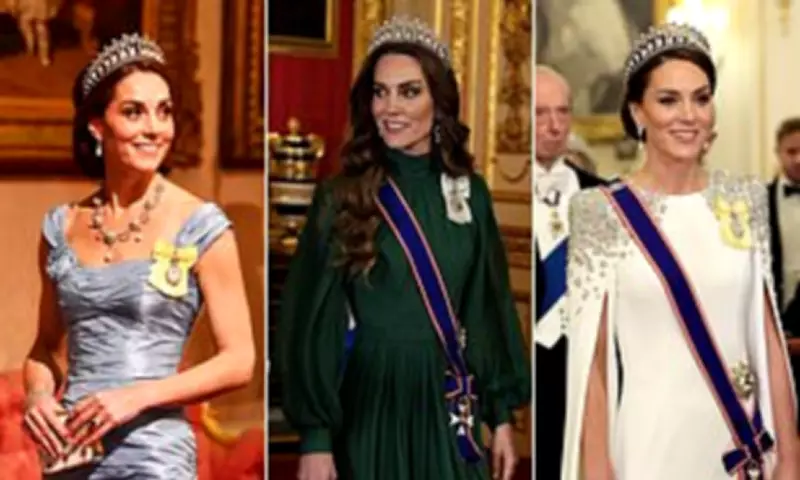
The Princess of Wales made her first tiara appearance of 2026 during the ongoing Nigerian state visit, selecting the Cambridge Lover's Knot tiara in what royal observers have noted as a predictable yet calculated choice. Kate, aged 44, joined the Prince of Wales, King Charles, Queen Camilla, and senior members of the royal family in welcoming Nigeria's President Bola Ahmed Tinubu and First Lady Oluremi Tinubu to Windsor Castle for a glittering state banquet.
A Regal Ensemble with Historical Significance
The future Queen appeared impossibly regal in a flowing green evening gown designed by Andrew Gn, but it was her selection of royal jewels that captured significant attention. Opting for the Cambridge Lover's Knot tiara, Kate chose a stunning heirloom that has been passed through royal generations from Queen Mary to Queen Elizabeth II, then to Princess Diana, and now to her daughter-in-law.
Since her inaugural wearing of the diamond and pearl tiara in 2015, this particular piece has rapidly become a favourite of the Princess of Wales. Remarkably, she has worn the royal jewel fourteen times over the past decade, demonstrating a clear preference for this specific tiara despite having multiple options at her disposal.

Expert Analysis Reveals Practical and Aesthetic Considerations
While Princess Diana once remarked that the tiara's weight gave her headaches, Kate has worn the Lover's Knot with surprising frequency, including twice last year and again in 2023. According to hair expert Tatiana Karelina, this repeated selection is far from accidental.
"The Princess of Wales's repeated choice of the Lover's Knot Tiara is far from accidental," explained Tatiana. "Pieces like this are not only historic jewels, but architectural elements that must harmonise with the wearer's natural proportions and styling preferences."
The expert noted that the tiara's beautifully balanced, slightly curved structure with suspended pearls draws the eye downward, working perfectly with Kate's signature soft volume through the crown and her preference for smooth, polished waves or low chignons.
Practical Elegance and Secure Fitting
Beyond aesthetic considerations, there exists a surprisingly practical reason why this tiara has become a trusted piece for the Princess of Wales. According to Tatiana, Kate's oval head shape with a refined hairline allows the tiara to sit securely without overwhelming her features while creating a regal elongation through her silhouette.
"When a tiara consistently complements both bone structure and styling, it becomes a trusted piece," Tatiana elaborated. "Hairstylists often build discreet internal support, think subtle padding, add expertly made hair toppers, anchoring pins, and precise placement to ensure stability and comfort."
This practical approach explains why Kate, who has four tiaras available to her, repeatedly returns to the Lover's Knot for high-profile occasions where movement and lighting are critical factors.
Historical Journey of a Royal Heirloom
The Lover's Knot tiara possesses a rich history dating back to its creation in 1914 by royal jewellers Garrard to Queen Mary's personal design. Using pearls and diamonds already in her possession, Queen Mary created a copy of a tiara owned by her grandmother, Princess Augusta of Hesse, who married the first Duke of Cambridge in 1818.
Featuring strong French influence with a neoclassical design on nineteen open-work diamond arches, the tiara encloses an oriental pearl drop from a diamond lover's knot bow. Queen Mary utilized existing jewels including her dismantled Some Ladies of England Tiara, pearls from the Girls of Great Britain and Ireland Tiara, and pearls from her favourite brooches to create this bespoke piece.
In her will, Queen Mary left the tiara to Queen Elizabeth II, who wore it frequently throughout her reign. In 1981, the Queen presented it as a wedding gift to Princess Diana, who wore it for the first time at the state opening of parliament that November. Following Diana's tragic death in 1997, the tiara remained in a Buckingham Palace safe until being entrusted to Kate, then the Duchess of Cambridge, in 2015.

Notable Appearances and Royal Protocol
Kate first wore the family jewel on December 8, 2015, when she attended the Queen's annual Diplomatic Reception in a touching tribute to her mother-in-law. Since that initial appearance, the mother-of-three has selected the tiara for numerous significant occasions including the royal wedding of Jordan's Crown Prince Hussein and Princess Rajwa in 2023, the first state banquet of King Charles's reign in 2022, and during former US president Donald Trump's state visit last year.
Tiaras are typically loaned to royals for their entire lifetime, with Kate's collection also including the Lotus Flower, the Strathmore Rose, and the Cartier Halo tiara. Interestingly, while the Lover's Knot receives significantly more use than other tiaras in the royal vault, the Cartier Halo has not been seen publicly since Kate's wedding day in 2011.
A Glittering State Banquet Setting
The Princess of Wales presented a picture of elegance as she shared a toast with the Nigerian president during the state banquet hosted by King Charles. Demonstrating the best of British hospitality, Kate smiled warmly while seated between the president and another member of his entourage.
Other royals contributed to the dazzling display, with the Prince of Wales wearing white tie with the Windsor tailcoat and his Most Noble Order of the Garter Sash with the 'Lesser George.' Queen Camilla sported a cream embroidered gown by Fiona Clare accompanied by a sapphire and diamond tiara with matching earrings, both pieces belonging to Queen Elizabeth II and given to her by her late father, George VI, as a wedding gift.
King Charles wore a blinding array of diamond-studded orders as he led the procession into the banquet hall and delivered a speech. President Bola Ahmed Tinubu and First Lady Oluremi Tinubu took their seats among the British royals for the crescendo of their two-day visit.
Royal Gathering and Diplomatic Significance
Running the length of St George's Hall, a 155-foot dining table had been adorned with sweet-smelling spring flowers gathered locally, illuminated by 143 candles. Alongside the King, Queen, Prince, and Princess of Wales, other attending royals included the Princess Royal and her husband Vice Admiral Sir Tim Lawrence, the Duke of Edinburgh, and the Duke and Duchess of Gloucester.
Notable Nigerian guests included author Sir Ben Okri, artist Yinka Shonibare, footballer Eniola Aluko, singer Tiwa Savage, presenter Ade Adepitan, athlete Christine Ohuruogu, and Diana Awards chief Tessie Ojo.
In his speech, King Charles began by wishing his guests "peace, blessings and an abundance of joy" during such a holy month. He highlighted that Nigeria became the UK's biggest export market in Africa this past January and praised the UK's substantial Nigerian diaspora, describing it as a "living bridge of over half a million people who connect our nations... and help make our cultures richer, our shared security stronger and our economies more prosperous."
The King acknowledged that there are "chapters in our shared history that I know have left some painful marks" but emphasized that "history is not merely a record of what was done to us - it is a lesson in how we go forward together to continue building a future rooted in growth and hope for all, and worthy of those who borne the pains of the past." He concluded to cheers with the Nigerian phrase: "Naija No Dey Carry Last" - meaning Nigerians Never Come Last.