The World's Largest Jewelled Egg: A Family's Obsession and Downfall
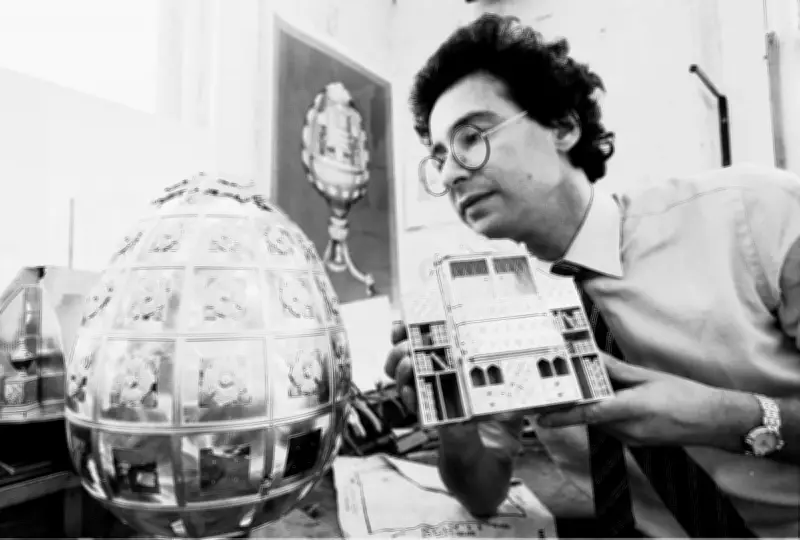
In May 1990, six million viewers watched as chat show host Terry Wogan introduced what he called "the world's biggest golden egg" on BBC Television Centre. The studio audience laughed as Wogan joked, "Seven million pounds, and you can't even eat it." The egg's creator, Paul Kutchinsky, beamed with pride as he showcased his 2-foot-tall masterpiece, adorned with thousands of pink diamonds and featuring a miniature jewelled library inside.
A Dream That Became an Obsession
Paul Kutchinsky's fascination with jewelled artworks began early in his career. Growing up in the family jewellery business, he felt a magnetic pull towards the legendary Carl Fabergé, whose ornate eggs had captivated Russian tsars in the late 19th century. Paul envisioned transforming the House of Kutchinsky by creating one-of-a-kind pieces for the oil-rich Middle East market, a risky move that required vast sums of expensive materials and months of labour.
His father, Jo, was reluctant to endorse this shift, leading to heated arguments and even a physical fight on the shop floor. Despite the tension, Paul pressed forward, driven by a dream that would soon consume his life.

The Birth of the Egg
The first sketch of the egg emerged almost by accident in 1989. Designer Cheryl Prewitt, hired by Paul to bring more women into the business, was doodling an egg with a jewelled library modelled on her parents' bookcase. Paul snatched the drawing, declaring, "We'll make that, Cheryl." The design grew increasingly complex, becoming what Prewitt later described as "a monster."
Paul secured a contract with the Argyle Diamond Mine in Western Australia, which agreed to supply over A$2 million worth of pink diamonds and cover half the manufacturing costs. The egg, officially named the Argyle Library Egg by Kutchinsky, was to be 63cm tall, made of 17,650 grams of 18-carat gold and 700 carats of diamonds. The sale price was set at no less than $5 million, with profits split 60/40 in Argyle's favour.
Family Strains and Financial Pressures
As Paul's obsession deepened, his wife Brenda grew increasingly disquieted. She nicknamed the egg "your father's ego," a sentiment that echoed through their home. Paul's promises of wealth and luxury—a new car, a family holiday, a swimming pool—were met with scepticism. Meanwhile, the financial strain on the business mounted, and Paul began an affair with a sales assistant, further fracturing the family.
Their daughter Serena, then a child, recalls acting up in school, prompting a meeting with her headteacher. When asked if anything had changed at home, no one mentioned the egg, but the tension was palpable. On the drive home, Paul repeated his promises, insisting that their lives would finally start again "after the egg."
The Egg's Public Debut and Global Tour
The egg launched at the Victoria and Albert Museum in London, where Serena sneaked a touch of its cool, hard surface before being chased away by security. It then embarked on a world tour, with stops in Tokyo, Basel, Hamburg, and New York City. In New York, Paul and Brenda flew on Concorde with the egg strapped into its own seat under the name "Mr Egg." Despite media frenzy and appearances on shows like The Today Show, no buyer emerged.
Donald Trump, known for his love of gold bling, showed no interest, and collector Malcolm Forbes died before Paul could pitch to him. The egg's unsold status became a source of humiliation, especially when a Wall Street banker dismissed it as "that old egg from Oz."
Financial Collapse and Personal Tragedy
By 1991, the House of Kutchinsky owed the bank over £1 million. With no sale in sight, the business was sold to a rival jeweller, and Paul was forced out. Almost a century of family history was wiped out. In 2000, Paul died in a Spanish road crash, his obituary making no mention of the egg that had defined his ambitions.
The egg was finally sold in 2002 to a Japanese buyer for ¥800 million (about £4.3 million), with most of the proceeds going to Argyle. It vanished into a bonded warehouse, leaving the family's wounds to fester.

A Daughter's Quest for Closure
Decades later, Serena Kutchinsky embarked on a quest to find the egg, spending money she didn't have on private detectives and consulting experts worldwide. Her search led her to a museum in Tokyo, where the egg was on display after being donated by the Mabuchi family.
There, she learned that the egg's new owners had fixed its faulty mechanics. Takashi Mabuchi, an engineer, had replaced the motor with one bought from a local electronics store for ¥9,500 and restructured the hinges so the doors opened smoothly. Seeing the egg work flawlessly, Serena felt a rush of vindication.
Legacy of a Glittering Folly
Reflecting on her father's creation, Serena acknowledges that the egg became a scapegoat for the family's misfortunes. The House of Kutchinsky's foundations were already shaky, and her parents were pulling in different directions. Yet, the egg remains a testament to Paul's eccentric, audacious ambition—a shimmering symbol of both love and loss.
Today, the egg stands as one of the most valuable artworks made in Britain in the 20th century, its story a poignant reminder of how obsession can both create and destroy.