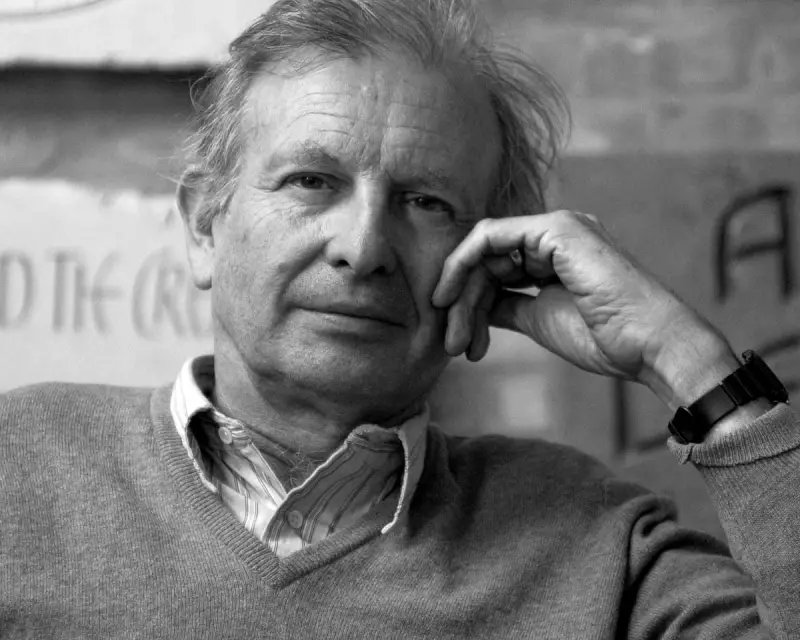
The world of British art and design has lost a towering figure with the death of Richard Kindersley at the age of 86. A master letter cutter, typeface designer, and sculptor, his profound belief in the unique value of handcrafted work left an indelible mark on the nation's architectural landscape.
A Life Dedicated to Craft and Architecture
Born in London on 14 May 1939, Richard Kindersley was the eldest child of the distinguished letter cutter David Kindersley, placing him in the direct lineage of the 20th-century revival of British typography pioneered by Eric Gill. He grew up immersed in stone-carving workshops, receiving a unique education that culminated in a formal apprenticeship with his father at age 21.
Kindersley founded his own studio in Kennington, south London, in 1970, where he worked for the rest of his life. He was a passionate advocate for the special coordination between hand and eye that only manual craftsmanship can achieve. Yet, he was no traditionalist opposed to modern methods; his genius lay in integrating this ancient skill seamlessly with contemporary architecture.

Iconic Public Works and Sculptures
His prolific career saw him collaborate with leading architects on major national projects. In the late 1960s, he began working with Sir William Holford at Exeter University, setting a precedent for thoughtful architectural lettering.
Among his most visible works is the lettering for the 1973 London Bridge and the monumental inscription for the Queen Elizabeth II Bridge at the Dartford Crossing. For the latter, he innovated with hotwire carving of polystyrene to create reverse moulds for concrete letters.
His work can be seen at some of Britain's most sacred and significant sites. Outside St Paul's Cathedral, a seven-metre-long slate and stone floor plan he designed illustrates the building's history. He also created the poignant Dunblane Massacre Standing Stone in Dunblane Cathedral in 2009.
Beyond inscriptions, Kindersley was a gifted sculptor. Notable pieces include the 1980 cast-aluminium totem, The Seven Ages of Man, at Baynard House in London, and the moving 2002 Emigration Stone in Cromarty, which commemorates the Highland Clearances.
A Defining Final Commission: The British Normandy Memorial
Perhaps his most challenging and significant project was his final major commission. Despite the Covid-19 lockdowns and nearing retirement, Kindersley led the creation of all the lettering for the British Normandy Memorial at Ver-sur-Mer in France, completed in 2021.
The memorial, overlooking Gold Beach, bears the names of 22,442 individuals who died during the D-Day landings and the Battle of Normandy. Kindersley selected the limestone and designed a dedicated font. In a pragmatic but difficult compromise, he oversaw the digital machine-cutting of the names for longevity and scale, understanding that hand-cutting them would have taken over a decade.
A revered teacher, he lectured at the City & Guilds of London Art School and for years led student trips to Italy to study classical inscriptions. His deep knowledge of Roman lettering directly informed his modern practice.
Richard Kindersley is survived by his wife, Katherine, three sons, and five grandchildren. His legacy is carved not only in stone and concrete across the UK but in the continued craft of adventurous lettering he helped to nurture.