Discovering the Many Faces of the Arctic
Neil Shea, a seasoned writer for National Geographic, once encountered the surprising claim that the Arctic does not exist as a single place. In his remarkable book Frostlines, he reveals this vast region as a mosaic of diverse landscapes, cultures, and ecosystems spread across eight modern nations. With dozens of languages, tribes, and homelands, Shea argues there is not one Arctic but many, each with its own unique story.
Encounters with Arctic Wildlife
Shea's Arctic odyssey began two decades ago in Canada's Admiralty Inlet, where he witnessed the mesmerizing behavior of narwhals known as "tusking." He describes how these whales thrust their heads above water, bringing their long tusks together in what he calls "a kind of slippery Musketeer salute." Historically, these tusks were mistaken for unicorn horns in medieval European courts, adding a layer of myth to these already mystical creatures.
His recent travels took him to Ellesmere Island in the high Arctic, an area slightly smaller than Great Britain with a human population of only about 200. Here, Shea had extraordinary encounters with Arctic wolves. One pack proved unusually tolerant of human presence, allowing him to get so close he could hear their stomachs rumbling. In a particularly surreal moment, the adult wolves went hunting, leaving Shea to watch over their pups, who howled "like the lost children they are" until their parents returned.

Human Stories in the Frozen North
From Ellesmere, Shea journeyed to King William Island, famed for its connection to Norwegian explorer Roald Amundsen. Amundsen spent winters here in 1903-1904 while searching for the Northwest Passage, learning crucial survival skills from the Inuit who called him "Amusi with the big nose." Shea stayed in Gjoa Haven, a tiny settlement named after Amundsen's ship, where he observed how modern technology like snowmobiles and mobile phones coexists with traditional ways of life.
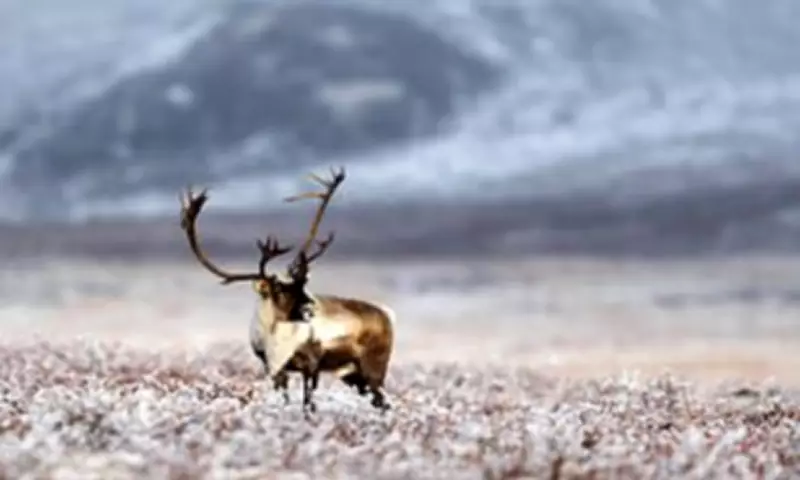
The caribou (known as reindeer in Europe) remains central to many Arctic peoples. Shea witnessed this firsthand with the Tlicho people of Canada's Northwest Territories, who "live at the edge of the greatest wildlife mystery in North America." Caribou numbers are declining across the continent for reasons not fully explained by climate change. When Shea accompanied a group of Tlicho who finally located a small herd after a long search, he noted, "I had never seen the Tlicho happier." An elder named Joe playfully mimicked antlers with splayed fingers as they listened to the caribou's hooves clicking "like castanets."
In Alaska, Shea visited the Nunamiut people, Arctic nomads until 1950, who now live in Anaktuvuk—"place of many caribou droppings." Here he encountered a unique religious mural depicting Jesus riding a caribou through an Arctic landscape, wearing caribou-skin clothing and holding a traditional drum.
Historical Mysteries and Modern Tensions
Greenland's history fascinated Shea, particularly the Norse settlements that lasted from the late tenth century until their mysterious disappearance in the 15th century. He explores the latest theory about their collapse: as elephant ivory from Africa became more available in late medieval Europe, trade in walrus tusks—essential to the Norse economy—declined, leading to isolation and eventual extinction of the settlements. Shea describes an eerie night camping in the ruins of Hvalsey Cathedral, where he mistook a whale's call for a human scream, only to remember that Hvalsey means "Whale Island."
Shea concludes his journeys in Kirkenes, Norway, just six miles from the Russian border. Here he teamed up with an exiled Russian journalist to explore rising tensions, encountering teenage soldiers at checkpoints and learning why even reindeer cannot cross freely between nations.

The Arctic as a Global Bellwether
Throughout his travels, Shea carries the words of Inuit activist Sheila Watt-Cloutier: "What is happening today in the Arctic is the future of the rest of the world." Frostlines serves as both a travelogue and a warning, documenting how climate change, cultural shifts, and geopolitical pressures are transforming this fragile region. Shea's vivid storytelling brings to life the many Arctics—their histories, peoples, wildlife, and uncertain futures—making his book an essential and enjoyable guide to understanding one of Earth's most critical regions.