Lucian Freud's Magical Drawings: The Essential Key to His Major Artistic Works
A groundbreaking new exhibition at the National Portrait Gallery in London is shedding fresh light on the profound significance of Lucian Freud's drawings and etchings within his overall artistic practice. Titled Lucian Freud: Drawing into Painting, the showcase presents 175 paintings and works on paper that demonstrate how drawing served as the vital foundation for Freud's celebrated paintings.
The Transformative Influence of Francis Bacon
In 1951, Freud created three remarkable drawings of fellow artist Francis Bacon during an evening at home. According to biographer William Feaver, Bacon adopted a provocative pose, undoing his trousers and rolling up his sleeves while suggesting Freud should capture this moment. Freud later revealed to Feaver that Bacon's influence prompted a crucial artistic realization.
"I got very impatient with the way I was working. It was limited and a limited vehicle for me," Freud confessed. "I realized that by working in the way I did I couldn't really evolve. The change wasn't perhaps more than one of focus, but it did make it possible for me to approach the whole thing in another way."

Despite Freud's self-critical assessment, the three line drawings of Bacon display extraordinary precision and fluidity that contradict any notion of limitation. These works exemplify the tireless artistic striving that characterizes all of Freud's output.
Drawing as Multifaceted Practice
For Freud, drawing served numerous purposes throughout his career. It began as childhood letter-writing practice and evolved into a fundamental component of his mature artistic methodology. He used drawing to prepare canvases with ghostly under-images that would disappear beneath paint layers, to solve compositional problems, and to study works at the National Gallery during late-night visits.
Curator Sarah Howgate highlights several pen-and-ink and charcoal drawings related to Freud's monumental canvas Large Interior, W11 (after Watteau), created between 1981 and 1983. Interestingly, many of these drawings were created after the painting's completion rather than as preparatory studies.
"Many of the drawings were a response to the finished painting; they weren't preparatory workings out," Howgate explains.
The Uncompromising Truth of Drawing
David Dawson, Freud's assistant from the early 1990s and the subject of his final portrait, emphasizes that drawing represented the artist's relentless pursuit of direct expression. "He's finding things out, he's exploring, and it's a quicker route to explore with a pencil or charcoal than the whole oil spectrum," Dawson observes.
Freud maintained that drawing possessed an unparalleled honesty compared to painting. "He always said you can never lie with drawing," Dawson recalls. "Whereas with paint, it's such an attractive medium, you can slightly smudge things, if you cut corners – which he never did, but you can. You can fake it a bit with paint. You can't with drawing."
Notable Works in the Exhibition
The exhibition features several remarkable pieces that illustrate Freud's drawing mastery:

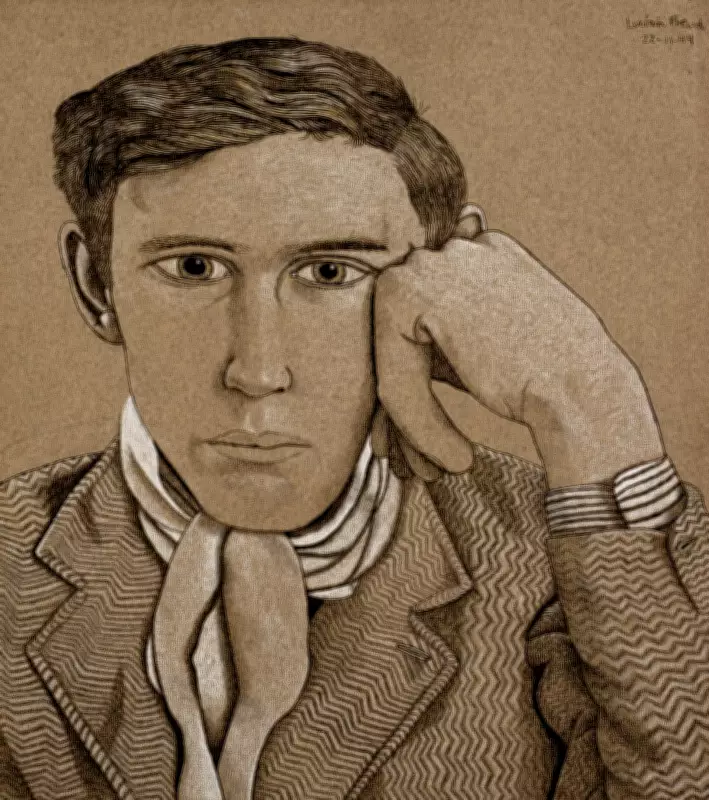
- Portrait of a Young Man (1944): This early work demonstrates Freud's incredible attention to detail in rendering hair texture, jacket weave, and cravat folds. His use of white chalk on colored paper recalls Ingres, leading art historian Herbert Read to describe Freud as "the Ingres of existentialism."
- Bella in her Pluto T-Shirt (etching, 1995): An earlier version of this portrait of Freud's daughter shows her without facial features, revealing how Freud would sometimes have printmakers smooth copper plates so he could rework unsatisfactory elements.
- Girl in Bed (1952): This work exemplifies Freud's commitment to capturing his subjects' inner lives rather than treating them as blank canvases for his projections.
- Solicitor's Head (2003): Dawson describes Freud's intense working proximity to subjects, often standing less than a meter away. "He'd come up really close to you, like, really close," Dawson recalls, noting the artist's nervous energy that kept sitters slightly on edge.
- David Hockney (2002): This portrait resulted from approximately 120 hours of sittings, during which Hockney also created a drawing of Freud. Interestingly, Freud only gave Hockney 45 minutes for his reciprocal portrait before departing.
Lucian Freud: Drawing Into Painting continues at the National Portrait Gallery in London through 4 May, offering visitors unprecedented insight into the drawing practices that underpinned one of Britain's most significant 20th-century artists.