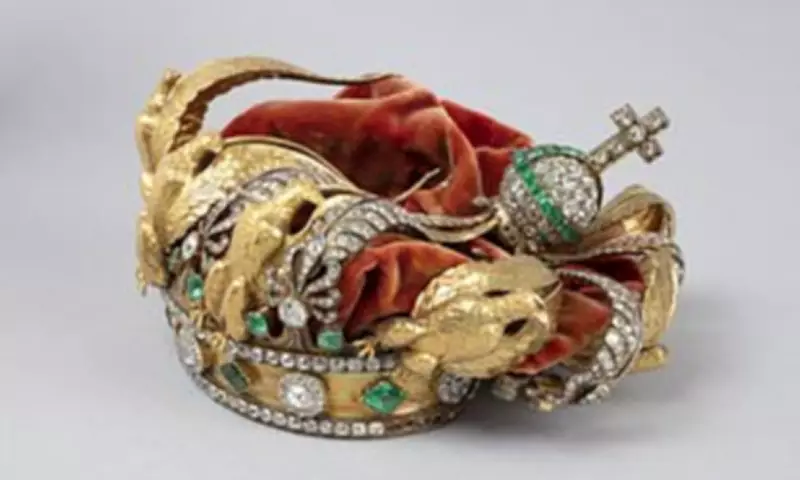
Louvre Museum Displays Damage to Historic Crown After Major Heist
The Louvre Museum in Paris has publicly released detailed photographs of Empress Eugénie's crown, a priceless historical artefact that sustained significant damage during a brazen robbery last October. While the crown was severely deformed in the incident, museum officials have confirmed that a complete restoration is feasible, offering a rare glimpse into the aftermath of one of the most audacious thefts in recent memory.
The Devastating Heist at the Louvre
On October 19, 2025, the world-renowned Louvre Museum was the target of a meticulously planned raid. Four individuals executed a daring operation, making off with an estimated £85 million worth of precious jewels from the institution's collection. The heist sent shockwaves through the art and cultural heritage communities, highlighting vulnerabilities in even the most secure museums.
Remarkably, Empress Eugénie's crown was not among the items stolen. Instead, it was discovered abandoned at the foot of the Apollo Gallery within the museum complex. However, the crown had not escaped unscathed. It suffered what the Louvre describes as "crushing damage" and was "significantly deformed" during the chaotic events of the robbery.

Assessment of the Crown's Condition
In a comprehensive state report, the Louvre provided a meticulous breakdown of the crown's current state. The museum emphasised that, despite the visible damage, the artefact "retained its near-complete integrity," which is the primary reason a full restoration is possible. The crown's mount, described as flexible and lightweight, underwent severe stress.
The damage likely occurred in two stages:
- The crown was forced through a narrow slot cut into its display case using an angle grinder. This action caused the crown's structural hoops to detach, with one hoop being lost entirely within the gallery.
- Subsequently, the crown suffered a violent impact, most likely when it was dropped or thrown, which resulted in the crushing deformation visible in the released images.
The report details the crown's composition and what remains. Originally featuring eight diamond and emerald palmettes alternating with eight gold eagles, only a single eagle is missing today. All palmettes are present, though four have detached from the mount and some are deformed. Crucially, the diamond and emerald globe atop the crown is fully intact and still attached to the frame.
Minimal Loss of Precious Stones
Perhaps the most astonishing revelation is the minimal loss of the crown's gemstones. Of the original 1,354 diamonds adorning the piece, only approximately ten very small stones are missing. These were located on the perimeter of the base. A further nine diamonds were detached but have been recovered and preserved. All 56 of the crown's emeralds remain accounted for.
"Although the crown's shape has been altered, almost all of its component parts are still present. Only one of its decorative elements is missing," the museum's report stated. "Therefore, its complete restoration will be possible without resorting to reconstruction or re-creation. It will simply involve reshaping its framework."
Historical Significance and Restoration Plans
Empress Eugénie's crown is an object of immense historical importance. It was commissioned by Emperor Napoleon III from his official jeweller, Alexandre Gabriel Lemonnier, for the 1855 Universal Exhibition. Interestingly, it was never used for a coronation and may never have been worn, as Empress Eugénie herself was never crowned. The Louvre acquired the crown in 1988.
Today, it stands as one of only three sovereign crowns preserved in France, alongside the crown of Louis XV and the so-called crown of Charlemagne. The restoration project will be overseen by a committee of experts led by the Louvre's director, Laurence des Cars. While the exact cost remains undetermined, preliminary estimates suggest it will begin at around €40,000 (approximately £34,774). The museum's commitment underscores the priceless cultural value of this artefact, ensuring it will be returned to public display for future generations.