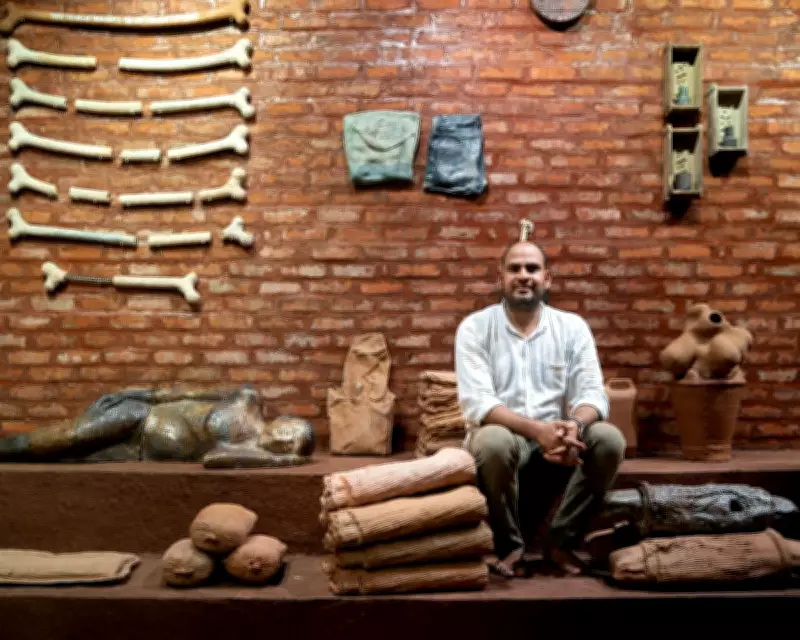
The Kochi-Muziris Biennale, South Asia's largest contemporary art event, is currently captivating audiences with its sixth edition, titled 'For the Time Being'. Set against the picturesque backdrop of Fort Kochi and Kerala's lush backwaters, this biennale transforms colonial warehouses and bungalows into immersive art spaces, where creation takes precedence over mere installation.
A Curatorial Vision Rooted in Intuition and Time
Lead curator Nikhil Chopra, co-founder of HH Art Spaces, describes the biennale as an intuitive process, akin to arranging flowers in a vase. The theme emphasises presence and temporality, inviting visitors to engage deeply with each artwork. Chopra explains, "We used time as a material, like clay or wood, allowing it to infuse every piece presented." This approach fosters a reflective experience in an age often dominated by distraction.
Artworks That Honour Labour and Nature
The biennale features poignant installations that address social and environmental themes. Birender Kumar Yadav's 'Only the Earth Knows Their Labour' sheds light on the forgotten workers of India's brick industry, while Kulpreet Singh's 'Indelible Black Marks' uses video and canvas to poetically mimic farmers ploughing scorched fields. Singh, hailing from a farming family in Punjab, critiques the blame often placed on farmers for issues like Delhi's pollution.

Emphasis on Local and Subcontinental Talent
Half of the 66 artists are Indian, with a strong representation from Kerala, reflecting the curators' dedication to showcasing regional voices. Chopra proudly notes that no international flights were taken to scout artists, relying instead on decade-long relationships forged by the Goan collective. International highlights include Marina Abramović, Ghanaian artist Ibrahim Mahama, and Argentinian Adrian Villar Rojas, adding a global dimension to the event.
Navigating Challenges in a Unique Environment
The biennale's setting in Kerala, known for its monsoons and humidity, presented logistical hurdles. Following devastating floods in 2018, this year's edition involved renovating derelict spaces and repairing roofs, as the event lacks a permanent home. Despite these challenges, the organisers embraced the environment's mould and patina, ensuring artists adapted their works to the conditions.
Jayashree Chakravarty's Tribute to Nature
Kolkata-based artist Jayashree Chakravarty's installation, 'Shelter: For the Time Being', memorialises vanishing marshlands in Salt Lake. Using cotton fabric, jute fibre, and seed pods, her suspended scrolls resemble capillaries, inviting visitors to interact and ponder how to bring nature closer. At 69, Chakravarty describes herself as a "silent observer," translating her observations into art that questions environmental loss.
A People's Biennale with Broad Appeal
Striving to maintain its reputation as a "people's biennale," tickets are priced affordably between Rs 100 to 200 (less than £2), attracting over a million visitors, with 80% from within a 500km radius. The event includes the Student's Biennale and Art Rooms hosting non-judgmental workshops, ensuring accessibility for all walks of life. Kochi's rich history as a cultural melting pot, with nearby sites like the Santa Cruz basilica and Paradesi Synagogue, enhances the experience.
Chopra reflects on Kerala's critical thinking and cultural awareness, noting that visitors value this as more than a mere outing—it's "a picnic among the art." The Kochi-Muziris Biennale continues until 31 March, offering a unique blend of art, history, and nature in one of India's most vibrant regions.