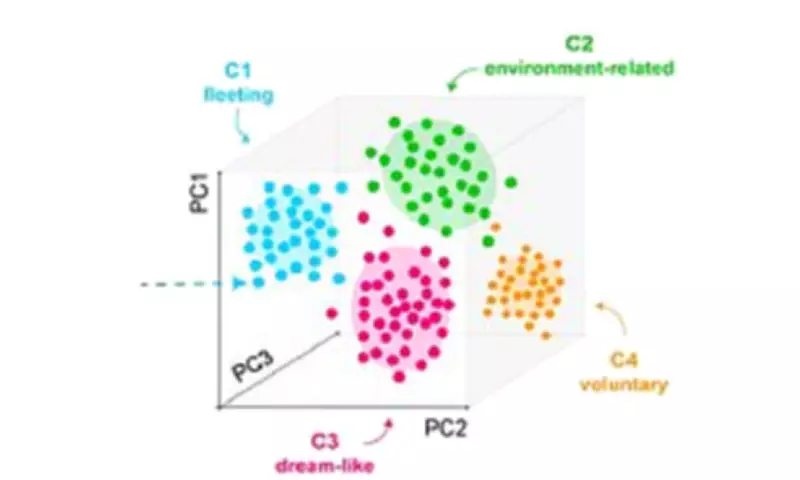
A new study challenges the traditional notion that dreams are confined to deep sleep, revealing that people can experience vivid, bizarre, dream-like occurrences while still awake. Researchers at the Paris Brain Institute have identified four distinct mental states that appear to float freely between wakefulness and sleep, defined as fleeting, alert, bizarre, and voluntary.
Key Findings
The study, published in the journal Cell Reports, involved 92 participants accustomed to napping. Their naps were interrupted at various points, and they were asked to describe their mental experiences from the previous 10 seconds. Brain activity was continuously recorded using an EEG cap. Analysis revealed not just two mental states (dreaming and awake) but four distinct states that occurred across wakefulness, sleep onset, and light sleep.
The Four Mental States
- Fleeting: Momentary recollections, such as thoughts of a deceased loved one.
- Alert: High level of connection to the surrounding environment.
- Bizarre: Weird visions, like seeing aliens.
- Voluntary: High level of control over thoughts, such as planning a to-do list.
First author Nicolas Decat stated, "The mental states traditionally associated with dreaming can arise just as well when we are asleep as when we are awake. In other words, the content of our thoughts does not follow the boundaries between waking and sleep." One participant, while awake, reported seeing ants crawling on her body against a backdrop of crossword puzzles. Conversely, another participant mentally reviewed their schedule for the next day while fully asleep.

Implications
The researchers suggest that most people assume extravagant mental content only occurs during deep sleep, likely due to memory bias. Decat explained, "We mainly remember dreams that come with strong emotions or those to which we attach particular meaning. Yet it is just as common to dream that we are working. Conversely, some people report fanciful daytime thoughts, like fragments of a dream, surfacing during everyday activities."
A separate study by Coker University found that dreams may act as a mental "practice space" for real-life social challenges, helping individuals prepare for situations involving relationships, reputation, survival, and caregiving.