Palestinians Race to Save Gaza's Ancient Heritage from War's Devastation
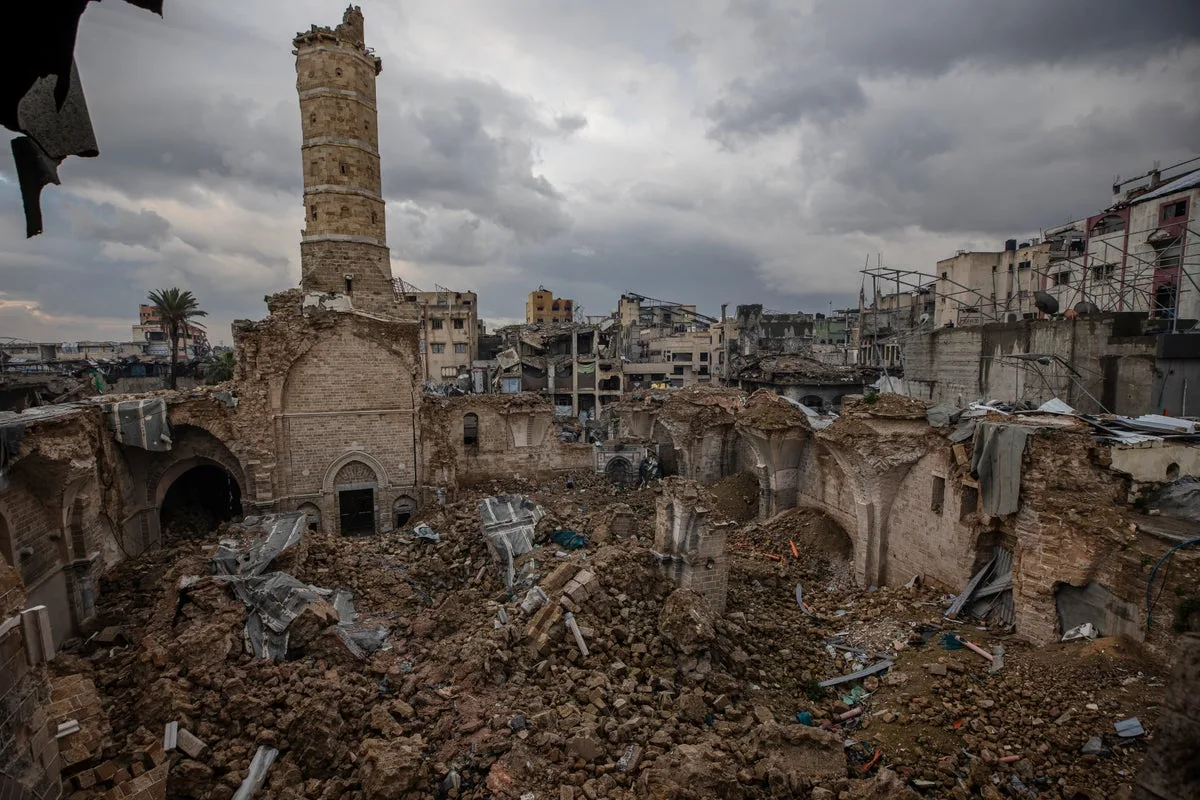
In the aftermath of Israel's military offensive against Hamas, Palestinians are urgently working to salvage fragments of Gaza's rich historical legacy from the widespread ruins. The Great Omari Mosque in Gaza City, a centuries-old symbol of resilience, now stands heavily damaged after being struck during the two-year conflict, which was recently muted by an uncertain ceasefire.
Memories Amidst the Rubble
Muneer Elbaz, a Palestinian heritage consultant, recalls with deep emotion the joy of visiting the Great Omari Mosque with his family before the war. "These were the best days," Elbaz said, describing promenades through lively markets around the mosque. "This place transports us from one era to another." Today, the sight of the rubble brings to mind "a tree that had been uprooted from the land." The mosque, built on a site where a Byzantine church once stood, has witnessed empires come and go, changing hands and religions through invasions.
According to Gaza's Health Ministry, Israel's military offensive killed over 72,000 Palestinians and erased entire extended families. Alongside this immense human toll, the conflict has imperiled the territory's cultural heritage, with dozens of historical sites damaged or destroyed.
Assessing the Cultural Damage
Israel launched its offensive after Hamas-led militants killed approximately 1,200 people, mostly civilians, and took 251 hostages in the October 7, 2023 attack. The Israeli military accuses Hamas of concealing military assets beneath or near heritage sites and other civilian structures. In response, the U.N. cultural agency UNESCO, using satellite images, has verified damage to at least 150 sites since the war began, including:
- 14 religious sites
- 115 buildings of historical or artistic interest
- 9 monuments
- 8 archaeological sites
These sites are described as fragments of Gaza's soul, connecting Palestinians to a history many fear is at risk of erasure. "These sites were an important element that solidifies the presence of the Palestinian people on this land and that represents the continuity of their cultural identity," said Issam Juha, co-director of the Centre for Cultural Heritage Preservation in the Israeli-occupied West Bank. He added, "They want to erase the Palestinian identity and Palestinian heritage and ... to remove any connection that keeps the Palestinian society clinging to this land."
Urgent Rescue Efforts Underway
With major military operations halted, Palestinians are gaining a clearer picture of the destruction. Organizations are attempting urgent rescue work at historical sites, though full-scale restoration and broader reconstruction face significant obstacles due to ongoing blockades and resource shortages.
The Centre for Cultural Heritage Preservation is focusing on the badly damaged Pasha Palace, which housed centuries-old artifacts. Many items appear to have been looted, including an Ottoman-era Quranic manuscript, medieval Mamluk-era jewelry, and a Roman-era sarcophagus, of which only fragments have been recovered, according to expert Hamouda al-Dohdar.
The Israeli military stated it struck "a Hamas military compound and an anti-tank missile array" at the Pasha Palace site and a "terror tunnel" at the Omari mosque, though it provided no evidence. Amir Abu al-Omrain, an official with Gaza's Hamas-run endowments ministry, denied the allegation about the mosque. An independent U.N. Human Rights Council commission said it was unaware of any evidence of a tunnel shaft in the mosque and noted that even a legitimate military objective would not justify the resulting damage. Israel has previously accused the commission of bias.
Other Heritage Sites Affected
The centuries-old Saint Porphyrius Orthodox church complex, which was sheltering displaced Palestinians, was also hit early in the war, causing deaths and injuries. The Israeli military said it targeted a nearby Hamas command center. UNESCO reported the church complex sustained moderate damage.
Some sites, like the 4th-century Saint Hilarion Monastery, appear spared, with UNESCO finding no evidence of damage there. Under international law, cultural property should not be targeted or used for military purposes. The Israeli military asserts it considers the sensitivity of cultural and religious sites, aims to minimize damage to civilian infrastructure, and adheres to international law.
A Rich Historical Tapestry
Gaza's history spans thousands of years, marked by commerce and conflict. Artifacts and accounts reveal its role as a crossroads for empires, from Egyptian pharaohs sending chariots through the coastal strip to traders doing business with ancient Greeks. The Omari mosque, named for Islam's second caliph, was initially built in the seventh century. Crusaders later converted it into a cathedral, and it reverted to a mosque after their expulsion.
"The building itself told the story of Gaza's past as a crossroads of trade, armies, empires, and religious traditions," said Stephennie Mulder, associate professor of Islamic art at the University of Texas at Austin. "For many Gazans, the Omari mosque stood as a beloved symbol of multiplicity, resilience and persistence." The mosque was damaged during World War I when the British shelled Gaza against the Ottoman Turks and was later rebuilt.
Personal Loss and Community Grief
For residents like Mohammad Shareef, 62, the mosque holds deep personal significance. He remembers attending prayers there with his father as a child, studying in its quiet confines, and later bringing his own children. "We were raised in it and around it, and there's no stone here that we haven't stepped on," he said, weeping over its destruction. "For the people of Gaza, this is their history."
The loss feels especially acute during the upcoming Muslim holy month of Ramadan, when thousands traditionally converged on the mosque for prayers amid a festive atmosphere. This year, a large tented structure has been erected nearby. Workers are now filling wheelbarrows in the shadow of a damaged minaret, focusing on recovery and preventing further damage by sifting through and storing stones.
Hosni Almazloum, an engineer at the site, noted the mosque's prayer hall ceiling collapsed and columns crumbled. He believes reconstruction is possible if construction supplies are allowed in, but the U.S.-brokered ceasefire agreement offers no timeline for Gaza's reconstruction. Many historic sites suffered neglect before the war due to the blockade imposed since Hamas seized power in 2007, previous conflicts, lack of resources, and urban sprawl.
Processing the War's Toll
Elbaz reflects that before the ceasefire, grief was a luxury he couldn't afford as his family focused on survival. "What would you begin to cry over?" he asked. "The historic mosques or your home or your history or your children's schools or the streets?" Now, processing the war's toll, he sometimes weeps away from his children's eyes. "Gaza is our mother," he said. "We have memories everywhere — in this tree, this flower, this garden and this mosque. Yes, we cry over every part of Gaza."