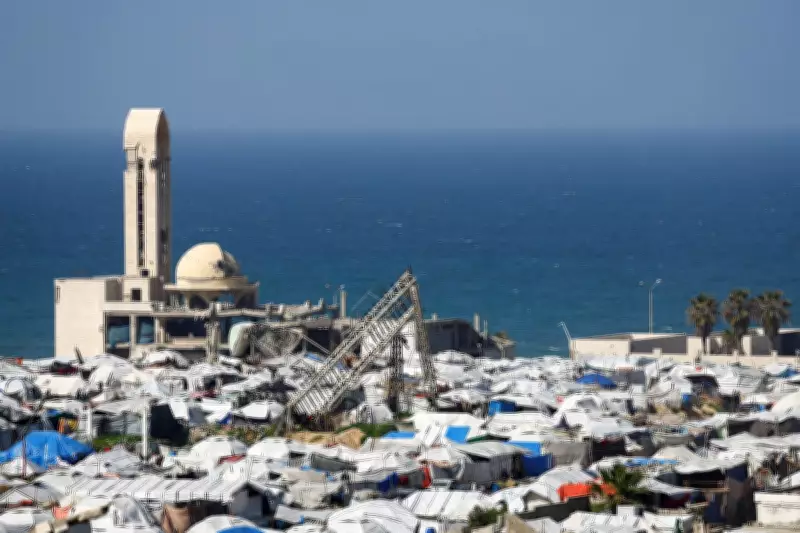
The Muslim fasting month of Ramadan has commenced in Gaza, with Palestinians observing the holy period amidst the shattered remnants of their communities and places of worship. Many have resorted to makeshift prayer spaces constructed from tarpaulins and wood, or gathering in the ruins of mosques, mourning their dead and lost sanctuaries under a fragile ceasefire and dire shortages.
Mosque Ruins Serve as Gathering Places
In Gaza City, the dome of the now-destroyed Al Hassaina mosque rests on a pile of rubble. Its former courtyard, once a vibrant gathering place, now sees families sleeping and cooking among the debris, with washing lines criss-crossing the area. Children clamber over cracked domes while women collect laundry hung between broken columns, highlighting the stark transformation of sacred spaces.
Emotional Toll on Worshippers
Sami Al Hissi, 61, a volunteer at the mosque, expressed deep sorrow as he stood on rubble where worshippers once stood shoulder to shoulder in prayer. "I can't bear to look at it," he said. "We used to pray comfortably. We used to see our friends, our loved ones. Now there are no loved ones, no friends, and no mosque." He noted that the mosque had previously drawn thousands of worshippers from neighbourhoods like Shejaia and Daraj during Ramadan, but now barely accommodates a hundred people amid the destruction.

Scale of Destruction and Conflict Background
According to the Hamas-run Gaza government media office, Israeli forces have completely destroyed 835 mosques and partially damaged 180 since the conflict began. Additionally, Israel has targeted churches on multiple occasions and destroyed 40 of Gaza's 60 cemeteries. Israel launched its air and ground war in Gaza after a Hamas-led cross-border attack on 7 October 2023 that killed 1,200 people, according to Israeli tallies. Israel's assault has resulted in 72,000 Palestinian deaths, as reported by health authorities.
Spiritual and Communal Loss
For many residents, the loss extends beyond physical structures to spiritual and communal dimensions. Khitam Jabr, displaced and now staying at a mosque, lamented, "We wished we could welcome Ramadan in a different atmosphere. We don't have enough mosques. All of the mosques were destroyed and there's nowhere to pray. Now we pray in tents, and the mosques became centres for the displaced."
Efforts to Rebuild Amid Shortages
Despite the devastation and severe shortages of materials, efforts are underway to rebuild small sections of mosques and establish makeshift prayer spaces. Amir Abu Al-Amrain, director of the religious affairs ministry in Gaza City, reported that 430 prayer areas have been reconstructed using reused plastic sheeting from greenhouses, wood, and tent materials. "Some are made of plastic sheets from greenhouses, some of wood, and some constructed with plastic sheets from tents," he explained, showcasing resilience in the face of adversity.
The situation underscores the ongoing humanitarian crisis, with Palestinians navigating Ramadan amidst ruins, displacement, and a precarious ceasefire, striving to maintain religious traditions despite overwhelming challenges.