Father's Heartbreaking Search for Family in Gaza Rubble
In the shattered remains of what was once his family home in Gaza City, Mahmoud Hammad crouches daily, sifting dirt through a large sieve with trembling hands. For over two years, since an Israeli airstrike destroyed his six-story building in December 2023, he has been engaged in a solitary, grueling mission: to recover the bones of his pregnant wife and five children from beneath the concrete and debris.
A Discovery Amid Devastation
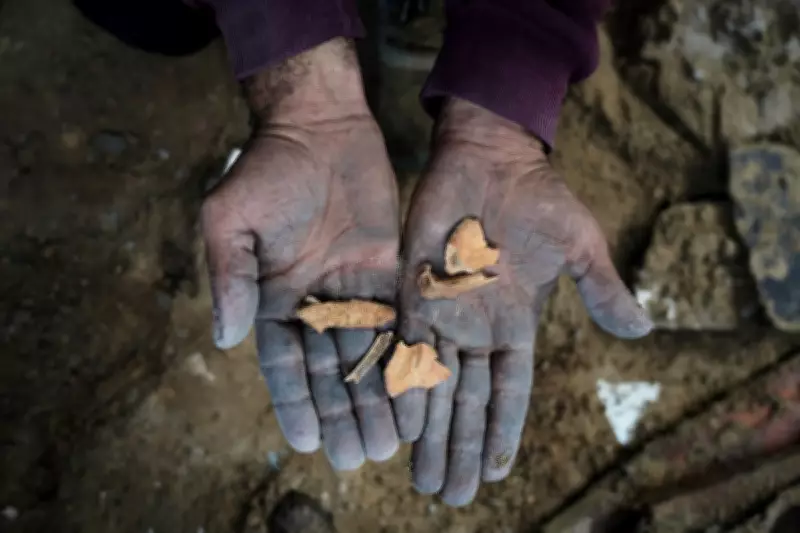
Recently, his persistence yielded a heartbreaking clue. Tiny bone fragments appeared in his sieve, which he believes belong to the unborn baby girl his wife was carrying at nine months. "I won't find them all," Hammad said with resigned sorrow, adding the fragments to a box of remains he has collected during months of digging with picks, shovels, and bare hands.
The 39-year-old father's story is one of thousands in Gaza, where approximately 8,000 people remain buried under the rubble of homes destroyed during Israel's military campaign against Hamas, according to Gaza's Health Ministry. While airstrikes and ground assaults made retrieval impossible for years, a ceasefire deal in October has allowed increased efforts, though severely hampered by a lack of heavy equipment.

The Day Everything Changed
Around 11:30 a.m. on December 6, 2023, an Israeli strike smashed into the building in Gaza City's Sabra neighborhood where Hammad lived with his family. He had just stepped out of their ground-floor apartment when the explosion hit. Inside, his wife Nema Hammad and their five children, aged 8 to 16, were finishing breakfast.
In the days before the strike, Israeli military leaflets had ordered residents to evacuate to southern Gaza. Hammad refused to leave, though his wife and children temporarily stayed with her parents in nearby Jabaliya. On December 5, Nema Hammad returned unexpectedly with the children, telling her husband, "Either we live together or we are martyred together."
"They were martyred, and I survived," Hammad said. His brother, sister-in-law, and their four sons were also killed in the strike. Hammad suffered multiple injuries including fractures and internal bleeding, but survived after treatment at a nearby clinic.
Months of Solitary Digging
After recovering, Hammad returned to the ruins and set up a shelter nearby. "I stayed with them, my wife and children, in the rubble," he explained. "Every day, I am talking to them. Their scent lingered, and I felt a deep connection with them."
When Gaza's Civil Defense couldn't help due to danger and equipment shortages, he began digging alone. He broke collapsed ceilings and walls into small stones, filling dozens of sacks that now surround the site. In March 2024, he found his first remains—bones covered with flesh, some partially eaten by animals.
By late 2024, he had reached his brother's third-floor apartment, recovering and burying those bodies in a temporary war cemetery. Since October, he has driven nine meters down to his own ground-floor apartment, focusing on the eastern side where his wife was last seen eating rice pudding in the living room.
Hope and Heartbreak in Equal Measure
The tiny bone fragments discovered recently have been shared via WhatsApp with a doctor who confirmed they appear to be from a small baby. Hammad believes they belong to the daughter they planned to name Haifa, after a sister-in-law killed weeks earlier by another Israeli strike.
"All the baby's clothes, a crib, and a room were prepared, and everyone at home was waiting for her arrival," he recalled. Finding these fragments has given him hope that he might eventually recover more of his family. "There's a clue that I'm reaching my wife and other children," he said, vowing to give them a proper burial once he collects enough remains.
Gaza's Overwhelming Rubble Crisis
More than 700 bodies have been recovered since the ceasefire began, according to Zaher al-Waheidi, head of the Health Ministry's records department. These add to a death toll exceeding 72,000 from the war that began after Hamas's October 7, 2023 attack on southern Israel that killed approximately 1,200 people and took 251 hostages.

The scale of destruction is staggering. Israeli bombardment destroyed or damaged 81% of Gaza's 250,000 buildings, according to UN satellite analysis, leaving 61 million tons of rubble—equivalent to 15 Great Pyramids of Giza or 25 Eiffel Towers by volume. Rescue work remains impossible in over 50% of Gaza still under Israeli military control, where buildings are systematically demolished.
Karem al-Dalu, a Civil Defense worker, noted that the UN and Red Cross recently coordinated entry of one excavator, but "that's not enough." He spoke while clearing rubble in Gaza City's Sheikh Radwan neighborhood, where a December 2023 airstrike leveled a building with about 120 people inside.
Rafiq Abdel-Khaleq Salem, whose family was among those sheltering there, said 66 bodies were recovered initially, with 54 remaining buried. Recent excavations found 27 more, but his wife and four children are still missing. "It is a painful feeling," Salem said. "I hoped to find my wife and children to bury them in graves and visit them."
For Mahmoud Hammad and thousands of other Gazans, the search continues amid ruins that represent both profound loss and the faint hope of closure.